
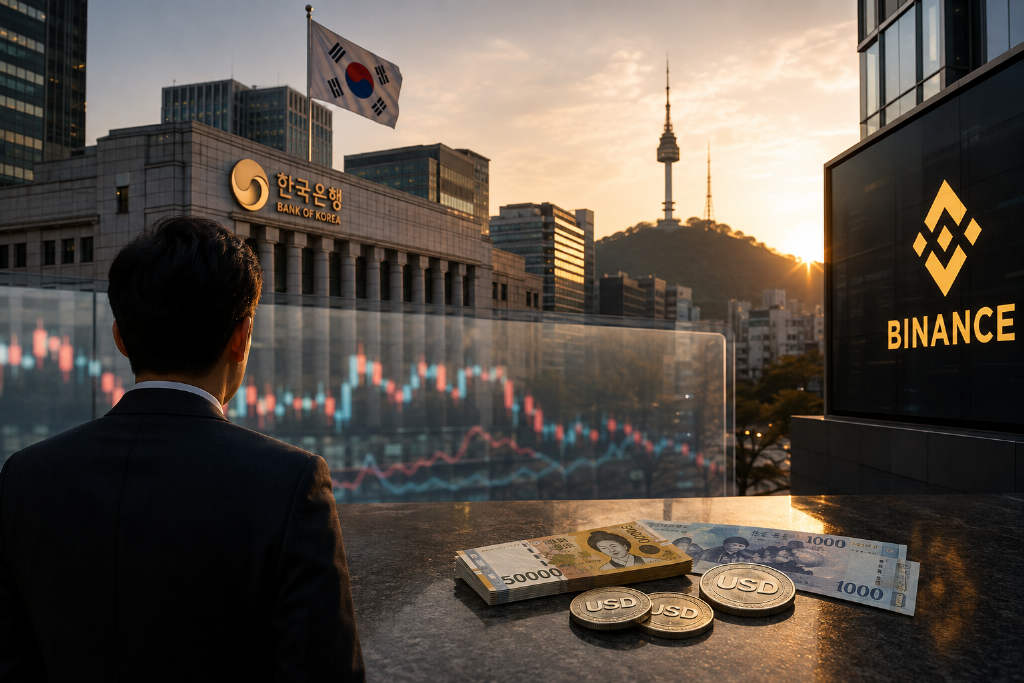
A Bank of Korea study says the impact of dollar-backed stablecoins may no longer be confined to crypto markets. Once a global exchange lists a local fiat currency against a dollar stablecoin, buying pressure in stablecoins can be transmitted to the traditional foreign-exchange market through arbitrage and liquidity providers, with a significant link to weakness in the local currency.
The central bank published the paper, titled Stablecoin–FX Linkages: Evidence from Fiat–Stablecoin Pair Listings on a Global Exchange, on Sept. 3. It uses Binance listings of fiat-to-dollar-stablecoin pairs as the event sample to examine how stablecoin pricing and conventional FX markets move together.
Pair listings strengthened the connection between stablecoin pricing and FX
According to the study, before those pairs were listed, a premium in local dollar stablecoins was mainly reflected in crypto-market pricing and had limited influence on the exchange rate between the U.S. dollar and the local currency. After Binance opened the relevant fiat pairs, price linkage between the two markets increased sharply.
The paper found that when dollar stablecoins traded at a higher premium relative to the local exchange rate, the related domestic currency showed clearer depreciation. It also found that net buyer-initiated order flow, used in the study as a proxy for stablecoin demand pressure, was significantly associated with depreciation in the fiat currencies included in those trading pairs.
How buying USDT or USDC can turn into dollar demand
The mechanism described in the report is simple. If investors buy large amounts of USDT or USDC with local currency, global market makers supply the stablecoins and receive that local currency in return. To manage exchange-rate risk, those market makers may then sell the local currency in the traditional FX market and buy dollars.
In that chain, demand moves from local currency into USDT, market makers accumulate local-currency exposure, and hedging activity shifts into the FX market through sales of the local currency and purchases of dollars. That is how depreciation pressure can pass from crypto markets into conventional foreign exchange.
South Korea has not seen an equally significant direct effect on the won, the BOK says
The Bank of Korea said there is currently no corresponding Binance fiat trading pair for the Korean won. For that reason, stablecoin buying pressure in South Korea is still showing up mainly as a so-called Korea premium in stablecoins, and the bank said it has not found an equally significant direct impact on the won exchange rate at this stage.
Even so, the central bank said the link between stablecoins and the won FX market could strengthen if South Korean companies, offshore investors and global market makers become more deeply involved in digital-asset markets. It said digital-asset regulation should not be discussed separately from FX policy and added that South Korea needs greater won internationalization and deeper FX-market liquidity.
The stablecoin market is nearing $300 billion
The report has gained attention as dollar stablecoins continue to expand. CoinGecko data cited in the article shows the global stablecoin market was worth about $291 billion as of Sept. 7. USDT accounted for about $183.4 billion, while USDC stood at about $74.5 billion. Together, the two represented nearly $258 billion, or close to 90% of the market.
That scale means stablecoins are no longer just a pricing tool inside crypto exchanges. The article describes them as an on-chain dollar system worth hundreds of billions of dollars. In economies with smaller domestic currencies and more open capital markets, heavy conversion from local currency into dollar stablecoins could create effects resembling traditional dollarization or capital outflows.
Taiwan’s central bank has raised a similar warning
The article says the Bank of Korea study is especially relevant for Taiwan. In its own stablecoin policy analysis released this year, Taiwan’s central bank said the leading stablecoins are mostly pegged 1:1 to the U.S. dollar, and when the public buys dollar stablecoins with local currency, the transaction "still essentially involves an exchange between the local currency and the U.S. dollar."
It also said that even if transactions move from banks to virtual asset service providers, those providers may still adjust their U.S. dollar positions through the banking system to manage inventory and exchange-rate risk. As a result, "U.S. dollar demand generated by stablecoin transactions will ultimately be transmitted to the physical foreign-exchange market."
The article adds that Taiwan’s central bank cited work by the Bank for International Settlements, the International Monetary Fund and the Hong Kong Monetary Authority. When a price gap opens between dollar stablecoins and the conventional dollar spot rate, arbitrage activity may increase. During periods of sharp market volatility, high-frequency arbitrage could lift FX trading volumes and amplify exchange-rate swings. The article says the Bank of Korea’s latest empirical findings provide new market evidence for that transmission channel.
Taiwan has formally brought stablecoins under legal regulation
Taiwan’s policy framework is also entering a new phase. Its Virtual Asset Service Act was published on July 22, 2026, and formally defined stablecoins as virtual assets linked to the value of one or more fiat currencies to maintain price stability.
Under the law, any stablecoin issuer seeking to operate in Taiwan must obtain approval from the Financial Supervisory Commission, and the FSC must consult the central bank before granting approval. Article 36 requires issuers to maintain full reserve assets and place them with domestic financial institutions. If issuance involves foreign exchange, it must follow central bank rules. The FSC and the central bank will jointly draft secondary rules covering reserve assets, reserves, issuance and redemption.
That puts FX risk directly inside the legal framework. The article says future policy choices, whether Taiwan develops a New Taiwan dollar stablecoin or allows more dollar stablecoins into local trading systems, will not be limited to crypto regulation. They will also touch foreign-exchange management and monetary policy.
The policy value of an NTD stablecoin
The Bank of Korea study also raises another question for Taiwan: if the market lacks a competitive digital currency tool denominated in New Taiwan dollars, could dollar stablecoins gradually become the de facto unit of account in the on-chain economy?
USDT and USDC already dominate most of the global stablecoin market. If Taiwan’s cross-border payments, Web3 investment activity and tokenized financial products become increasingly dependent on dollar stablecoins, local capital may move more frequently between the New Taiwan dollar and dollar-backed stablecoins.
The article says that gives an NTD stablecoin a strategic role beyond payment innovation. It could help preserve the New Taiwan dollar’s pricing and payment functions in on-chain finance and reduce the degree of dollarization in digital finance.
The broader conclusion from the Bank of Korea study is that stablecoin markets and FX markets no longer operate as two fully separate systems. As exchanges, market makers and cross-border funding channels become more tightly connected, buy orders for USDT or USDC that begin in crypto markets may eventually show up as U.S. dollar demand in the traditional FX market.
For Taiwan, the Virtual Asset Service Act is only the first step. The article says the next stage, especially secondary rules on foreign-currency stablecoins, NTD stablecoins, reserve assets and fiat trading pairs on exchanges, will shape whether Taiwan can support digital-finance innovation while containing spillover risks to the New Taiwan dollar and monetary sovereignty.