
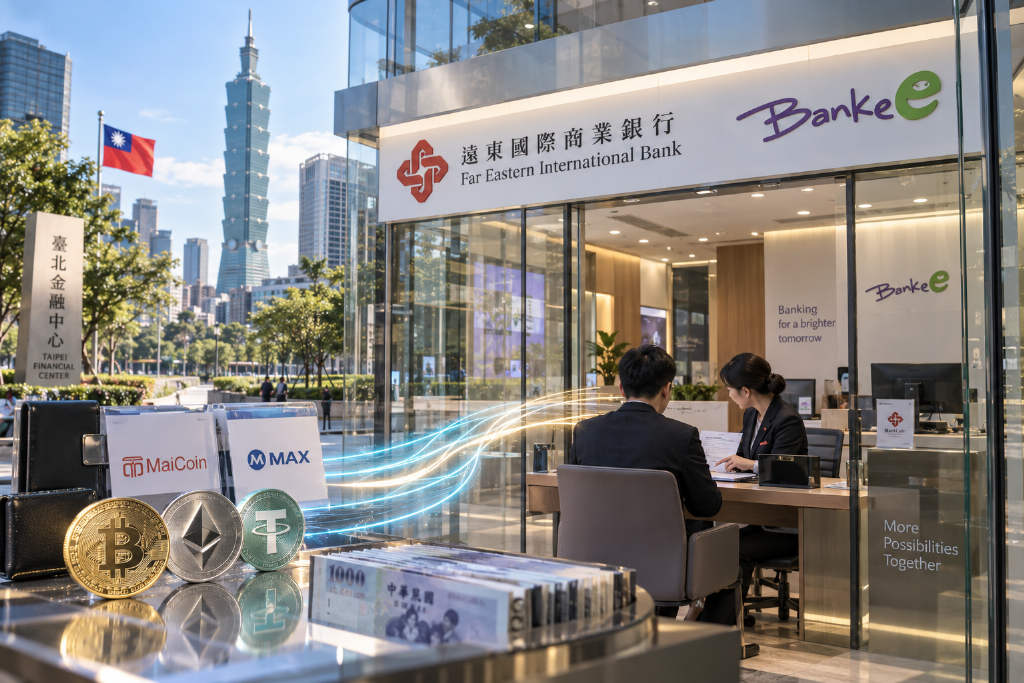
Far Eastern International Bank’s Bankee has launched a revolving credit product called "Bi Xu Dai," allowing applicants to include BTC, ETH, and USDT held in MaiCoin and MAX accounts in the bank’s financial review for a New Taiwan dollar loan.
According to the public product details, the loan has a one-year term and supports flexible drawdown and repayment. Interest is calculated daily, and borrowing and repaying on the same day carries no interest charge. The processing fee is NT$1,688, while the floating annual rate ranges from 3.45% to 15%, calculated as the bank’s time-deposit index rate plus a markup.
Which crypto assets are recognized
Bankee describes the product as a revolving unsecured credit loan that incorporates virtual assets into financial qualification review. At this stage, only BTC, ETH, and USDT held in the applicant’s own MaiCoin and MAX accounts are recognized. Taiwan dollar balances in those accounts are also included under the terms, while assets on other exchanges or in other tokens are not counted.
That means the bank is accepting crypto assets on designated platforms as part of its credit evaluation materials. Still, the public plan says the conversion method for those holdings and the final approved loan amount remain subject to the bank’s review.
Who can apply and what is required for the NT$1.5 million ceiling
The official conditions for the maximum loan amount of NT$1.5 million are listed as follows:
- Salaried employees: stable income, annual income from their main job of at least NT$1 million, and total asset balances with Far Eastern International Bank maintained at NT$1 million for the past three consecutive months.
- Self-employed business owners: total asset balances with the bank maintained at NT$3 million for the past three consecutive months. Those who do not meet this threshold cannot apply for the program.
The public explanation also says these bank asset thresholds cannot be replaced directly by exchange-held crypto balances. Actual eligibility and final approval remain at the bank’s discretion.
Rates, fees, and application process
The minimum rate is 3.45%. The actual rate is determined by each applicant’s credit profile and floats with the bank’s time-deposit index rate plus a markup. Same-day borrowing and repayment may avoid interest, but the NT$1,688 processing fee still applies.
Applicants can go to the official Bankee page for the product, click the loan application button, complete the online form, upload supporting documents, and proceed with contract signing and identity verification. No separate loan operation is required on MaiCoin or MAX.
After approval and before the credit line is set up, the borrower must open a qualifying Bankee New Taiwan dollar digital deposit account to serve as the account for drawdown and interest deduction.
How it differs from Aave
The key distinction is that Bankee uses crypto assets as part of personal financial proof in a bank underwriting process. Based on the currently public plan, it does not describe a mechanism in which tokens are deposited into a collateral contract, a health factor is calculated from token prices, or on-chain liquidation is triggered.
Aave’s standard borrowing model works differently. Using Aave V3 as the example cited in the source, a user first deposits supported tokens into the protocol as collateral and then borrows other tokens. Borrowing capacity depends mainly on collateral value, loan-to-value parameters, and market liquidity, not on salary or a bank’s credit decision.
For example, a user can deposit ETH and borrow USDC, keeping exposure to ETH while obtaining a stablecoin. At the same time, withdrawals of the collateral remain constrained by the safety requirements of the open borrowing position.
Why liquidation can happen on Aave
Aave uses the Health Factor to measure the safety of a borrowing position. If collateral falls in value, the borrowed asset rises in value, or accrued interest pushes the Health Factor below 1, the position may be liquidated.
Liquidators can repay part of the debt and receive the corresponding collateral plus a liquidation bonus. Because of that, borrowers need to add collateral or repay part of the debt to keep the position safe.
Bankee Bi Xu Dai vs. Aave V3
| Category | Bankee Bi Xu Dai | Aave V3 standard collateralized borrowing |
|---|---|---|
| Lending basis | Bank personal credit underwriting | On-chain overcollateralization |
| Use of crypto assets | Proof of financial strength | Deposited into the protocol as collateral |
| Funds received | New Taiwan dollars | Supported on-chain tokens |
| Interest rate | Floating bank index rate plus markup | Changes with factors such as pool utilization |
| Loan term | 1 year | Generally no fixed maturity as long as collateral remains sufficient |
| Liquidation mechanism | No on-chain liquidation mechanism listed in the public plan; handled under the credit contract | Liquidation can occur when the Health Factor falls below 1 |