
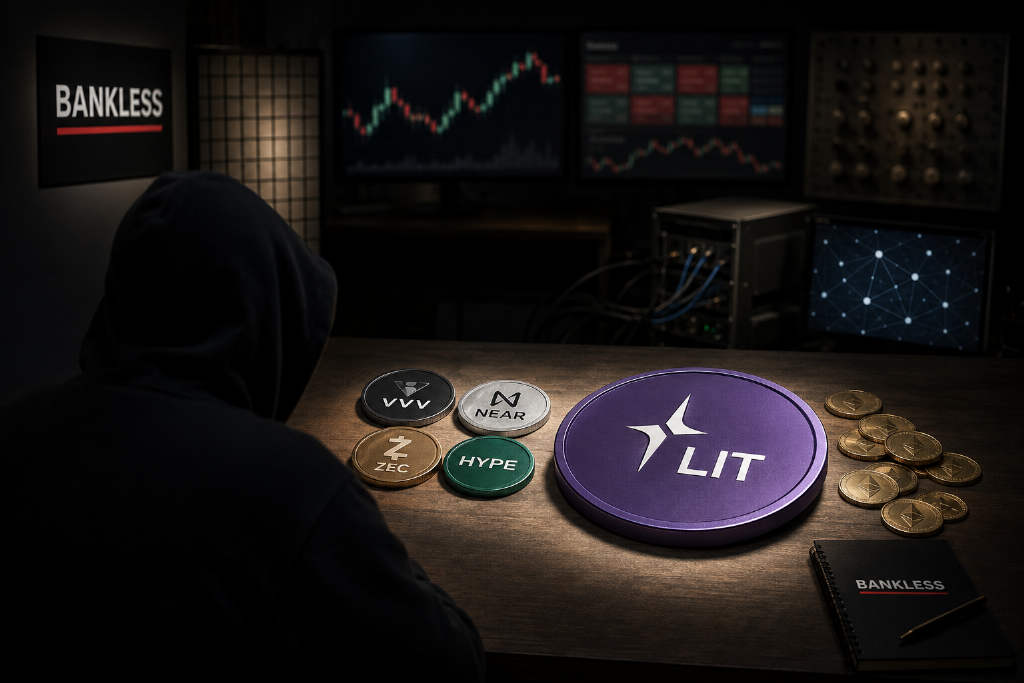
On May 21, Bankless co-founder David Hoffman wrote on X that the tone on crypto Twitter had changed and that he had sold his last remaining ETH. Three and a half months later, based on the price levels and position disclosures cited by PANews, that rotation turned into a portfolio that materially outperformed ETH.
How the ETH proceeds were deployed
PANews said Hoffman laid out the full switch in early June. The capital from the ETH exit was split into two parts.
About 50% was deployed right away across four names: VVV, NEAR, ZEC, and HYPE. The report said Hoffman explicitly noted that his NEAR entry was around $1.4.
The other 50% was kept for dollar-cost averaging. In his words, the money was set aside to slowly buy something that had not moved yet. That allocation ultimately went entirely into LIT, the token tied to Lighter, an onchain perpetual futures exchange built on zkRollup.
Why LIT became the largest single position
According to the article, Hoffman’s reasoning for LIT was unusually clear. Exchanges remain the best business model in crypto, he said. Lighter’s buyback pace was around twice that of HYPE. Its zk circuits let users verify, without permission, whether the exchange was following its own rules. He also pointed to lower latency, a better fee structure, and support for a wider set of assets, including the pre-IPO market.
When asked how to choose between LIT and HYPE, Hoffman’s answer was that LIT was both HYPE’s beta and its alpha. PANews also noted that he later posted in late June that he regretted not buying more LIT.
The report framed the portfolio as a clean thematic basket: ZEC for the privacy trade, HYPE and LIT for structural growth in onchain derivatives, NEAR for cross-chain infrastructure and the AI agent theme, and VVV for decentralized AI inference. Across five assets, the exposure covered four separate narratives. None was tied directly to Ethereum Layer 1 valuation.
Performance versus ETH
PANews compared approximate early-June entry prices with the latest prices in early September. Hoffman sold ETH in late May, entered the first batch of positions between late May and early June, and continued DCA purchases in LIT through mid-June.
- ETH: sold around $2,100, versus about $2,450 now, a gain of roughly 17%.
- ZEC: entered around $540, later moved above $1,200, up more than 120%.
- HYPE: entered around $56, versus about $87 now, up roughly 55%.
- LIT: DCA average around $1.5 to $2, versus about $4.7 now, up roughly 135% to 210%.
- NEAR: entered around $1.4, versus about $2.37 now, up roughly 69%.
- VVV: entered around $16 to $18, versus about $17 now, broadly flat.
The article said ZEC briefly touched $1,200 on Sept. 6. HYPE set a record high of $89.54 the same day. LIT printed a fresh high of $4.95 on Sept. 5.
Using a simple estimate, PANews assumed 50% of the capital was split equally across VVV, NEAR, ZEC, and HYPE, with each taking 12.5%, while the remaining 50% went to LIT. On that basis, the whole basket returned about 90% to 120% on a midpoint estimate. Over the same period, ETH was up about 17%, leaving Hoffman’s portfolio ahead by at least 70 percentage points.
What drove the biggest winners
ZEC was one of the strongest performers. PANews linked the move to the launch of Grayscale’s spot ZEC ETF, ZCSH, on NYSE Arca on Aug. 25. Two weeks after listing, its assets under management expanded from $300 million to $460 million. The article also cited $46 million in short liquidations as part of the squeeze higher.
HYPE gained roughly 55%. The report said Hyperliquid’s cumulative token burn had passed $4 billion, while average daily protocol revenue stayed near $2.26 million.
LIT was the portfolio’s key position because it represented about half of total capital. That made it the largest contributor in absolute return terms. PANews argued that Hoffman used LIT as a higher-beta expression within the same exchange vertical as HYPE, while also leaning on faster buybacks, transparency from zk-based verification, and the possibility that lower fees could pull users over. The article added that, in hindsight, LIT had risen about 500% from its bottom to current levels.
The article’s view on NEAR and ZEC
NEAR returned about 69%, which was not the headline number in the basket, but PANews highlighted an added layer to the trade. It said NEAR Intents currently acts as a kind of toll booth in the ZEC rally, with ZEC-related pairs accounting for nearly 40% of total volume on NEAR Intents.
From that, the report argued that Hoffman may have built a self-reinforcing portfolio without intending to. If ZEC rises and more trading flows through Zashi Wallet and NEAR Intents, fee income on NEAR Intents increases as well, which in turn supports more NEAR buybacks. In PANews’ telling, the two positions were connected by a hidden positive feedback loop.
VVV was the laggard. The article said the decentralized AI inference narrative around Venice AI spiked briefly in early June but failed to attract sustained catalysts, and Hoffman did not publicly add to the position.
The broader conclusion drawn by PANews
The report said the real signal in Hoffman’s scorecard was not simply who went up the most. Its central point was that crypto’s center of value may be shifting from Layer 1 valuation toward application-layer revenue.
ETH, the asset Hoffman sold, is a Layer 1 asset whose valuation framework rests on network effects, the developer ecosystem, and gas burn. The five assets he bought were presented differently:
- HYPE and LIT were tied to verifiable protocol revenue and buybacks.
- ZEC was tied to institutionalized demand through an ETF and to observable privacy-use data onchain, including shielded supply share.
- NEAR was tied to settlement-layer transaction volume and fees in cross-chain activity.
- VVV was tied to real usage of AI inference services.
PANews’ conclusion was that all five assets shared one trait: their valuation anchors came from onchain activity that could be independently verified, rather than promises attached to future narratives.
The article also noted that selling ETH did not mean Hoffman had turned against Ethereum. It quoted him as still believing Ethereum would win. The distinction, in PANews’ reading, was that in a market with scarce liquidity, belief alone does not generate returns; verifiable cash flow and measurable demand do.