
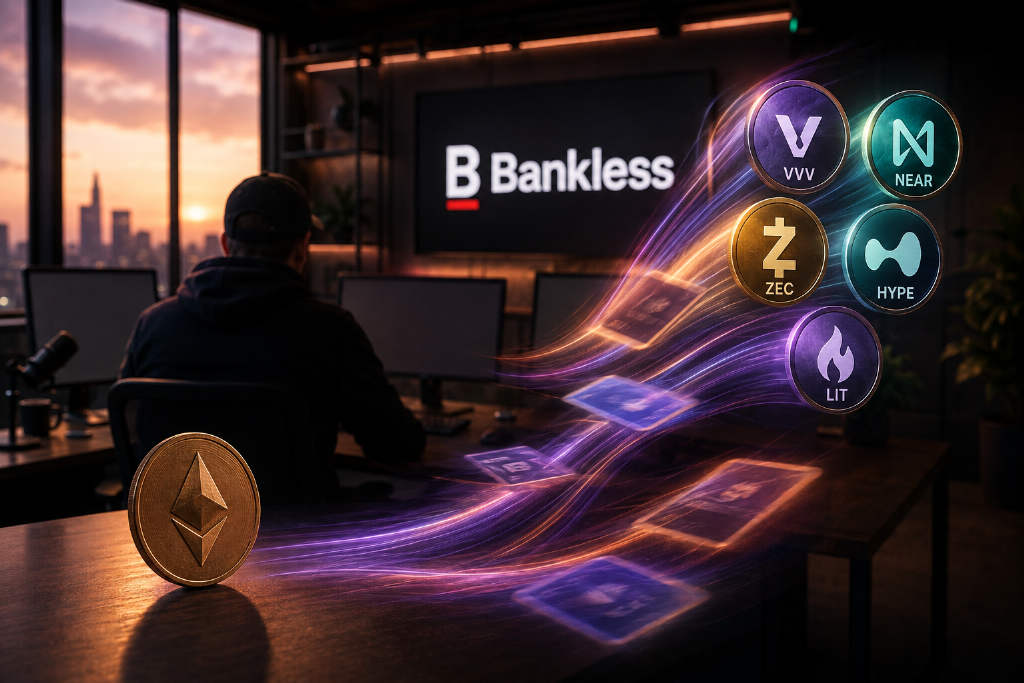
Bankless co-founder David Hoffman sold the rest of his ETH in late May and redeployed the money across five crypto assets tied to different themes. Using the position path he later disclosed and the approximate entry and current prices cited in the report, the portfolio returned about 90% to 120% over roughly three and a half months, far ahead of ETH’s gain of about 17% over the same stretch.
The report says Hoffman, one of the most visible long-time advocates for Ethereum in the Bankless camp, posted on May 21 that the mood on crypto Twitter had changed and that he had sold his last bit of ETH.
About three and a half months later, that rotation looked highly profitable. In early June, Hoffman laid out the full path of the trade on X, showing that the capital from the ETH exit was deployed in two stages across VVV, NEAR, ZEC, HYPE and LIT.
How the post-ETH capital was deployed
Roughly 50% of the proceeds went immediately into four assets after the ETH sale: VVV, NEAR, ZEC and HYPE. The report identifies VVV as the governance token of Venice AI. It also notes that Hoffman explicitly said he bought NEAR at around $1.4.
The other 50% was held back for DCA, or dollar-cost averaging. His quote in the report was that he wanted to keep buying something that had not gone up yet. That capital eventually went entirely into LIT, the token of Lighter, which the article describes as a zkRollup-based on-chain perpetual futures exchange.
The piece says Hoffman’s case for LIT was unusually direct: exchanges remain one of the best business models in crypto; Lighter’s buyback pace is about twice that of HYPE; zk circuits let users verify without permission whether the exchange is following its own rules; and the product offers lower latency, a better fee structure and support for more assets, including the Pre-IPO market.
When asked how to choose between LIT and HYPE, his answer, as cited in the report, was that LIT is both HYPE’s beta and its alpha. The article also says he later posted in late June that he regretted not buying more LIT.
The framework behind the five-token basket
The report breaks the allocation into four theme buckets:
- ZEC as a privacy trade.
- HYPE and LIT as bets on structural growth in on-chain derivatives.
- NEAR as exposure to cross-chain infrastructure and the AI agent narrative.
- VVV as a decentralized AI inference play.
It argues that the five assets span four narrative tracks, and none of them are tied to Ethereum layer-1 valuation.
Price moves and estimated portfolio returns
The report uses approximate prices around early June as the main reference point and compares them with prices in early September.
ETH was sold at about $2,100 and later traded around $2,450, for a gain of roughly 17%.
ZEC was bought at about $540 and later moved above $1,200, for a gain of more than 120%. The report says ZEC briefly touched $1,200 on Sept. 6, doubling in around three months.
HYPE was bought at about $56 and later traded around $87, for a gain of about 55%. On Sept. 6, it hit a record high of $89.54.
LIT was accumulated in a range of about $1.5 to $2, based on a DCA average, and later traded around $4.7, implying a gain of about 135% to 210%. The article says it set a fresh high of $4.95 on Sept. 5. Because LIT accounted for 50% of total capital and was Hoffman’s largest single position, it delivered the biggest absolute contribution to the portfolio.
NEAR was bought at about $1.4, a level the report says Hoffman personally confirmed, and later traded around $2.37, up about 69%.
VVV was bought around $16 to $18. The report says it was trading near its all-time high area in early June and had touched a record of $21.32 on June 3. It was later around $17, leaving it roughly flat. The piece describes it as the weakest of the five positions and the only one on which Hoffman did not publicly signal added conviction or regret over not buying more.
Using those figures, the report makes a rough portfolio estimate. If 50% of the capital was split equally across VVV, NEAR, ZEC and HYPE, or 12.5% each, and the other 50% was allocated to LIT, then the overall return would land at about 90% to 120% on a midpoint basis. ETH rose about 17% over the same period. On that measure, the basket beat ETH by at least 70 percentage points.
What drove ZEC, HYPE and LIT
The article ties ZEC’s move to ETF-related developments. It says Grayscale’s ZEC spot ETF, ticker ZCSH, began trading on NYSE Arca on Aug. 25. Within two weeks, assets under management climbed from $300 million to $460 million, and the move coincided with $46 million in short liquidations.
For HYPE, the report says Hyperliquid has burned more than $4 billion worth of tokens in total and has maintained average daily protocol revenue of $2.26 million.
For LIT, the article emphasizes a higher-beta profile relative to HYPE. Its argument is that while the market focused on HYPE as a potential on-chain equivalent of CME, Hoffman picked an earlier-stage, smaller-cap competitor with a more aggressive product setup, faster buybacks, transparency from zk verification and lower fees that could help attract user flow.
The piece also says that, in hindsight, LIT had risen about 500% from its bottom to current levels, which it presents as validation for that line of thinking.
A possible link between NEAR and ZEC
NEAR’s gain of 69% ranked fourth in the basket, so it did not stand out on returns alone. Even so, the report argues that it may have had a hidden connection to the ZEC position.
According to the article, NEAR Intents has acted as a toll gate during the ZEC rally, with ZEC-related trading pairs accounting for nearly 40% of total NEAR Intents volume. On that reading, stronger ZEC price action could drive more flow through the Zashi wallet and NEAR Intents, increase fee revenue, and strengthen buybacks of NEAR. The report describes that as a potential positive feedback loop inside the portfolio.
From layer-1 valuation to application-layer revenue
The final section shifts from trade performance to valuation logic. The article argues that the more important signal is not simply which token rose the most, but that crypto market value is moving away from layer-1 valuation stories and toward application-layer revenue.
In the report’s framing, ETH is a layer-1 asset valued around network effects, developer activity and gas burn. By contrast, HYPE and LIT are tied to verifiable protocol revenue and buybacks; ZEC is tied to institutional demand through the ETF and observable privacy usage data on-chain; NEAR is tied to transaction volume and fee generation at the cross-chain settlement layer; and VVV is tied to real demand for AI inference services.
The article says those five assets share one feature: their valuations are linked to on-chain activity that can be independently verified rather than promises about the future.
It also notes that Hoffman’s ETH sale was not presented as a judgment on Ethereum’s technology. The report quotes him as still believing Ethereum will win. The point, in the article’s framing, is that in a liquidity-constrained market, belief alone does not generate returns, while verifiable cash flow and quantifiable demand can.