
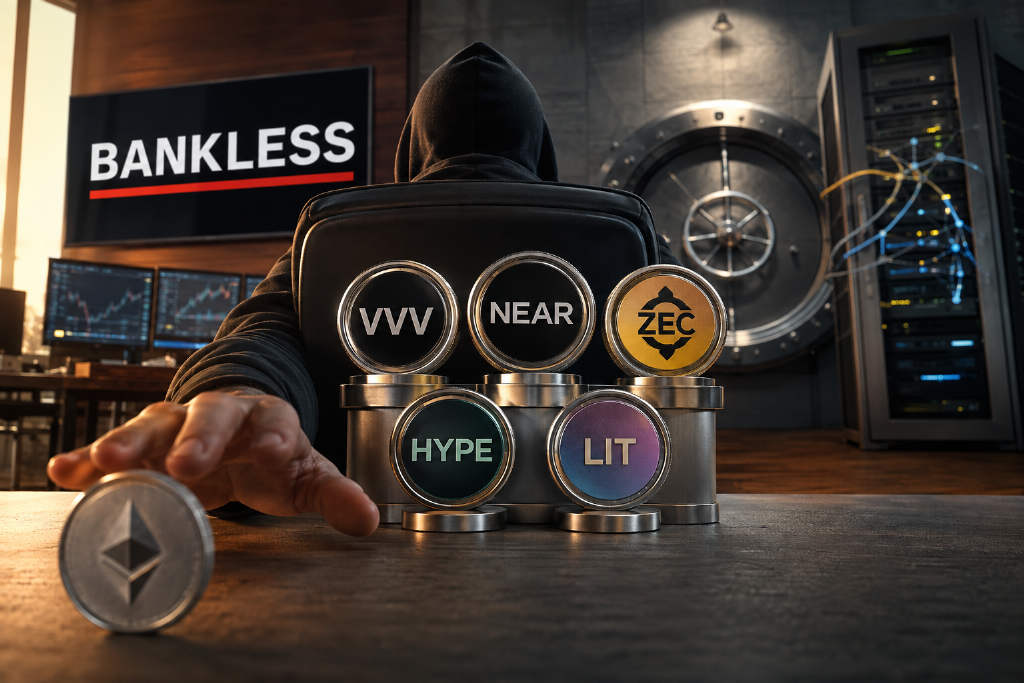
On May 21, David Hoffman, co-founder of Bankless and one of the most outspoken Ethereum advocates of the past six years, said in a post that the mood on crypto Twitter had changed and that he had sold the last of his ETH.
Three and a half months later, the move has turned into a clear winning trade, based on the performance figures cited in the source article.
How Hoffman redeployed the capital after exiting ETH
In early June, Hoffman laid out the full rotation path on X. The article says the funds from the ETH exit were divided into two parts.
The first bucket, about 50% of the capital, was deployed right after the ETH sale into four assets: VVV, NEAR, ZEC and HYPE. Hoffman explicitly said in a post that he bought NEAR at roughly $1.4.
The second bucket, also about 50%, was held back for DCA purchases. In his words, it was money he would use to slowly buy something that had not moved yet. That capital ultimately went entirely into LIT, the token of Lighter, an onchain perpetuals exchange built on zkRollup technology.
The article says Hoffman’s case for LIT was unusually direct. Exchanges remain the best business model in crypto, he argued; Lighter’s buyback pace was about twice that of HYPE; zk circuits let users verify without permission whether the exchange is following its own rules; and the product offered lower latency, a better fee structure and support for more assets, including pre-IPO markets.
When asked how to choose between LIT and HYPE, Hoffman’s answer, as quoted by the article, was that LIT was both HYPE’s beta and its alpha. By late June, he had also posted that he regretted not buying more LIT.
Five assets, four narrative tracks
The portfolio mapped neatly across four themes, according to the report.
- ZEC was a bet on the privacy narrative.
- HYPE and LIT were bets on structural growth in onchain derivatives.
- NEAR was a bet on cross-chain infrastructure and the AI agent narrative.
- VVV was a bet on decentralized AI inference.
Those five positions covered four distinct tracks, and none of them depended on Ethereum Layer 1 valuation as the core thesis.
Scorecard: the article estimates portfolio gains of roughly 90% to 120%
The report compares the prices around Hoffman’s disclosed entries with early-September levels. It places the ETH exit in late May, the first wave of purchases from late May to early June, and the LIT DCA program through mid-June. For comparison, it uses approximate early-June prices as the cost basis and early-September prices as the latest reference point.
ETH was sold at about $2,100 and was later around $2,450, a gain of roughly 17%.
ZEC was bought at about $540 and later moved above $1,200, a rise of more than 120%. The article says ZEC briefly touched $1,200 on Sept. 6, doubling within three months. It links that move to the Aug. 25 launch of Grayscale’s ZEC spot ETF, ZCSH, on NYSE Arca. Two weeks after listing, AUM had expanded from $300 million to $460 million, and the move was also accompanied by $46 million in short liquidations.
HYPE was bought at about $56 and later traded around $87, up about 55%. On Sept. 6, it set a new all-time high of $89.54. The article adds that Hyperliquid’s cumulative token burn had exceeded $4 billion and that daily protocol revenue was holding around $2.26 million.
LIT was accumulated at roughly $1.5 to $2, based on the reported DCA range, and later traded around $4.7, implying gains of about 135% to 210%. It hit a record high of $4.95 on Sept. 5. Because LIT accounted for 50% of Hoffman’s total capital and was his largest single position, the article says it delivered the biggest absolute profit in the basket.
NEAR was bought at around $1.4, a level the article says Hoffman himself confirmed, and later traded near $2.37, up about 69%.
VVV was bought around $16 to $18. The report notes that VVV was trading near its all-time high area in early June and reached a record high of $21.32 on June 3. It was later around $17, leaving it roughly flat. Among the five names, VVV was the weakest performer, and the article says it was also the only position Hoffman neither publicly added to nor described with regret for not buying more.
Using a rough portfolio model, the article assumes 50% of capital was equally split among VVV, NEAR, ZEC and HYPE, or 12.5% each, while the other 50% went to LIT. On a midpoint basis, total portfolio return is estimated at about 90% to 120%, compared with roughly 17% for ETH over the same period.
By that measure, the basket outperformed ETH by at least 70 percentage points.
Why the article says the trade worked
The source argues that the key point is not just how much any one token rallied, but how the market validated Hoffman’s selection framework over the following three and a half months.
In ZEC’s case, the article says the move had a visible setup. Grayscale’s ETF filing had been moving through the SEC process since November last year, and the Aug. 25 launch merely turned a long-developing institutional variable into price action. Hoffman bought in May, after ZEC had already climbed from the low-$30 range at the start of the year to above $500. The report frames that decision as a bet that catalyst certainty outweighed short-term price risk.
It gives more space to LIT. While much of the market was focused on HYPE as a potential onchain equivalent of CME, Hoffman chose an earlier-stage rival with a smaller market cap and, in the article’s wording, potentially more aggressive product design. His framework was to look for a higher-elasticity beta within the same segment, while also leaning on faster buybacks, a transparency premium from zk-based verification and the user migration potential that could come from lower fees. Looking back, the article says LIT had risen about 500% from its bottom to current levels, validating that line of thinking.
NEAR returned about 69%, which placed it fourth in the group and made it look less striking than ZEC or LIT. Still, the article points to a possible link between the two positions. It says NEAR Intents acted as a toll gate during the ZEC run, with ZEC-related trading pairs accounting for nearly 40% of total NEAR Intents volume. On that view, Hoffman may have built a self-reinforcing portfolio without explicitly setting out to do so: as ZEC rises, trading flow through the Zashi wallet and NEAR Intents increases, fee income at NEAR Intents rises, and buybacks of NEAR strengthen.
VVV was the one position that did not play out. The article says the decentralized AI inference narrative around Venice AI spiked briefly in early June and then lost momentum, with no sustained catalyst afterward. Hoffman did not publicly add to that position.
A shift from Layer 1 valuation toward application-layer revenue
The article’s broader argument is that Hoffman’s scorecard points to something more important than a simple leaderboard of winners and losers: value in crypto may be shifting from Layer 1 valuation toward application-layer revenue.
ETH, the asset he sold, is a Layer 1 token typically valued through network effects, developer activity and the gas burn mechanism. Of the five assets he bought, HYPE and LIT are tied to verifiable protocol revenue and buybacks. ZEC is tied to institutional demand through the ETF and to observable onchain privacy usage data, including the share of shielded supply. NEAR is tied to transaction volume and fee generation in a cross-chain settlement layer. VVV is tied to actual call volume for AI inference services.
What those assets share, in the article’s telling, is that their valuation anchors come from independently verifiable onchain activity rather than promises about the future.
The report also notes that Hoffman’s sale of ETH was not presented as a judgment on Ethereum’s technical prospects. It quotes him as still believing Ethereum will win. The distinction, as framed by the article, is that in a liquidity-constrained market, conviction by itself does not create returns; verifiable cash flow and quantifiable demand do.