

Barclays said the August U.S. jobs report was stronger than expected on the headline but was also boosted by temporary and statistical factors, leaving the underlying picture of labor demand less firm than the top-line number suggested. The bank kept its base case for a 25 basis point Federal Open Market Committee rate hike in September and said next week’s inflation data will be the next critical input.

Data released by the U.S. Bureau of Labor Statistics on Sept. 4 showed nonfarm payrolls increased by 162,000 in August. That was well above Barclays’ forecast for 25,000 and ahead of the 55,000 consensus expectation. The prior two months were revised up by a combined 55,000, with July revised from -23,000 to +21,000.
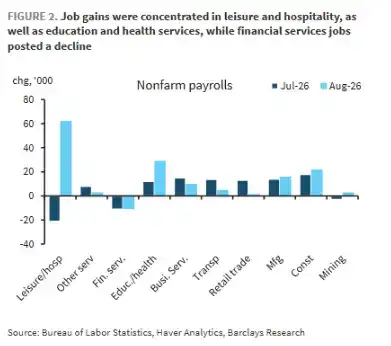
According to Wallstreetcn, citing Trader-Tracker coverage, the Marc Giannoni team at Barclays said after the release that part of the strength came from temporary rebounds in leisure and hospitality and in local education hiring, rather than a sustained improvement in labor demand. The report also noted that job growth was concentrated in leisure and hospitality as well as education and health services, while financial services lost jobs.
Headline payroll growth beat forecasts, but the composition was uneven
On the surface, the report was strong. August payroll growth of 162,000 lifted the three-month average to 71,000 a month, still above Barclays’ estimate of roughly zero for break-even job growth. Even so, the team said the release included a technical overstatement.

Leisure and hospitality added 62,000 jobs after two straight monthly declines, which Barclays treated as a rebound effect. State and local education payrolls rose 42,000 in August, largely reversing a 58,000 drop in July. Government payrolls added 35,000 overall, with local education accounting for much of that increase.
Private payrolls increased by 127,000. Within that, services contributed 86,000, manufacturing added 16,000, construction rose by 22,000, and mining added 3,000. Barclays said the three-month average for private nonfarm payroll growth, at 75,000 a month, is a cleaner gauge of underlying labor demand and should carry more weight than any single monthly print affected by noise.
Birth-death adjustments also boosted the August reading
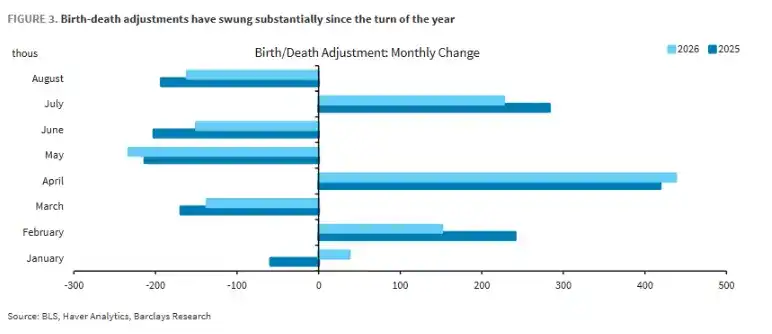
Barclays said the August report was also affected by the BLS birth-death adjustment process. Compared with the same month in 2025, the drag from the birth-death adjustment was about 32,000 smaller this August, which mechanically pushed the headline figure higher. The bank noted that these adjustments have swung sharply since the start of the year.

Over the June-to-August three-month average, however, the scale of the adjustment looked broadly similar across the two years: -37,000 in 2025 and -28,000 in 2026. That suggests some of the monthly volatility offsets over time.
Barclays said the volatility may be tied to a methodology change introduced by the BLS in January. Under that approach, the agency uses employment information from existing sample firms to infer the employment effect of newly created businesses. The revised method is meant to reduce benchmark revisions, but the monthly impact remains difficult to anticipate.
Unemployment ticked up as labor supply expanded
The unemployment rate rose by 5 basis points in August. On an unrounded basis it was 4.141%, up from 4.090% in July, though it still rounded to 4.1%.

That increase did not come from a drop in household employment. Household survey employment rose by 569,000, but the labor force expanded by 683,000, which was a larger increase and pushed the unemployment rate slightly higher.
Labor force participation rose 0.2 percentage points to 61.6%. The move was led by a 0.8 percentage point jump among workers aged 16 to 24, while those aged 55 and older contributed another 0.3 percentage point increase. Barclays said the prime-age participation rate, the 25-to-54 group that it treats as the more informative measure, was unchanged at 83.4%.
The bank added that about 0.2 percentage points of participation-rate decline since May mainly reflected weaker willingness to participate within age groups rather than population aging. Barclays said that pattern is consistent with a labor-supply squeeze linked to tighter mobility restrictions and supports its view that break-even job growth remains limited.

Income data improved, though underlying wage growth still looked soft
Barclays said the more constructive part of the employment report came from income measures. Average hourly earnings rose 0.27% month over month and 3.3% year over year, above July’s 0.16% monthly gain. Average weekly hours increased by 0.1 hour to 34.4. Combined private-sector wage income rose 0.67% from the prior month, the fastest pace since January, when it increased 0.78%.
On a three-month annualized basis, wage income growth reached 4.7%, up from 3.7% through May. Barclays said that still implies positive real income growth after inflation, pointing to a marginal improvement in purchasing power.
At the same time, the bank did not treat the one-month average hourly earnings figure as decisive. Its wage-growth model assigns limited weight to the August average hourly earnings signal and continues to estimate underlying wage growth at 0.26% a month, or 3.1% at an annual rate. Barclays said that sits inside the 3.0% to 3.5% range the Federal Reserve sees as consistent with its 2% inflation target.
The estimate incorporates the rise in the second-quarter Employment Cost Index and data from the Atlanta Fed wage growth tracker. Barclays also said the current 4.7% income growth pace is unlikely to last and expects real consumer spending growth to slow to a 1.5% seasonally adjusted annualized quarterly rate in the second half.
September hike odds edged higher, with inflation now in focus
Taking the jobs, wages, hours, and unemployment details together, Barclays said the August labor report marginally strengthened the case for a 25 basis point September FOMC hike, which matches its standing base case.
The bank’s reasoning is that job growth remains above break-even and that firmer wages and longer hours support labor income. The weak point in the report was the mild rise in unemployment, though Barclays said that sat somewhat awkwardly beside the stronger pace of job creation.
Attention has now shifted to next week’s inflation report. Barclays expects both core CPI and core PCE to rise 0.23% month over month in August. Even with that relatively mild reading, the bank said it would not be enough on its own to rule out a September hike because Fed Chair Warsh has repeatedly said policymakers need confidence that inflation is moving back to target in a way that is both clear and sufficiently fast.
For fixed-income and rates traders, Barclays’ baseline still points to a September hike, leaving front-end yields under pressure. The inflation print is the last major piece of the puzzle for this month.