


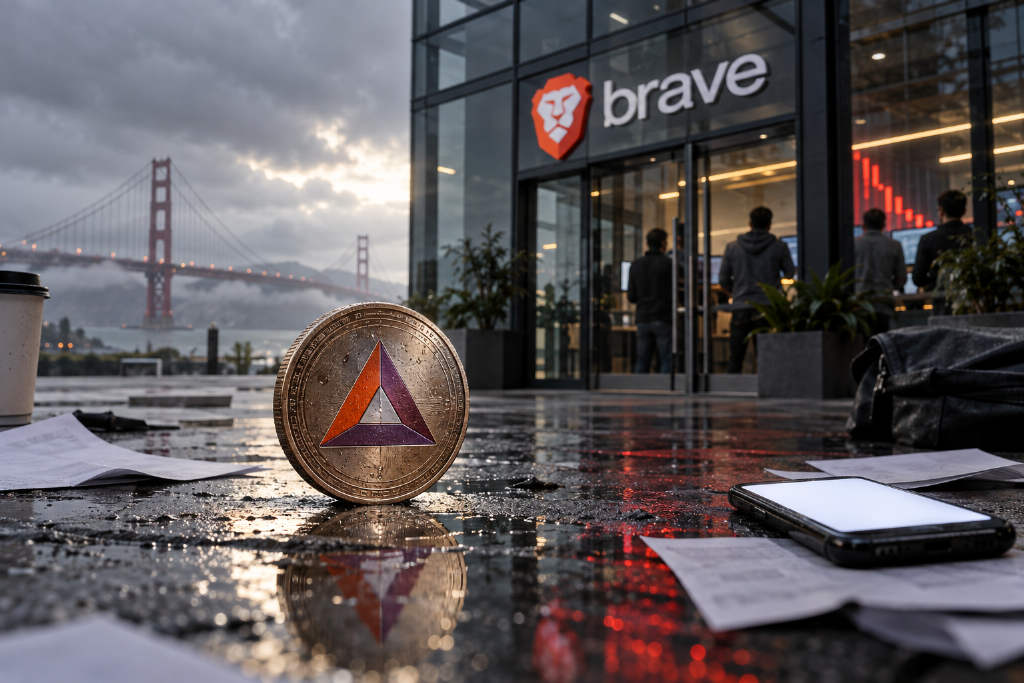
BAT’s latest rally is drawing attention for more than the size of the move. The bigger question is whether the story behind it can turn into shipped products.
After spending much of the year quiet, the token of a project with a market capitalization below $300 million broke sharply higher in the second week of October. Basic Attention Token, or BAT, climbed from $0.078 on Sept. 13 to $0.205 on Oct. 13, up more than 124% over the month. The steepest stretch came in the final week: BAT rose 34% on Oct. 9, perpetual futures open interest jumped 60% in a single day on Oct. 10, and the token added another 10% within one hour on Oct. 13.
That happened while BTC fell 1% and total crypto market capitalization shrank 1.5%. BAT moved against the broader market.
One signal stood out. BAT’s perpetual funding rate stayed negative while price kept rising. In practice, that points to shorts being more crowded than longs, with short sellers paying longs to hold positions. If price continues to move up, those shorts can be forced to close, and that covering becomes fresh buy pressure. It is the classic short-squeeze setup.
The issue is whether there is enough fundamental support behind the move.
Brave has put three major cards on the table in the past three months
The narrative behind BAT’s rally follows a fairly clear timeline.
On July 9, Brave released BAT Roadmap 4.0, its biggest roadmap update since 2017. The core shift was a repositioning of BAT from a token tied to ad rewards into what Brave described as attention payment infrastructure for the AI era.
The roadmap introduced four product directions at once.
- Support for the x402 protocol and Machine Payments Protocol, or MPP, allowing AI agents to execute micropayments autonomously inside the Brave browser. That places BAT directly into one of 2026’s hottest themes: AI agents.
- BravePay, a privacy-focused payment protocol layer built around stablecoins, with support for self-custody, .brave addresses, and stablecoins compliant with the GENIUS Act.
- Brave Rewards Card, a physical payment card that lets users earn BAT through spending and also use BAT in everyday purchases, extending the token’s use case beyond the browser and into retail payments.
- Creator Contribution Protocol, a mechanism under which creators would receive automatic micropayments through BAT’s blockchain ledger when AI platforms use their content for training or inference. That ties BAT to the global debate over AI copyright compensation in 2026.
On Aug. 3, Brave opened the waitlist for the Brave Rewards Card. It was the first concrete product step after the Roadmap 4.0 release. Brave did not disclose the issuing partner or supported regions, but the move gave the community a specific milestone to watch.
In early October, BAT also began to be discussed as a candidate chain-key token for Internet Computer, or ICP. If that happens, BAT would gain native cross-chain integration and a broader set of use cases.
All of these moves point in the same direction. Brave is trying to move BAT from a browser reward point into a cross-platform payment token. AI micropayments, physical card spending, creator compensation, and cross-chain integration all serve the same goal: finding utility for BAT outside browser advertising.
Price action shows a split picture between spot demand and leverage
Market data presents a mixed structure rather than a clean bullish trend.
The bullish side is easy to see. BAT rose 34% on Oct. 9, moving from $0.094 to $0.131. It gained another 16% on Oct. 12 to reach $0.175. On Oct. 13, it touched $0.205, up 33% over 24 hours. On the daily chart, the token completed a swing structure shift from bearish to bullish and broke above two key resistance levels: the May high at $0.127 and the February high at $0.139. Trading volume reached $51.7 million during the rally, confirming active buyer participation.
There is another side to the tape. Data from Oct. 10 showed open interest surging 60% in one day, a sign that leveraged positions were flooding in. By Oct. 12, price was still rising, but trading volume had fallen 16%. That suggests spot buying was weakening in the later stage of the move while leverage was taking over. RSI had also reached 87.91, placing BAT in deeply overbought territory.
The negative funding rate makes the picture even more complicated. In a typical sharp rally, funding turns positive as longs become crowded. BAT did the opposite. Shorts were still adding or holding on rather than giving up.
That leaves two possible readings.
The optimistic one is that spot demand has been strong enough to keep squeezing shorts before they can react. Under that view, negative funding combined with rising open interest is a classic sign that the short squeeze is not over yet.
The cautious one is that shorts may not simply be trapped. Negative funding can also mean the cost of shorting is lower, allowing better-positioned traders to wait for price to reach target levels before selling into strength. If spot demand runs out, leveraged longs could become the first side to face liquidations.
At around $0.20, BAT is still far from a full revival
BAT is now trading around $0.20, but that level looks different when placed in a wider frame.
The token’s all-time high was $1.939 in November 2021. At current levels, BAT remains down 90% from that peak. Even after a 124% rebound, it has only bounced from historical lows and still sits about 35% below the local high of $0.302 reached in January 2026.
Its market capitalization is about $300 million, placing it around No. 120 on CoinMarketCap. For a token launched in 2017 and tied to Brave, a browser product with tens of millions of monthly active users, that valuation has been heavily compressed. Brave has more than 50 million monthly active users, and Leo AI has already integrated models from Anthropic and Meta. BAT has long been priced like an old token with no active narrative despite being attached to a live product and an existing user base.
Roadmap 4.0 is an attempt to change that pricing logic. AI micropayments, stablecoin payment cards, and creator compensation are all themes that the market has been willing to assign premium valuations to in 2026.
Still, most of those ideas remain at the roadmap stage. The Brave Rewards Card has opened a waitlist, but there is no issuance timeline. BravePay exists in the white paper, but no code has been released. Support for x402 is described as coming soon, without a specific date.
That is why a real comeback for an older token cannot be measured by one sharp rally alone. It depends on whether the narrative keeps converting into deliverables.
If Brave launches an actual Rewards Card product in the fourth quarter, or brings out an MVP for BravePay, BAT’s rebound could start to look less like a sentiment-driven move and more like a repricing based on utility. If the next three months bring only a roadmap and a waitlist, the 124% gain may end up looking like a better entry point for shorts.