
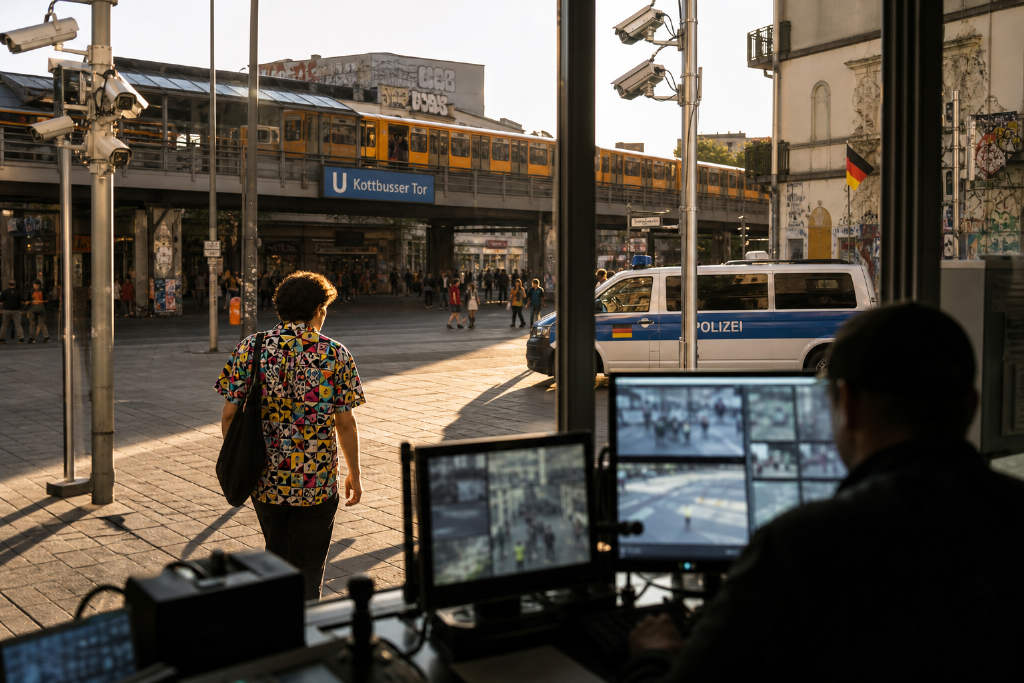
Berlin police have only just rolled out an AI video surveillance pilot in Kottbusser Tor, and Berlin artist Simon Weckert has already staged a public test of its limits with a brightly patterned shirt. His claim is straightforward: no intrusion into the system is needed. A person only has to wear the shirt and walk past the camera for the AI to lose confidence that it is looking at a human figure.
Kottbusser Tor pilot went live in August
Berlin police began using the AI-based monitoring system in the Kottbusser Tor district in August. About 30 cameras watch the intersection, an area known for persistent public safety concerns, and analyze people’s movements in real time in an attempt to trigger alerts before violence breaks out.
Kottbusser Tor has long been a policing focus in Berlin. In December 2025, the Berlin parliament amended the General Safety and Order Act, loosening the legal basis for this kind of monitoring. The system then entered live pilot operation this August.
Officials have presented the project in a way meant to reduce concern. People in the footage are represented only as stick-figure-like skeletal forms, according to the official description. The system does not perform facial recognition. Instead, it looks for specific movement patterns such as punching, kicking, or drawing a knife, and sends an alert only after it detects anomalous behavior. That design, authorities say, preserves anonymity for passersby.
Critics say the legal shift matters as much as the software
Weckert’s project page points to a different issue. It describes the camera as Berlin’s first legally authorized camera able to record urban public space without a concrete cause, effectively writing a "record first" approach into the rules.
Under the pilot plan, the system is expected to require about 2.47 million euros in construction costs and 2.13 million euros in operating costs from 2026 to 2030. German outlet netzpolitik.org has called it a "behavior scanner" and said it marks the start of automated surveillance.
Berlin police have also said that if the pilot succeeds, the system will be expanded to locations including Warschauer Straße and then gradually introduced to other districts with higher crime rates. In that sense, the 30 cameras activated in August are only the first batch.
How the shirt was built to confuse detection models
Weckert says the system is not recognizing "humans" in any meaningful sense. It is recognizing statistical features. "AI systems consist of multiple layers. They have never learned what a ‘human’ is. What they have learned is what humans statistically look like across millions of training images," he said.
He turned that idea into a shirt using a technique called TC-EGA, which generates seamless repeating textures. In academic terms, the result is an adversarial texture. Rather than placing a single patch on one part of the body, as some earlier work did, Weckert spread the disruptive pattern across the entire garment so that front, side, and back views would all feed the detector the same confusing signals.
He repeatedly tested the pattern against the open-source object detection model YOLO, adjusting color blocks and overlaps based on the output, then running another round. He continued until the system’s confidence in the label "this is a person" dropped sharply.
He described the mechanism this way: "Saturated color transitions strongly activate the early layers of the network, while overlapping shapes interrupt the continuity of the body outline, so the detector can no longer bind those parts into one human figure."
Sold under a Creative Commons license
The shirt is made from a 65% recycled polyester blend, produced in Latvia, and sold publicly under a Creative Commons license for $75 per piece. Part of the proceeds is donated to organizations opposing the expansion of surveillance, turning the work from a one-off art experiment into a longer-running advocacy project.
Not his first intervention against machine perception
Weckert is best known for an earlier challenge to automated systems. In 2020, he placed 99 second-hand smartphones in a handcart and moved through Berlin slowly enough to make Google Maps classify an otherwise open road as a major traffic jam. The episode is still treated as a classic case of adversarial performance art.
This time, his target is more immediate: a live street-level surveillance system that is already operating and may help determine when an alert is triggered and for whom.
"A square under surveillance has already changed the people inside it long before any alarm sounds," Weckert said. Whether the shirt will fool the next generation of systems is not, in his view, the central question. The more basic question is whether the camera should have been treated as a normal presence in the first place.