
Bernstein said in a July 27 report that the bigger message behind the latest AI supply-chain announcements is not a fresh round of AI chip buying, but the growing effort to secure memory and advanced packaging before supply tightens further.
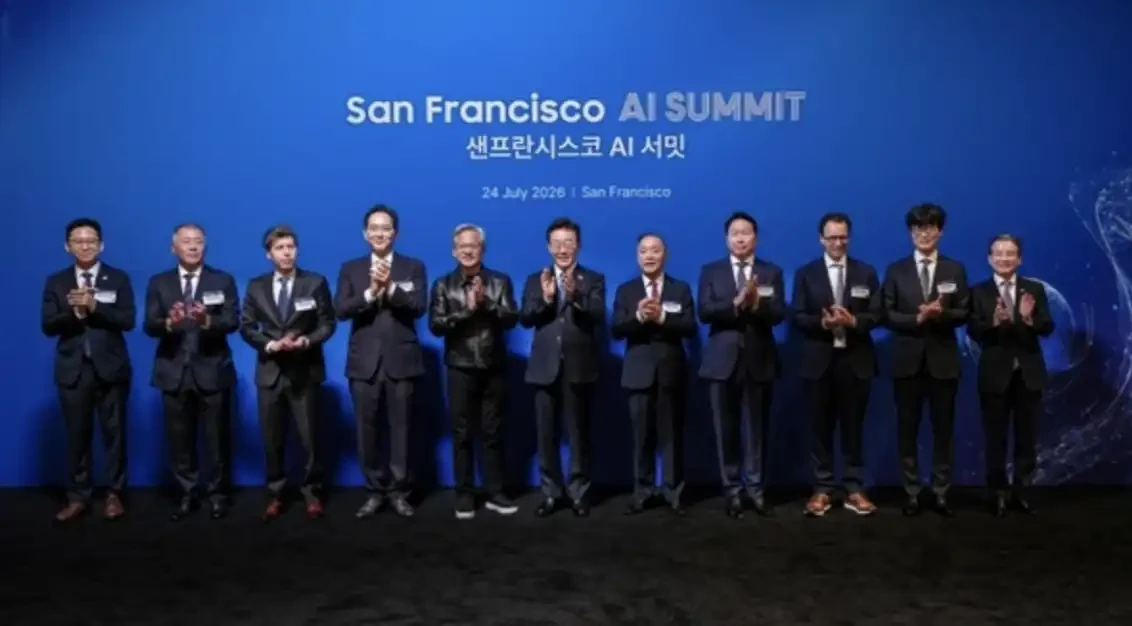
On July 24, SK Group and Nvidia announced at the AI Summit in San Francisco that they would expand a comprehensive partnership valued at more than $500 billion, covering AI factory projects and next-generation memory. Samsung Electronics then signed a memorandum of understanding with Broadcom for more than $200 billion of cooperation in memory and foundry over the next five years through 2030. Taken together, the two frameworks exceed $700 billion.
Bernstein said those numbers need to be separated and read with caution. The arrangements are still framed mainly as a partnership and an MOU, not fully disclosed procurement contracts. Actual purchase volumes, pricing, delivery schedules and product mix were not disclosed.
AI server growth depends on more than GPUs
The report argues that AI server expansion is not driven by GPUs alone. Compute chips such as GPUs and ASICs still need HBM, DRAM, NAND, advanced packaging and dependable delivery before they can move into data centers at scale. If those links lag, shipments from AI chip companies such as Nvidia and Broadcom can be delayed as well.
That is why Bernstein put the focus on memory rather than treating the announcements as another straightforward wave of AI chip orders. In its view, the supply race is extending from GPUs to memory and packaging capacity secured years in advance.
The SK Group-Nvidia framework and the Samsung-Broadcom MOU are different deals
Bernstein said the more than $500 billion figure tied to SK Group and Nvidia is not a standalone memory procurement contract awarded to SK hynix. It is a broader partnership across the group.
Within that structure, SK hynix is responsible for HBM4 and next-generation memory cooperation, while SK Telecom is the main AI factory participant. Based on official information from Nvidia and SK hynix, the package includes up to 2GW of AI factory capacity from SK Telecom, NVIDIA DSX, the Vera Rubin platform and SK hynix HBM4. The first AI factory is planned to come online in 2027.
Bernstein said the market implication is fairly direct. As AI systems after Vera Rubin continue to raise requirements for HBM and system-level supply, memory is no longer just a standardized component purchase. It becomes part of whether an AI computing platform can be delivered on schedule.
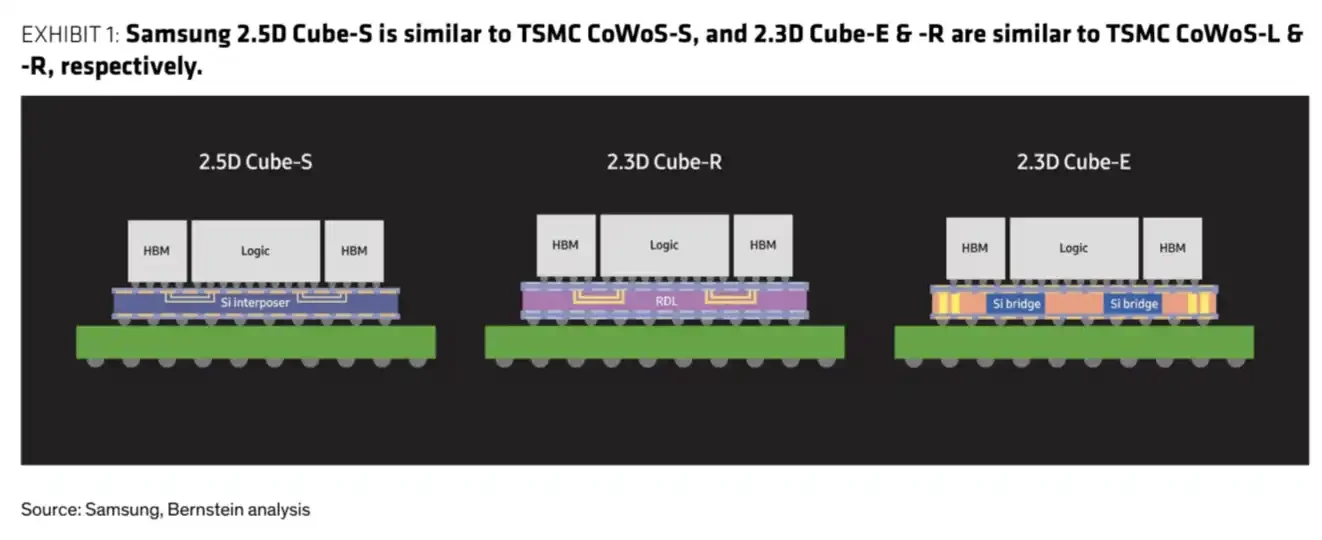
The Samsung-Broadcom agreement is more explicit in scope. Samsung said the cooperation, worth more than $200 billion over the next five years through 2030, covers memory and foundry support for Broadcom’s next-generation AI accelerator, as well as manufacturing tied to 2nm and advanced packaging including 2.3D and 2.5D integration.
Bernstein said the issue is not only whether Broadcom may shift part of its AI ASIC production to Samsung. Samsung is also trying to offer AI chip customers a bundled route that combines memory, advanced process technology and advanced packaging as an alternative deliverable solution outside Taiwan Semiconductor Manufacturing Co. (TSMC).
Samsung packaging is being compared with TSMC CoWoS
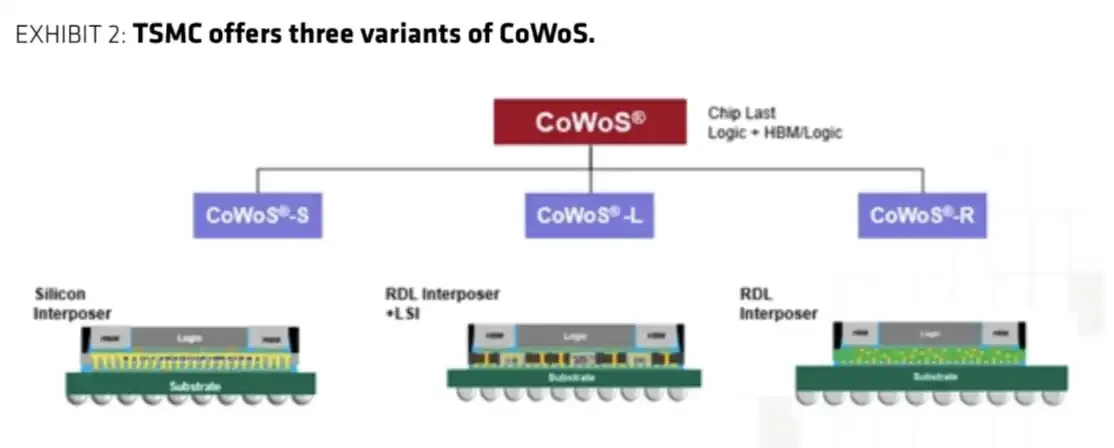
On the technical side, Samsung’s Cube-S, Cube-E and Cube-R are described as 2.5D and 2.3D Cube packaging. Bernstein compared them with TSMC’s CoWoS-S, CoWoS-L and CoWoS-R. In both cases, the central task is to connect logic chips with HBM at high bandwidth and support multi-chip integration.

The report’s takeaway is that advanced packaging is no longer just a back-end manufacturing step. It sits on the critical path for AI system delivery.
Bernstein’s main focus is memory supply being locked in early
Bernstein said the most important signal in the two announcements is that memory supply is being reserved well ahead of demand peaks.
In AI server buildouts, compute chips matter, but supply elasticity is tighter for HBM and high-end memory, customer qualification takes longer and advanced packaging can also become a bottleneck for complete system delivery. Large buyers would rather secure multi-year frameworks now than wait for a tight spot market later.
The report cited market-consensus figures showing annual global memory industry revenue at about $0.9 trillion in 2026 and about $1.3 trillion in both 2027 and 2028. TrendForce had earlier publicly projected the global memory market at about $1.28 trillion in 2027. Participants include Samsung, SK hynix, Micron, KIOXIA and Chinese memory makers.
Bernstein cautioned that these industry totals should not be treated as direct incremental revenue from the SK Group-Nvidia and Samsung-Broadcom arrangements. The announcements do not disclose exact purchase volumes, product mix, pricing formulas or delivery timing. They also do not say how much of the framework values reflect new capacity and how much simply extends existing relationships over a longer period.
Even so, Bernstein said the signal is clear enough. AI customers are treating HBM and advanced packaging as strategic resources, and the pricing power of leading memory suppliers remains under close market watch. Unlike a traditional storage cycle driven more by PC, smartphone and server inventories, the AI cycle ties HBM more closely to advanced packaging, making supply and demand easier to shape around a small group of major buyers and major suppliers.
Samsung may gain validation opportunities, but Bernstein stays cautious on the TSMC impact
Because the Samsung-Broadcom MOU mentions 2nm and below, advanced packaging and AI accelerators, the market has naturally asked whether TSMC’s share could come under pressure.
Bernstein’s answer is measured. Even if Broadcom eventually moves part of its AI ASIC production to Samsung, the near-term impact on TSMC earnings may be limited because demand for advanced capacity remains very strong. More customer validation opportunities for Samsung do not automatically mean immediate order losses for TSMC.
The real test, the report said, is execution. AI chip customers do not need just one manufacturing step to work. They need HBM, logic chips, packaging, substrates, yields and delivery schedules to hold up at the same time. If any link slows, the technology roadmap described in the MOU will be difficult to convert into real shipments.
For Samsung, Bernstein said, this is a chance to extend its memory strength into a system-level AI supply chain. Samsung has scale in memory, but market attention in HBM leadership and customer trust in advanced foundry has more often centered on SK hynix and TSMC. If the long-term framework with Broadcom is executed well, Samsung could reassert the value of a combined memory, foundry and packaging offering.
Positive ratings remain, but an MOU is not an order book
Bernstein maintained Outperform ratings on Samsung Electronics, SK hynix, Micron, Nvidia and Broadcom, while keeping KIOXIA at Underperform.
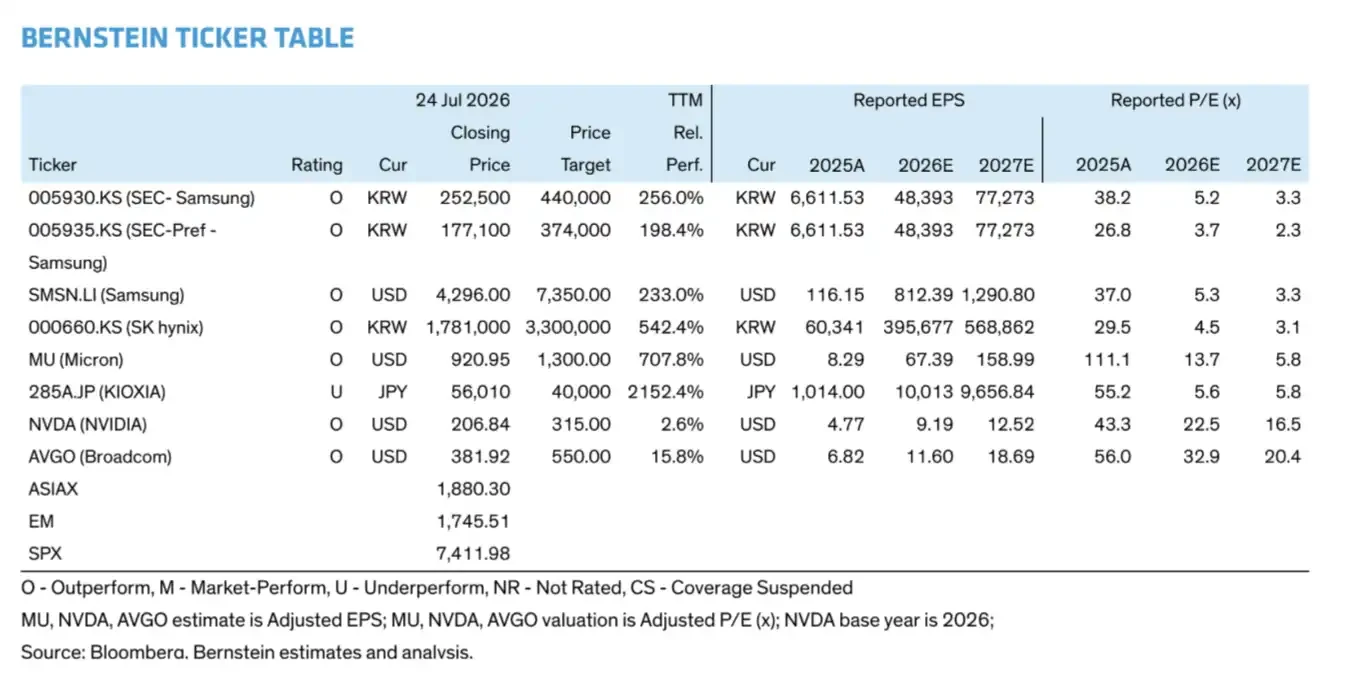
Its target prices are KRW 440,000 for Samsung common shares, KRW 3.3 million for SK hynix, $315 for Nvidia and $550 for Broadcom. The ratings and targets are reported in line with the source note.
Still, Bernstein said those ratings do not mean the announced cooperation has already turned into certain earnings. A more careful reading is that AI memory supply is becoming more strategic, and leading memory makers as well as major AI chip customers are using long-term arrangements to reduce future supply risk.
The report also laid out the main uncertainties. A partnership or MOU is not a final procurement contract, and pricing, volume and delivery schedules remain undisclosed. Whether Samsung’s tie-up with Broadcom can translate into meaningful AI ASIC foundry or advanced-packaging share will depend on customer qualification, yield and capacity planning. Even with very large headline values, it is difficult to say how much incremental revenue these frameworks could add against an annual memory market around $1.3 trillion near 2027.
Longer term, Bernstein said competition inside the storage industry remains a pressure point. Progress by Chinese memory suppliers, especially in NAND, could affect industry profit margins. DRAM and HBM face higher barriers in EUV, process technology and customer qualification, so near-term pressure is relatively smaller, but today’s supply tightness should not be projected as a permanent advantage.
The firm’s clearest conclusion is that the confirmed signal here is not that $700 billion of orders has already landed. It is that major AI buyers are starting to use multi-year frameworks to secure memory and packaging resources. Whether those plans turn into realized revenue will show up later in capital spending, HBM shipments, customer prepayments, capacity additions and actual delivery cadence.