
Patrol Already Pays for Itself; Other Scenarios Need 30%–50% Price Cuts
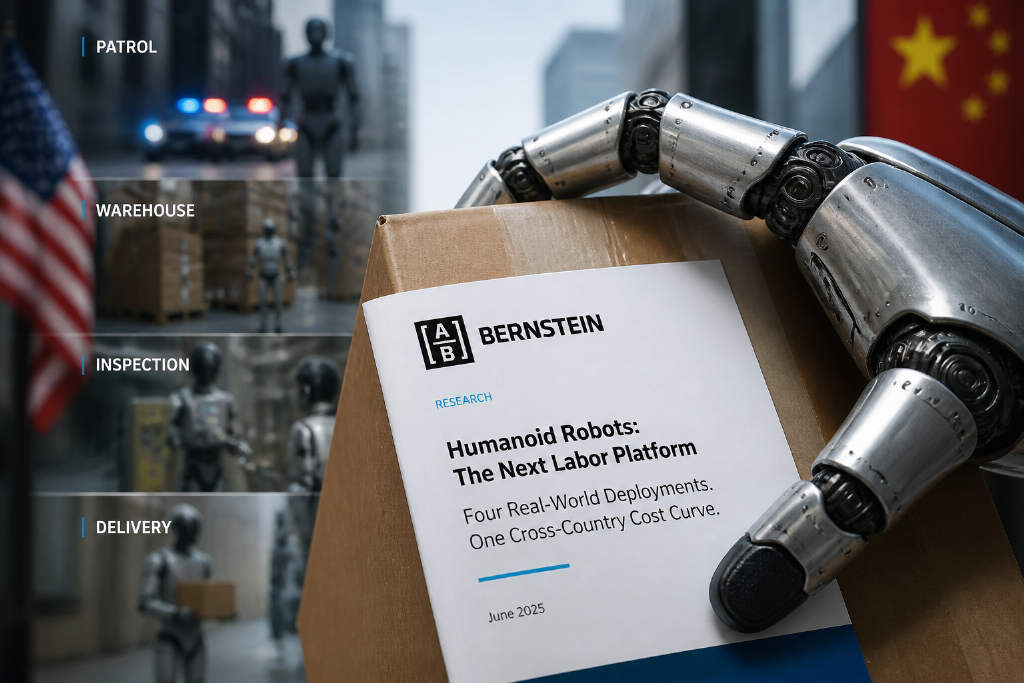
On August 25, Bernstein released a research report that, for the first time, puts hard numbers on the economics of humanoid robots in four application scenarios spanning the U.S. and China: urban patrol, warehouse palletizing, factory material handling and inspection, and last-mile delivery.
Bernstein breaks payback period into upfront investment divided by annual net savings. Upfront investment covers the robot purchase price plus system integration costs; annual net savings equal the labor costs replaced minus ongoing maintenance and human oversight expenses.
At current prices, payback periods across the four scenarios range from 1 year to 6.7 years. U.S. urban patrol is the quickest at just 1 year; factory material handling and inspection in China takes the longest at 6.7 years. The U.S. consistently outperforms China on payback because American labor costs run 3 to 5 times higher than Chinese levels—even though robot prices are also steeper stateside, the labor savings cover the upfront outlay faster.
Patrol has already achieved sub-two-year payback in both the U.S. and China. For the other three scenarios to hit the 2.5-year threshold that Bernstein considers the tipping point for accelerated adoption, robot prices in China need to fall 30% to 50%, while U.S. prices need to drop 5% to 40%.
Bernstein argues price will not remain a barrier for long. Experience from the EV and lithium-battery industries shows costs decline 15% to 18% for every doubling of cumulative production, with the learning curve steepest at very low volumes. Once humanoid robots enter mass production, cost reductions could outpace expectations. Agility and other leading manufacturers have already demonstrated similar cost-decline trajectories in investor presentations.
Total Addressable Market Exceeds 10 Million Units; 2031 Shipments Seen at 1 Million
Bernstein estimates the four scenarios can support roughly 10 million humanoid robot deployments in China and about 1.2 million in the United States. Factory material handling and inspection is the single largest category—6 million units in China, 600,000 in the U.S. Urban patrol accounts for 1.8 million units in China, warehouse palletizing 500,000, and delivery 1.6 million.
Assuming an 8% penetration rate over five years, cumulative installations across the four scenarios would reach roughly 900,000 units by 2031, with annual shipments exceeding 500,000—approximately 50% of projected global humanoid robot shipments that year. Bernstein forecasts total global annual shipments of 1 million units by 2031, with these four scenarios contributing about half.
Bernstein acknowledges this is not the full market. Factory assembly, commercial services, and household applications carry larger long-term potential and have already seen proof-of-concept pilots, but neither the technology nor the economics support large-scale deployment in the near term.
Three Metrics to Identify Winners
Bernstein recommends investors track humanoid robot companies along three dimensions:
- Commercial sales trajectory. Proof-of-concept trials and lab demos do not constitute a sustainable business model. Verifiable expansion of paying customers is the core indicator of whether a company has genuinely entered the commercialization phase. Growing orders and repeat purchases speak louder than any technology demonstration.
- Performance improvement trajectory. The volume of data matters less than the efficiency of the data loop. Companies that continuously refine reinforcement-learning models using real-world deployment data will improve performance significantly faster than rivals stuck in the lab. The critical question is whether the "deploy-collect-train" feedback loop is established and running.
- Gravitational pull toward the center of the industrial ecosystem. The humanoid robot supply chain spans chips, sensors, motors, reducers, and AI models. Companies that attract system integrators to build ecosystems around their platforms will achieve faster iteration cycles and lower supply-chain costs.
This article is based on Bernstein's research report dated August 25, 2026. All ratings, price targets, earnings forecasts, and related judgments cited are the views of the brokerage's analysts and do not constitute investment advice. Markets carry risk; decisions should be made independently.
