


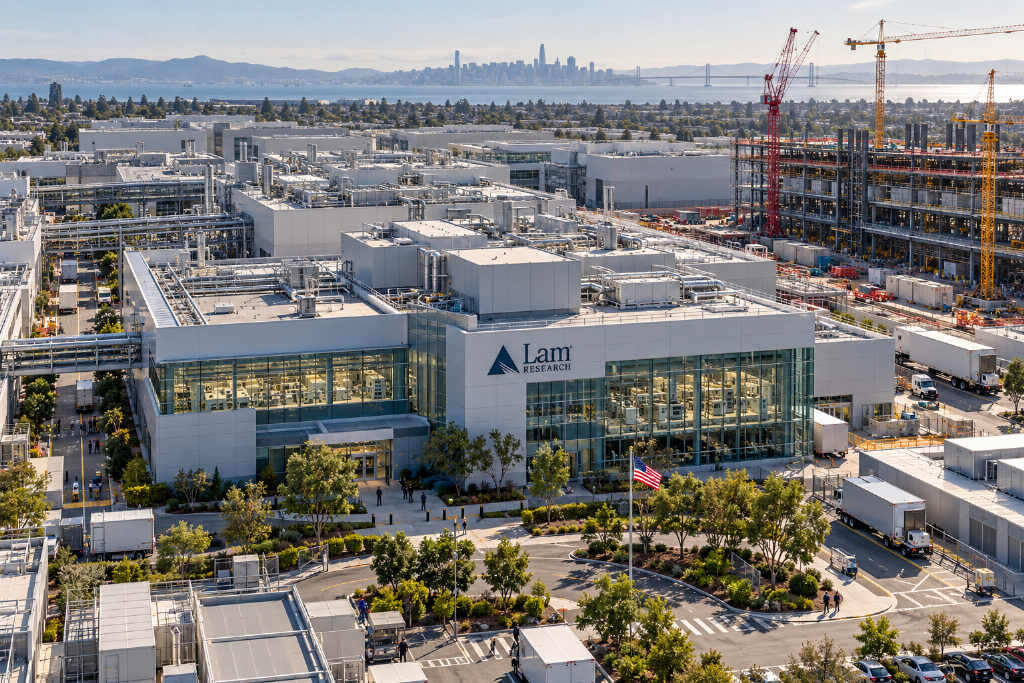
Bernstein said in a report dated Oct. 22, 2026 that Lam Research delivered fiscal 2027 first-quarter results slightly ahead of consensus, helped by stronger systems revenue. The company reported revenue of $8.222 billion, earnings per share of $2.20, and gross margin of 52.4%, a 20-year high. Bernstein maintained its Outperform rating on the stock, but cut its price target to $350 from $385 and reduced its valuation multiple to 30x from 35x.
First-quarter revenue and margins came in above expectations
Lam Research posted fiscal first-quarter revenue of $8.222 billion, above the $8.127 billion consensus estimate and above the company’s own $8.1 billion guide. Systems revenue reached $5.733 billion, up 35% from the prior quarter and 62% from a year earlier, topping the $5.46 billion consensus estimate. Customer Support Business Group, or CSBG, revenue was $2.49 billion, up 1% quarter over quarter and 40% year over year, but below the $2.72 billion consensus figure.
Gross margin was 52.4%, above the 52.1% consensus and the company’s 52.0% guide, improving by about 40 basis points from the prior quarter. Bernstein said the gain reflected a favorable customer and product mix. Operating margin came in at 40.2%, above the 39.8% consensus estimate. EPS of $2.20 was slightly above the $2.19 consensus. The tax rate was 16.5%, higher than the expected 15.1%, mainly because of a higher U.S. tax rate on foreign income and the geographic revenue mix.
Systems growth was led by foundry, NAND and DRAM
Bernstein said the earnings beat was driven by systems revenue. By end market, foundry accounted for 46% of systems revenue, NAND for 26%, DRAM for 20%, and logic plus other for 8%.
- Foundry revenue rose 41% quarter over quarter, supported by leading-edge nodes and advanced packaging, while China mature-node spending declined.
- DRAM revenue increased 17%, tied to wafer additions and process migrations.
- NAND revenue climbed 52% as customers moved to tools for 256-layer and higher devices, with initial spending beginning on 384-layer equipment.
- Logic revenue increased 8% quarter over quarter.
That mix, in Bernstein’s view, explains why Lam was able to beat expectations on both revenue and profitability.
China revenue rose to 35% of total sales
China represented 35% of Lam’s revenue in the quarter, up from 26% in the previous quarter, with revenue from the region increasing by about $1.1 billion sequentially. Other regional shares were 18% for Taiwan, 20% for Korea, 8% for the U.S., 9% for Japan, 6% for Southeast Asia, and 4% for Europe.
Bernstein said the increase in China revenue was driven mainly by domestic customers, while multinational customers in China also remained relatively strong. For the second quarter, the broker expects China’s revenue share to fall meaningfully from the first-quarter level, with domestic customer revenue declining and multinational customer demand staying stable. Bernstein said the higher China concentration looks like quarterly volatility rather than a structural trend.
The report also said spending on mature nodes in China is declining, while spending on leading-edge nodes and advanced packaging is rising, improving the mix. A higher China revenue share can pressure gross margin, but Lam still posted a 20-year high in first-quarter gross margin because customer and product mix offset that drag. Lam’s second-quarter gross margin guide is 52.5%. Bernstein noted that even with a lower China mix and a weaker customer mix, gross margin is expected to stay roughly flat sequentially.
Second-quarter guide matched consensus, with supply-chain constraints weighing on shipments
Management said on the earnings call that supply-chain constraints affected the outlook. Lam guided for second-quarter revenue of $8.6 billion, in line with consensus, though Bernstein said that figure may have fallen short of buy-side expectations. The company guided gross margin to 52.5%, above the 51.9% consensus estimate, and operating margin to 40.5%, above the 39.6% consensus. EPS guidance was $2.33, slightly below the $2.34 consensus, mainly because of a higher tax rate.
Management said the revenue guide already reflects the negative impact of supply-chain challenges and that the company is working through them. Any shipments delayed from the December quarter will be completed in the March quarter. Bernstein said Lam’s outlook would likely have been better without those constraints.
The broker added that the slight EPS shortfall versus consensus was mostly a tax issue, while the gross margin and operating margin outlooks were better than expected. In Bernstein’s view, the supply-chain issue is short term and does not change the full-year trend. It shifts some revenue timing into later periods, with the March quarter expected to absorb the delayed shipments. Lam shares fell in after-hours trading, which Bernstein said partly reflected buy-side expectations for a higher guide.
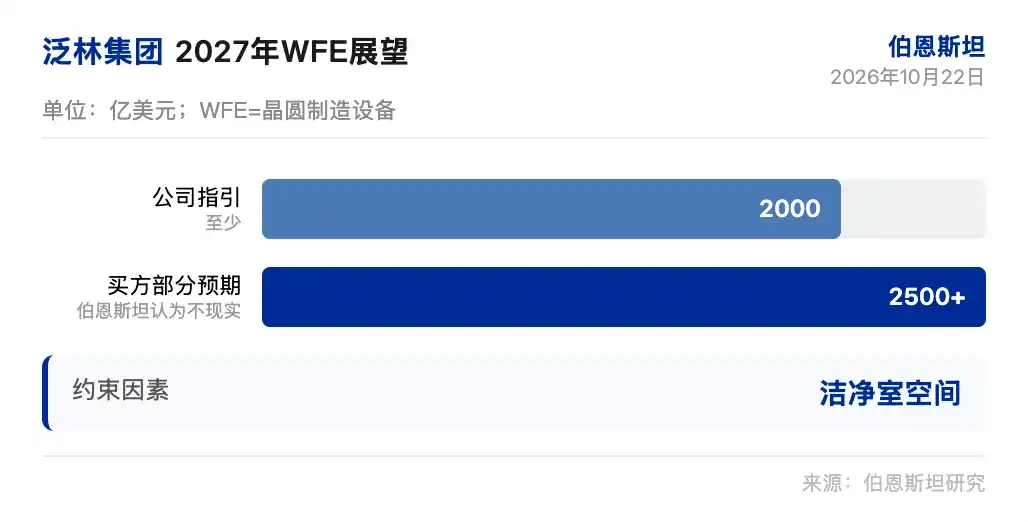
Lam’s 2027 WFE outlook starts at at least $200 billion, but cleanroom space remains the bottleneck
Lam gave its first calendar 2027 wafer fab equipment, or WFE, outlook at at least $200 billion, while management said cleanroom space remains a limiting factor. The company reiterated that it expects to continue outperforming the market, with systems revenue growth of at least 30% and CSBG growth of at least 15%. By end market, DRAM is expected to grow the fastest, followed by advanced logic and NAND, while advanced packaging remains strong.
Bernstein said some buy-side expectations for more than $250 billion are unrealistic because cleanroom constraints make that level difficult to achieve. The report said actual demand is well above the current outlook. As data-center capacity is built out, equipment demand should follow, but fab construction takes time and cleanroom space is the hard cap.
Bernstein also said Lam plans to provide more specific figures on its January 2027 call. As supply conditions and cleanroom availability become clearer, the 2027 WFE number could move higher. Even so, the pace would depend on cleanroom delivery schedules. The report said demand for Lam’s tools is strong, but deliveries are limited by customers’ infrastructure build-out timelines.
Bernstein raised earnings forecasts but cut the valuation multiple
After the quarter, Bernstein increased its forecasts for Lam’s revenue and earnings across the next several fiscal years.
- Fiscal 2027 revenue was raised to $35.2 billion from $34.6 billion.
- Fiscal 2028 revenue was raised to $40.8 billion from $38.9 billion.
- Fiscal 2029 revenue was raised to $47.1 billion from $45.3 billion.
- Fiscal 2027 EPS was raised to $9.62 from $9.22.
- Fiscal 2028 EPS was raised to $11.69 from $10.97.
- Fiscal 2029 EPS was raised to $14.23 from $13.65.
Even with those higher forecasts, Bernstein cut its valuation multiple to 30x from 35x to reflect a WFE environment that remains constrained. Based on 30x fiscal 2028 EPS of $11.69, the broker lowered its price target to $350 from $385. With the stock at $260.81, the target implies 34% upside.
Cash returns, free cash flow and inventory metrics also improved
Bernstein said Lam’s valuation is now close to 25x next-12-month earnings and 20x fiscal 2028 earnings, making the shares more attractive. The company’s cash return profile remained strong. Cash returns in the quarter were $1.336 billion, equal to 41% of free cash flow, and 79% over the past 12 months.
Free cash flow was $3.24 billion in the quarter and about $6.5 billion over the past 12 months. Days of inventory fell to 106, and inventory turns rose to about 3.4x, the highest level in seven years. Lam had $3 billion remaining under its repurchase authorization and plans to continue buybacks in the December quarter.
Report takeaway
Bernstein’s view is that Lam delivered a modest earnings beat, posted a 20-year high gross margin, saw China revenue concentration rise, and issued second-quarter guidance shaped by supply-chain constraints. Its calendar 2027 WFE outlook, meanwhile, is still limited by cleanroom availability. The broker kept its Outperform rating and set a $350 price target.
The ratings, price target, earnings forecasts and related judgments cited here are drawn from Bernstein’s Oct. 22, 2026 research report as summarized in the source material. They represent the broker’s view, not the position of this publication, and do not constitute investment advice. The source material also states that markets carry risk and investment decisions should be made independently.