
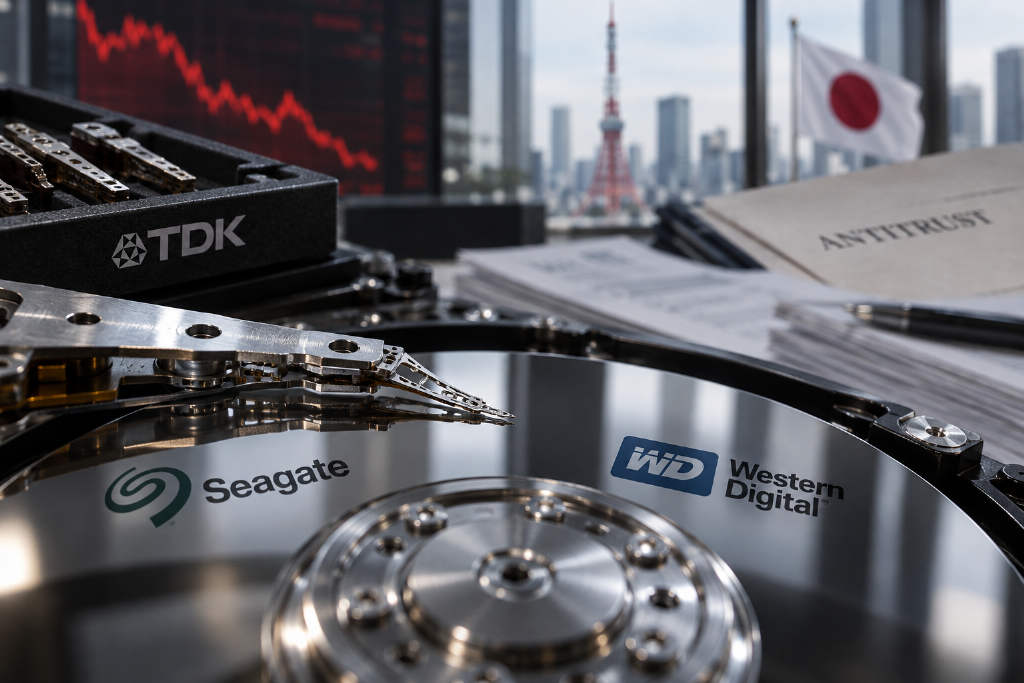
Bernstein said the fight over TDK’s HDD head business does not pose the kind of threat to Seagate and Western Digital that the market appeared to price in after the news broke. That view ran against the day’s share-price move, with Seagate down 9% and Western Digital off 7%.
In a report dated Oct. 7, 2026, Bernstein maintained Outperform ratings on both companies. It kept a $1,350 price target on Seagate and a $770 target on Western Digital. The firm’s central argument was that the direct risk from a potential TDK asset deal is far smaller than the sell-off suggested, because regulatory, financing and supply-chain hurdles all stand in the way of a transaction.
Bernstein says the market fixated on three overstated worries
After Bloomberg reported that Seagate and Toshiba were competing for TDK’s head business, investors focused on three concerns. Toshiba has been more aggressive on capacity expansion. If Toshiba were to win the asset, a vertically integrated Toshiba could hurt Seagate and Western Digital. If Seagate won, Western Digital could end up at a disadvantage.
Bernstein said all three fears were overstated. The report said the story had not been confirmed. While the Bloomberg piece included substantial detail and sourcing and therefore looked credible on its face, the seriousness of any negotiations remained unclear. TDK and Toshiba both denied that any decision had been made and disputed some details in the Bloomberg report, though neither directly denied that discussions were taking place.
The firm also argued that Toshiba would still trail its larger rivals even if its capacity rose. On an exabyte basis, Toshiba holds about 11% of the HDD market. Bernstein said that if Toshiba’s exabyte capacity were to double while Seagate and Western Digital each grew 25%, Toshiba’s exabyte share would rise from 11.2% to 16.8%. In Bernstein’s view, a 5.6 percentage-point gain is not large enough to be alarming. Buying the business would mainly secure Toshiba’s existing head supply rather than directly adding HDD manufacturing output or head production capacity.
TDK is not a critical source of supply for Seagate or Western Digital
Bernstein said Seagate and Western Digital have limited dependence on TDK. TDK accounts for roughly 15% to 20% of the global HDD head market, while the remaining 80% to 85% is largely covered by internal production at Seagate and Western Digital.
The firm estimated that Toshiba represents about 14% of industry head demand, above its 11.2% HDD share, because its drives have lower capacity per platter and therefore require more heads per exabyte. Bernstein said Toshiba alone absorbs 70% to 90% of TDK’s head output. What remains would cover only 1% to 7% of Seagate’s and Western Digital’s combined head needs.
Bernstein also cited company filings to support the point. Seagate has said it designs and manufactures many of the key technologies used in its HDD products, including read-write heads, recording media and other core components. Western Digital has said it designs and manufactures nearly all recording heads and magnetic recording media used in its HDD products. On that basis, Bernstein said TDK may matter at the margin, especially in periods of strong demand, but it is not a key source for most of either company’s production.
Regulatory and financing barriers could block a deal
Bernstein said any bidder would face meaningful regulatory obstacles. TDK is the only independent manufacturer among the three HDD head makers. A successful acquisition by any HDD producer would mean the buyer controls a critical component input for its rivals, a setup that Bernstein said would likely trigger strict antitrust review.
A Seagate-TDK combination looks particularly difficult, according to the report. Bernstein said that pairing would put more than half of global head output under one roof, with Seagate at more than 40% and TDK at 15% to 20%. Toshiba would then have to source heads from one of its two main and larger competitors, while Western Digital would lose an outside supply option as well.
A Toshiba-TDK deal may be more plausible than a Seagate bid, but Bernstein was still skeptical. Seagate and Western Digital make their own heads, yet they rely on TDK to cover peaks in demand. If Toshiba controlled TDK, it could still gain pricing power and constrain Seagate’s and Western Digital’s ability to ramp capacity during periods of severe storage shortages.
Toshiba’s own capital structure is another obstacle. S&P has rated Toshiba’s corporate debt BB. Bernstein estimated that a multibillion-dollar acquisition of TDK would add to existing acquisition debt and come alongside a proposed $380 million in capital spending. Given Toshiba’s weak financial condition and poor execution in HDDs, Bernstein said the deal could turn into a strategic mistake for the company.
The report added that Toshiba’s historical execution in the HDD business has been weak, with capacity expansion and technology iteration lagging peers. Even if it acquired the TDK asset, integration would not be simple.
Outperform maintained on both names, with Seagate preferred
Bernstein maintained its Outperform rating on Seagate and Western Digital. Its $1,350 target on Seagate is based on 21x FY28 earnings per share of $64.40. The firm said improving fundamentals, a five-year compound annual growth rate in EPS of more than 70%, and leadership in HAMR support a 21x multiple and possibly more.
Western Digital’s $770 target is also based on 21x FY28 EPS. Bernstein said Western Digital is largely self-sufficient in HAMR and should be insulated from the headline in any scenario. After the company’s separation, its head business remained self-supplied, leaving it with less marginal dependence on TDK than the market feared.
On risk, Bernstein said both companies face pressure from digestion of hyperscaler cloud capital spending, shifts in hyperscaler purchasing patterns, and NAND improvements that could take share from HDDs. Western Digital also faces the risk that a HAMR transition could weigh on gross margin and earnings per share. If hyperscaler buying patterns change, HDD demand would come under direct pressure.
Bernstein said investors should buy Seagate and Western Digital on weakness, with Seagate as its top pick. That stance assumes a TDK deal either does not happen or does not impair head supply for the two companies if it does. In Bernstein’s view, regulatory scrutiny and Toshiba’s financial constraints make approval less likely.
Report attribution and disclaimer
This article is a整理与解读 by Chaoxiang Research of a third-party brokerage report from Bernstein dated Oct. 7, 2026, combined with public market information. The ratings, price targets, earnings forecasts and related judgments cited in the article are the views of Bernstein’s analysts and represent only the position of their institution, not the view of Chaoxiang Research, and do not constitute investment advice.
Markets involve risk, and decisions should be made independently. The article should not be used as a basis for buying or selling any security.