
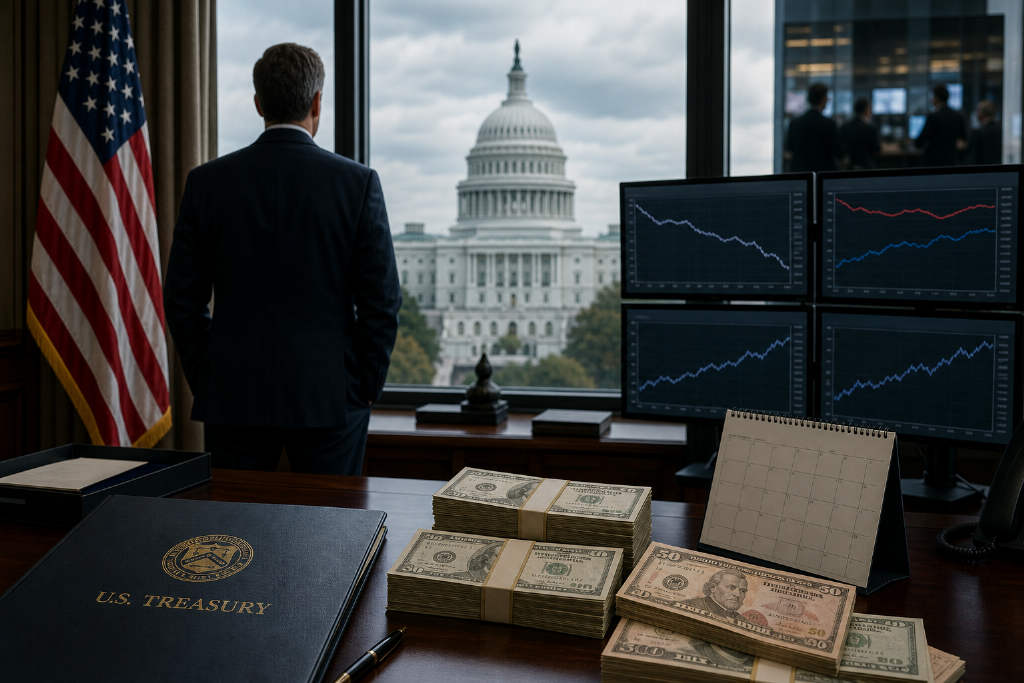
U.S. Treasury Secretary Bessent is being described as trying to force Treasury yields lower through a series of interventions, with the 10-year yield targeted at around 4.3% before the midterm elections. The trade, as framed in the report, is not mainly about changing the market’s structural direction. It is about pressing on a technical weak point: bond shorts held by CTA and trend-following funds that are already close to historical extremes.
On Aug. 25, Fox Business reporter Charlie Gasparino wrote on X that, according to a Wall Street executive familiar with the thinking, Bessent’s aim is to make bond shorts "fearful." The methods described included Treasury buybacks, more issuance of short-term debt, and the cancellation of ultra-long securities such as the 20-year bond. The idea, according to that account, is to first drive the 10-year yield from current levels toward 5%, then use short covering to push it back down.
That framing shifts the focus. Instead of treating the effort as a full attempt to reverse the long-term yield trend, the report presents it as a tactical move designed to buy time.
Buybacks and TGA support have had only limited effect
Debate around Bessent’s Treasury buyback strategy has been building for some time. Critics cited in the report argue that the scale of the buybacks is too small relative to the size of the fiscal deficit, total debt, and still-elevated inflation pressures. On that view, the measures cannot meaningfully change the path of yields on their own.
Price action this week was used as evidence. Treasury yields kept climbing along with oil prices. Only after the Treasury told CNBC that it could use as much as $954 billion from the Treasury General Account, or TGA, as support did yields ease slightly. Even then, the pullback was modest.
The report also says the Treasury’s actions have created friction inside the policy apparatus. According to the account cited, the moves have frustrated Federal Reserve Chair Warsh and weakened his willingness to continue shrinking the Fed’s balance sheet. Market watchers quoted in the piece took that as a sign that the Treasury and the Fed had become tied together, at least to some degree, through their balance-sheet actions.
The reported logic is to buy time, not reverse the trend
Seen through that lens, the strategy becomes more coherent. The report argues that in an environment where deep deficit reduction in Congress looks unlikely, any attempt to permanently reverse the rise in yields would struggle. A much narrower objective, keeping the surface of the market stable through the midterm election window, calls for a different set of tools.
Gasparino, citing a Wall Street executive said to be directly familiar with Bessent’s approach, said Bessent was willing to do "whatever it takes" to pressure bond shorts. The toolkit mentioned in the piece includes buybacks, changes to the debt issuance mix, and the removal of some longer-dated maturities. The report’s interpretation is that the campaign is aimed at the market’s technical setup rather than the deeper drivers behind higher yields.
Goldman points to stretched CTA short positioning
The short-squeeze thesis depends on positioning. Goldman Sachs’ futures desk said in its latest weekly report that CTA and trend-following funds hold sizable short positions across global bond markets, measured at about $155 million in DV01, a gauge of profit and loss sensitivity to a one-basis-point move in rates. In the report’s wording, that leaves short exposure near multi-year highs, while trend signals across major markets have stayed negative for an extended period.
Goldman’s scenario analysis goes a step farther. If the bond market keeps falling, the room for additional CTA shorting is already limited. If prices rebound instead, short covering could become large. Goldman estimated that if prices rise by two standard deviations over one month, the combined scale of covering and renewed buying could reach $150 million in DV01. More strikingly, the report says the amount of short covering associated with that two-standard-deviation move would be the largest on record.
The article adds that CTA bond shorts have been building since the start of the year and are now close to historical extremes. If market signals flip, that could create a self-reinforcing loop, with rising prices forcing more covering and more covering feeding price gains.
A two-month political window and a 4.3% target
Putting those pieces together, the report lays out a relatively clear tactical objective: use interventions such as buybacks and debt issuance changes to lift bond prices, set off passive CTA short covering, and create a positive feedback loop between price gains and position unwinds. The end point, in that telling, is a move in the 10-year Treasury yield down toward 4.3%.
The political timing is also explicit. Roughly two months remain before the midterm elections. If yields fall into that zone before then, the report says mortgage rates could come down as well, giving the Trump administration a policy success story to point to even with oil prices rising and geopolitical tensions still in view.
The report says post-election structural pressure could return
The same analysis also carries a warning. It argues that this approach is about buying time, not removing the forces that have been pushing yields higher. Using oil prices and the Iran ceasefire agreement as examples, the piece says market realities are likely to reassert themselves after the midterm elections. At that point, structural upward pressure on yields and the valuation drag facing equities could come back more forcefully.
Before that happens, investors may need to watch for a concentrated wave of short covering in U.S. Treasuries. Based on signals seen last week, the report says that process could intensify over the next several days.
The original article was authored by Wallstreetcn. PANews said the piece reflects the views of a contributing columnist and does not represent PANews’ own position or investment advice.