
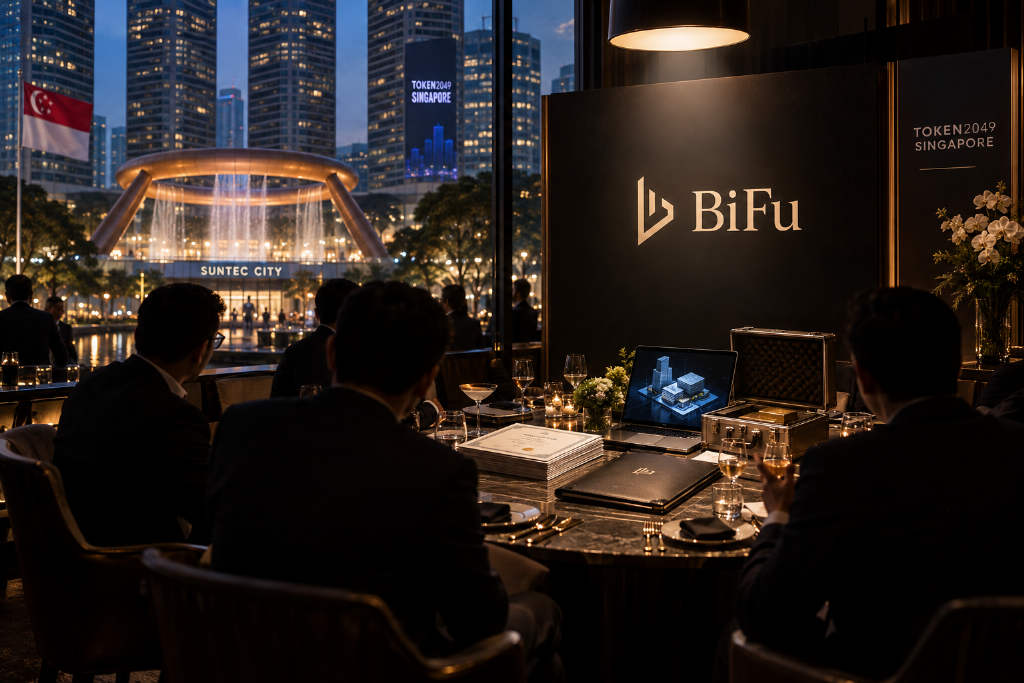
BiFu made its first formal public appearance on Oct. 7 during the opening day of Token2049 Singapore, hosting two back-to-back offline events at Synthesis in Suntec City: a VIP private dinner and a broader industry networking reception. Both were built around the same theme: “Beyond the hype: what is still missing for RWA to achieve real adoption?”

The company said the event started at 6:15 p.m. and the venue was full.
A dinner framed around practical questions, not just the RWA narrative
On social media, the gathering had a simpler label: “BiFu invites you to dinner.” It was, in literal terms, a meal shared with industry participants. But the discussion was aimed at something more specific. Rather than restating the promise of RWA, BiFu used the evening to focus on the practical issues that sit between putting assets on-chain and turning them into positions that users actually hold.
The dinner was invitation-only. Guests included RWA projects and asset owners, trading platforms and multi-asset platforms, funds, market makers and venture capital firms, wealth management institutions and family offices, stablecoin and payments teams, and representatives from Singapore’s local FinTech and Web3 ecosystem. BiFu said the closed-door, small-format setup was intended to support dense and candid discussion instead of another networking dinner built around small talk.
Four speakers, one central question
The main stage portion of the evening consisted of four consecutive talks. Each speaker addressed the same question — what is still missing for RWA to land in the real market — from a different angle: platform design, traditional finance, compliance infrastructure and trading.

Hayek K, CEO of BiFu
Opening the session, Hayek K started with BiFu’s original intent. He said the team has tried many things over the years, but one goal has remained unchanged: the pursuit of “free finance.” In practical terms for ordinary users, he framed that as a set of concrete questions: whether users have more choices, whether they can understand what they are buying, and whether they can decide to participate only after understanding the risks. BiFu, he said, wants to make those choices easier and give users more confidence in making them.
He also said trading carries market risk and leverage amplifies that risk, and that does not change because of any promise. Market direction cannot be controlled by any platform, he said, but BiFu is responsible for how it operates and for the responsibilities that come with that operation.
Describing what BiFu is trying to build, Hayek K used the image of a bridge. On one side are centralized platforms and services that users already know. On the other are on-chain assets, protocols and participation methods. BiFu’s role, he said, is to serve as a middle layer connecting CeFi and DeFi, sorting through the complexity so that suitable users can participate more easily without hiding the risks involved.
He said BiFu is focused on three tasks. First, understanding assets clearly: the company plans to advance fund tokenization and explore RWA, but it will not assume an asset is good simply because it has been put on-chain. Second, designing participation methods properly: around token staking and products that fit wealth-management frameworks, BiFu wants to explain what type of asset fits which mechanism, what need it addresses and what risk the user takes. Third, turning those judgments into actual products. He cited the company’s earlier gold-related products and its planned leveraged funds as part of that effort. He closed by thanking early partners who trusted the company during its cold-start phase, as well as colleagues who stayed with the project and friends who later left.
Thomas Wu, speaker focused on RWA and asset management
Thomas Wu, who has a background in traditional finance and wealth management, approached the topic from an asset-management perspective. As tokenization expands across funds, bonds and equities, he said, RWA is connecting traditional financial assets with on-chain capital and users. The harder question comes after that step: once an asset is on-chain, how does it generate sustained investment demand, trading activity and commercial value?

His central point was direct: tokenization by itself does not create a high-quality asset. Tokenisation changes issuance, distribution and participation, but it cannot replace underlying cash flow, legal rights, valuation discipline or exit conditions. For users, he said, four questions matter most: what they are holding, where the money is going, who is responsible and how they can exit.
Wu also described the complementarity between traditional finance and Web3. Traditional institutions are strong in asset and issuer access, research and pricing, product structuring and risk management. Web3 is stronger in on-chain technology, crypto-native users, wallet and trading experience, and rapid iteration. If the two sides can work together on asset issuance, trading, collateralized financing and structured products, exchanges can become a key hub linking assets, capital and users. He said he recognizes BiFu’s work in fund tokenization and in connecting CeFi with DeFi, and he expressed interest in future cooperation.
Colin Lam of Finloop, head of RWA business
Colin Lam, identified in the event materials by the Chinese name Xinglu, added a compliance and infrastructure view. Citing data, he said on-chain RWA excluding stablecoins had reached about $38.6 billion as of September 2026, roughly seven times the level seen at the start of 2025. He also said multiple institutions project the market could reach the trillions of dollars by 2030.
In his view, compliance is the necessary path if RWA is to scale. Major jurisdictions including the United States, the European Union, Hong Kong, Singapore, the United Arab Emirates, South Korea and Japan have already begun putting regulatory frameworks in place, while non-compliant crypto businesses are facing higher and higher barriers.

Lam said three structural gaps still separate traditional finance from on-chain markets:
- Legal alignment, because jurisdictions do not recognize tokenized rights in the same way.
- System alignment, because blockchains run around the clock while traditional clearing and settlement windows remain relatively fixed.
- Product alignment, because traditional finance offers a wide range of products but clear on-chain pathways remain limited.
Finloop, which he described as a licensed institution holding multiple Hong Kong Securities and Futures Commission licenses, wants to act as a compliant B2B layer that understands both Web2 and Web3 and helps more institutions enter the RWA market with lower barriers.
Harvey Liu, head of asset operations and trader lead at BiFu
Harvey Liu took up what he described as the most practical question and the one users care about most: once an asset is tokenized and listed on a platform, how does a user actually make money from it? In his view, tokenization solves the question of whether an asset can be held, but not whether it can generate returns.
He said a complete return path needs three pieces working together: product, investment and strategy. Product answers whether the asset can be used. Investment answers what to choose. Strategy answers how to execute. None of the three can be missing. He also said Earn products, structured products and RWA each involve different user flows and different forms of risk disclosure, and they should not be treated as the same thing. The first principle in product design, he said, is making sure users clearly understand what they hold.
Liu also drew a clear line around the platform’s role. Helping users pursue returns is not the same as guaranteeing returns. Returns come from underlying assets and the market, not from the platform. BiFu does not make any return promises, he said, and it will not package strategies as “principal-protected” or “high-yield wealth management.” Returns, risks, fees and exits are determined by the underlying asset and the specific product. What the platform can keep improving is the path between users and asset opportunities, making it shorter, clearer and more executable. As he put it, whether users make money depends on the asset and the market, but the return path should be as clear as the asset path.

After the four talks ended, the discussion did not stop. Guests continued to press speakers on the issues they cared about, which BiFu said was exactly the kind of outcome it wanted from the dinner.
The reception opened the room to a wider set of participants
After dinner, the event shifted into a more open industry networking session. The pace was looser than the closed-door discussion and the format was more fluid. Attendees included founders and co-founders of RWA and Web3 projects, ecosystem and growth leads, teams from trading platforms and financial infrastructure providers, BiFu partners, KOLs and content creators, community operators, media, researchers and investment institutions.
Bryan, wealth management specialist at BiFu
Bryan opened his themed sharing session with a simple line: “When opportunity appears, you need to already be there.” He said markets are already global and opportunities already exist 24 hours a day, but user accounts remain fragmented. Trading crypto, buying and selling stocks, and allocating to gold and foreign exchange often happen in separate systems. Time is lost in account opening, transfers and waiting between platforms, and real opportunities are often missed in the process.
He said the real value of RWA is not simply that an asset is put on-chain. The key question is whether it can enter an account that users can understand, trust, choose and actually hold. BiFu Wealth, he said, has already launched products including a spot gold enhanced fund, Stable Yield Fund, FUIDL and an FX steady return fund. The goal is to make opportunities that were previously aimed mainly at institutions gradually accessible and allocatable for a broader group of ordinary investors.

He closed with two phrases: “One Account, Trade the World” and “Be Here, for You.” No matter which market an opportunity appears in, he said, BiFu wants users to already be present. With live performances, prize draws and drinks arranged on site, attendees were able to sit down after a packed day of meetings and talk through the projects they are advancing, the practical problems they are facing and possible directions for future cooperation. The reception had been scheduled to end at 10 p.m., but it continued until after 11 p.m.
BiFu says its RWA products are live and fundraising has begun
BiFu’s decision to make RWA a core topic during Token2049 is directly tied to its own business path. The company said the key to RWA adoption is not any single asset class, but the account and network that carry those assets.
BiFu said the RWA products under its wealth unit, BiFu Wealth, are already live and have entered the fundraising stage. The first batch covers two directions. One is private debt assets with fixed-income characteristics and relatively lower risk, aimed at users seeking steadier returns. The other is primary-market equity projects focused on leading companies in frontier technology sectors such as artificial intelligence, giving users a chance to participate before those companies go public.
According to BiFu, each project clearly displays its risk level, minimum investment amount and real-time fundraising progress. The minimum ticket size is in the range of $10,000 to $20,000. Users do not need to understand complex on-chain mechanics, the company said, and can choose based on their own risk preference and capital plans. In that sense, the experience of participating in RWA is not very different from selecting a wealth-management product.
BiNet and the unified account model
BiFu said that user experience is supported by BiNet, its network for trading across asset classes. The company said BiNet integrates six categories of markets into one account system: crypto assets, foreign exchange, commodities, stocks, RWA and prediction markets. Users complete identity verification once and can then access all six markets with the same account and the same pool of funds, without repeatedly opening accounts and moving capital across platforms.

At the infrastructure level, BiFu said BiNet is built on four unified capabilities: identity, funds, risk control and compliance. It also aggregates liquidity from more than 200 global exchanges and combines that with a sub-millisecond trading engine and smart routing, allowing cross-market trading to run with the continuity of a single market.
BiFu summarized its goal in one line: turning RWA from an industry buzzword into a real position inside the accounts of ordinary investors. The company presented that as its answer to “free finance,” and as the reason this theme sat at the center of its first public night in Singapore.
About BiFu
BiFu describes itself as a next-generation multi-asset trading platform connecting trading, assets and future markets. Through a unified account system, it offers access to crypto contracts, FX CFDs, tokenized stocks and RWA, prediction markets, Earn products and copy trading.
The source article also carried a disclaimer stating that markets involve risk, investment requires caution, and the article does not constitute investment advice. Users should consider whether any opinions, views or conclusions fit their own circumstances, and bear responsibility for investment decisions made on that basis.
