

Binance Alpha has listed MarsCoin, a U.S. stock meme token, in its first new meme listing in more than four months. In a market segment MarsBit says it had earlier expected Robinhood’s chain to lead, the attention has instead shifted to BNB Smart Chain, or BSC.

Why Binance matters in this narrative
MarsBit says leaving Binance out of the original framework was a mistake. The publication’s view is that Binance has spent a long period using Binance Alpha to compete for, and reinforce, pricing power over on-chain assets.
That logic, as laid out in the article, is why BSC-related names deserve attention whenever the market starts to treat U.S. stock meme tokens as a viable theme. MarsBit gives three reasons.
- Binance has the strongest liquidity edge among centralized exchanges. If another CEX tried to lead this trade, MarsBit argues it would be much harder to trigger the same level of retail response.
- Different exchanges have different profit structures, compliance concerns and operating constraints. In MarsBit’s telling, that leaves few competitors with both the incentive and the room to push the theme as aggressively as Binance can.
- Public chains and DEXs have motivation too. The article says Solana would clearly like to recreate the kind of setup seen in 2024, when meme coins from its ecosystem reached Binance. Even so, MarsBit argues that chains and DEXs have fewer tools than Binance, making it inefficient to fight for leadership in a single narrative.
The implication goes beyond this one theme. MarsBit’s broader point is that when a fresh on-chain asset narrative appears, BSC should be monitored early because Binance has both the capacity to move a token and a reason to do so.

Why the upside case still needs restraint
The article does not treat that advantage as a guarantee that every Binance Alpha listing will produce an outsized run. MarsBit points to the recent “打币” theme associated with Solana’s $ANSEM and notes that not every theme gets an Alpha listing in the first place. Even when a token does make it onto Alpha, it does not mean it will reach the kind of heights market participants associate with a life-changing Binance trade.
In MarsBit’s view, short-term sentiment catalysts lose power each time they are repeated. It also warns against building an aggressive U.S. stock meme thesis solely on a post from CZ saying he would buy or sell some meme coins in the coming weeks to test new things. For traders hoping to buy at a market capitalization in the tens of millions and sell in the hundreds of millions, the article says the risk-reward balance still needs to be examined carefully.
Attention is rising, but the theme is still early
MarsBit describes the Binance Alpha listing as positive because it lifts attention around the category. At the same time, it says the market is still overly focused on short-lived attention events, including traffic being split between flap and four, as well as speculation over whether CZ will buy.

That tells the publication two things. First, the narrative does have room to develop, especially now that Binance has shown it takes the category seriously enough to list it. Second, the market still is not treating the theme in a mature way. If positioning continues to revolve around platform diversion and the prospect of a celebrity buy, MarsBit argues, the narrative’s ceiling stays limited.
Without a breakout beyond crypto, the ceiling stays low
The article is direct on this point. In the current market environment, it says, expecting a U.S. stock meme token to reach a $1 billion valuation and then spill liquidity across the market the way ORDI did after climbing to a $2 billion valuation in the inscription cycle is unrealistic. A bigger outcome would require the theme to break out of crypto-native circulation.
MarsBit uses two examples to explain what that kind of breakout looks like.
- When Trump launched a token, many participants already expected the end result to disappoint. Even so, the event carried breakout potential because mainstream media could keep amplifying it.
- pump.fun’s rapid-fire meme style produced plenty of frustration in the market, especially without an airdrop, yet the speed and intensity of the format still pulled in younger users. Many of them arrived through word of mouth from classmates or gaming friends rather than through a conventional crypto narrative.
That is why MarsBit says U.S. stock meme tokens cannot remain framed as just another crypto-native issuance story. Ideas such as airdropping tokenized stocks to holders or layering on DeFi mechanics do not solve the problem because they do not move the conversation outside the crypto audience.

The breakout path MarsBit sees
The article lays out a possible route. As the theme heats up inside crypto and trading volume rises, U.S. stock meme tokens on chains such as Robinhood’s network and BSC could consume the tokenized stock inventory paired against them. Once that on-chain supply is exhausted, more of the corresponding stock would need to be bought in the equity market and minted on-chain.
MarsBit says this is why $GME on Robinhood’s chain once became a focal point. Heavy trading pushed the tokenized GameStop stock on that chain to a large premium. That gap was then narrowed as stock was bought in the equity market and minted on-chain.
The article says a repeat of that setup would likely require one of two conditions. One is coordinated capital aggressively driving a single asset higher. The other is a market-led consensus standard, where a project builds deeper liquidity and a larger pool of underlying stock exposure, giving it more influence on the equity side as well.
Even then, MarsBit says, the most important issue remains unresolved: distribution. The claim that a meme token can catalyze buying interest in a stock has to be communicated to stock traders, not just circulated among on-chain traders.
If the breakout does not happen naturally, asset selection becomes critical
If the market cannot force that crossover organically, MarsBit argues that projects will need to rely on a more practical construction logic. It proposes two filters.
- Would the holders of the paired stock care about the idea that meme-token trading could support the stock price narrative?
- Does the stock itself have enough meme characteristics, whether from its history or from live events around it now, to support fresh meme storytelling?
Using that framework, MarsBit says tokens paired with so-called meme stocks such as GameStop, AMC and Wendy’s have more room for imagination. The article explicitly notes that this label is not meant to say those companies lack real value. The point is that the short squeezes and similar episodes around them are already highly memetic events.
Why GameStop stands out
GameStop is the article’s main case study. MarsBit notes that many people still associate the stock with the retail-driven short squeeze years ago and the trading restrictions that followed. Later, same-name meme tokens called $GME on Ethereum and Solana also surged on the return of Roaring Kitty, another short-lived attention event.
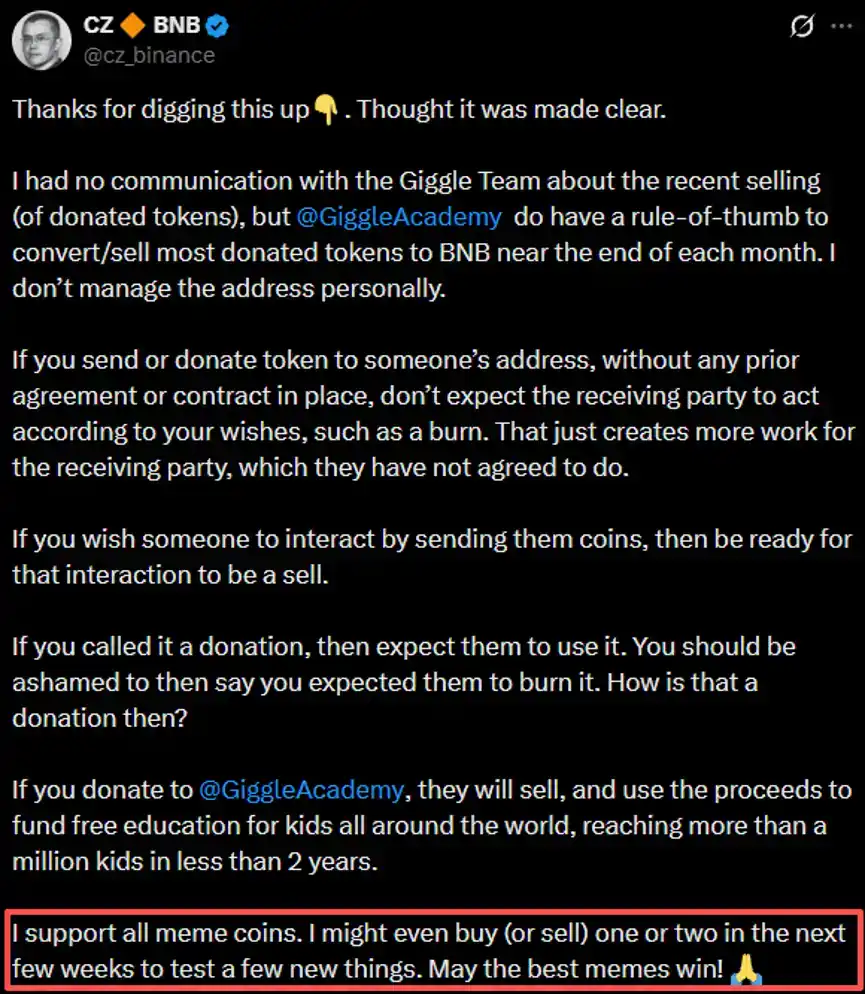
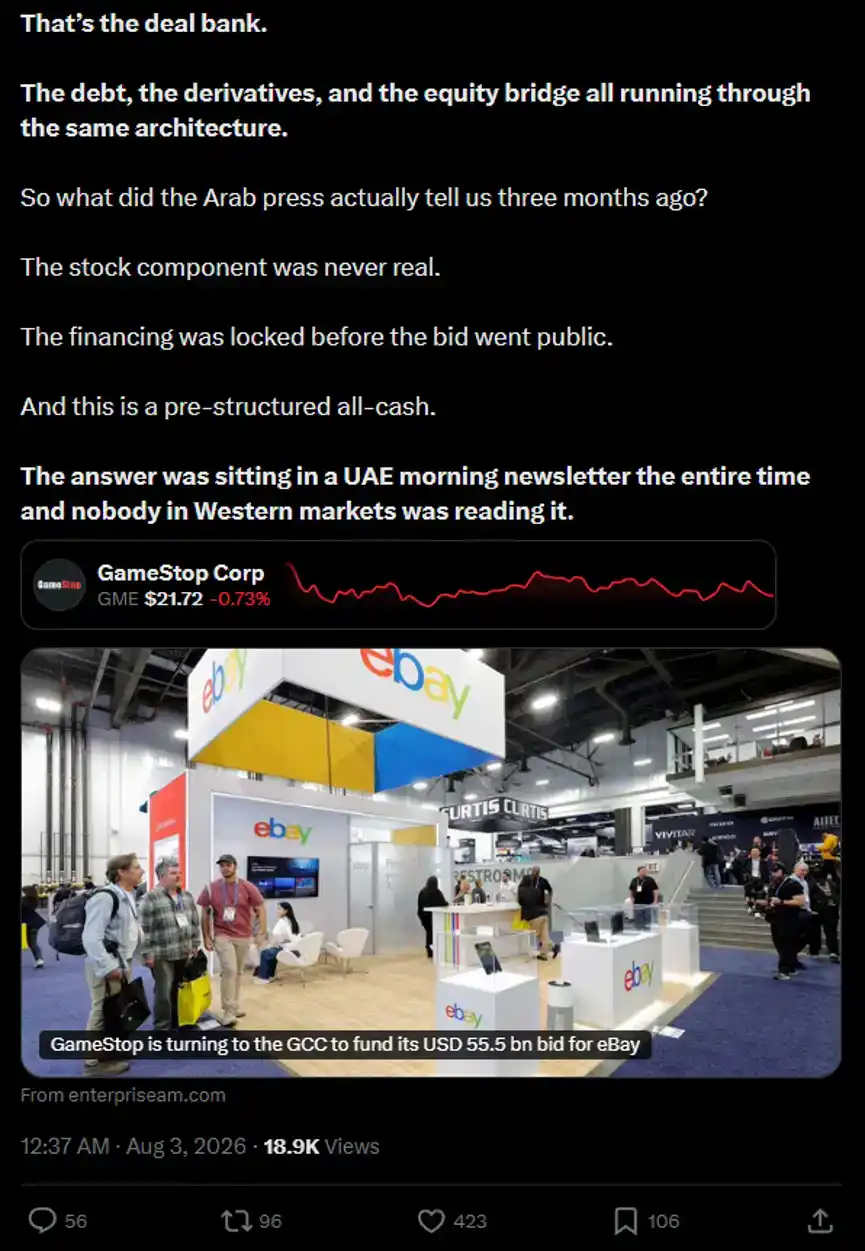
But the article says GameStop still has an active retail audience on X. It points to discussion around GameStop potentially making an outsized acquisition of eBay, an idea many people doubt but supporters continue to promote. It also mentions ongoing analysis of unusual GameStop options activity and continued monitoring of posts from GameStop CEO Ryan Cohen.
In MarsBit’s assessment, those GameStop followers are among the stock traders most likely to be pulled into an on-chain meme ecosystem. The article says even small changes, such as Ryan Cohen’s X account keeping only one follow tied to GameStop, are enough to trigger interpretation among supporters. To MarsBit, the same kind of community-driven posting that crypto meme traders view as ecosystem building can already be seen around GameStop.
Robinhood and Binance are playing different roles
MarsBit says its repeated focus on GameStop should not be read as a directional preference for one ticker. What matters is whether there is a path that can be anticipated and eventually carry the story outside crypto.
On Robinhood, the article says compliance makes it unlikely that the company will directly list assets from its own chain on the main platform. MarsBit adds that Robinhood CEO Vlad appears familiar with meme culture, citing a recent livestream in which $CASHCAT briefly appeared in his recent searches and noting that he sometimes follows projects in the ecosystem. Even so, the article suggests that may be as far as Robinhood can go.
Binance, by contrast, has the strength to recreate a “Binance life-changing trade” version of the U.S. stock meme sector, but MarsBit says there may be little reason for it to push that far. The article compares the setup to a market where one racing game already exists and a major company launches another without needing to bankrupt the first. In the same way, Binance does not need to destroy the original narrative. It only needs to make sure users can participate on BSC as well. MarsBit adds that MarsCoin on BSC is already leading the field by market capitalization.
The article ends with a clear conclusion. If U.S. stock meme tokens are going to produce another large-scale wealth story, internal crypto flows alone are unlikely to be enough. The theme has to break beyond the market’s existing audience. Without relying on the chance arrival of coordinated capital, MarsBit says the cleaner path would be a narrative that stock traders can understand, repeat and help spread.