

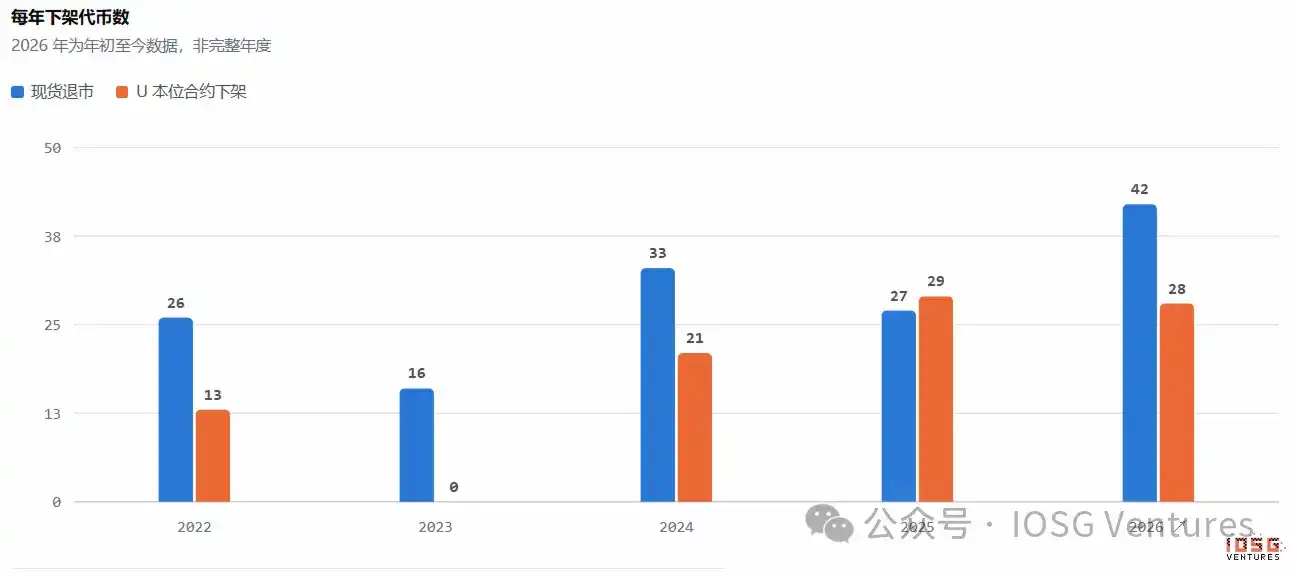
Binance has removed 42 spot tokens and 28 USD-margined perpetual contracts so far in 2026, according to a study by IOSG author Ethan. The report says the spot figure, counted through Aug. 11, already exceeds any full-year total since 2022, and the pace of delisting has been picking up.
The dataset draws from Binance announcements, Binance exchange data and CoinGecko. It spans from Feb. 17, 2022 to Aug. 11, 2026 and covers 144 historical spot delisting events and 150 contract delisting events. The paper focuses on Binance’s 2026 removals and examines token origin, fully diluted valuation, trading volume and open interest to explain what tends to survive on the exchange.
Delisting batches are arriving faster in 2026
The report puts the last eight months at 42 spot removals and 28 contract removals. It says spot delistings have already moved past the peak annual count seen in the prior four years.
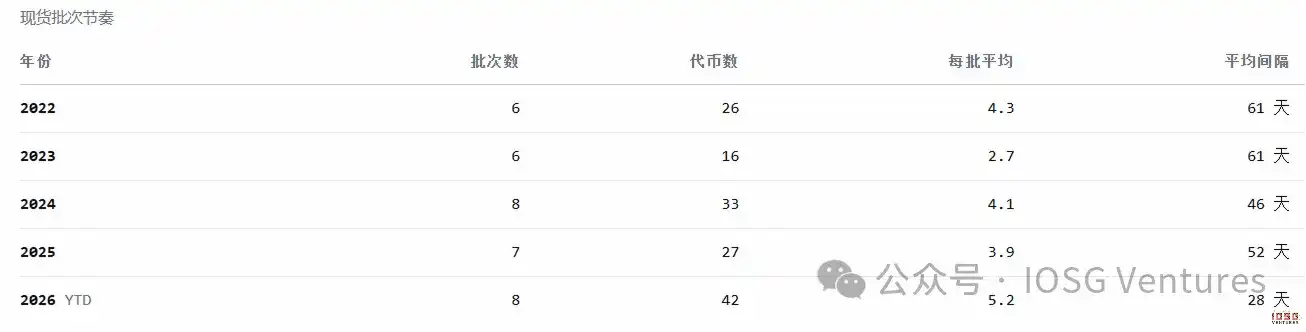
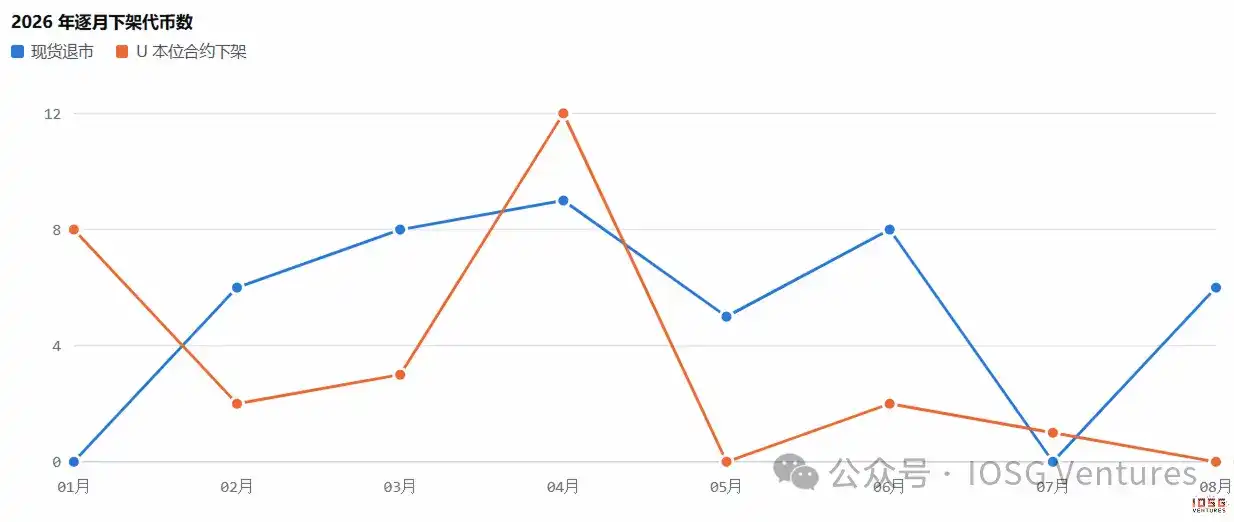
The cadence has changed as well. Binance has issued a delisting batch every 28 days on average in 2026, versus once every 52 days in 2025. Each batch has also grown larger, averaging more than five tokens. Across eight announcements, the gap between batches ranged from 8 days to 44 days. The shortest stretch came between April 9 and April 17, when two batches landed close together and nine tokens were removed in a single month.
Spot is cutting older assets, contracts are cutting newer ones
The median survival time at delisting moved in opposite directions across the two shelves. For spot, it rose from 4.1 years in 2022 to 5.1 years in 2026. For contracts, it fell from 1.3 years to 0.8 years. Ethan’s conclusion is straightforward: Binance’s spot market is clearing out older inventory, while the derivatives side is removing newer listings much earlier.
Among the 42 spot tokens delisted in 2026, 31 had been listed in 2021 or earlier. PIVX, FUN and LRC each lasted 8.6 years. On the contract side, all 28 delisting events involved contracts launched after 2024. Of those, 23 were listed in 2025, and 11 did not survive six months.
The report also breaks down Binance’s historical listing structure. The exchange has listed 1,114 assets in total: 284 appeared only on spot, 474 were listed on both spot and contracts, and 356 appeared only on contracts. Of the contract tokens delisted in 2026, 93% had never been listed on spot.
Ethan describes the difference this way: the contract layer is a low-commitment pricing layer. It is cash-settled, does not require custody and does not amount to endorsement, which makes it easier to list a hot narrative quickly and remove it just as quickly. Spot is different. It carries custody, node maintenance and compliance obligations. In that framing, spot delistings are a cleanup of historical inventory, while contract delistings are a rollback of speculative trial exposure.
The common path is from perps to spot
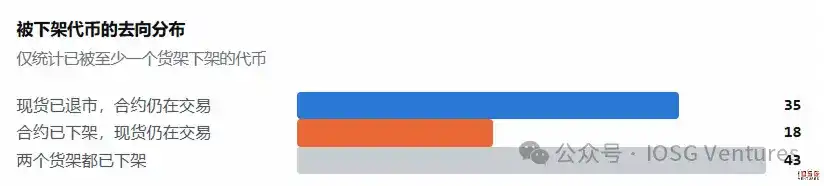
Looking at projects removed from at least one of the two shelves, the report found 35 cases where spot had been delisted while contracts were still trading. The reverse showed up only 18 times. Another 43 projects were removed from both spot and contracts.
The paper summarizes that pattern as “From Perps to Spot.” Its reasoning is that removing spot saves real operating costs and reduces regulatory and reputational exposure. Removing contracts saves less money and means giving up potential revenue tied to volatility, funding rates and liquidations. In other words, an asset whose fundamentals have already run their course may still remain tradable as a pure financial derivative.

Which sectors are disappearing
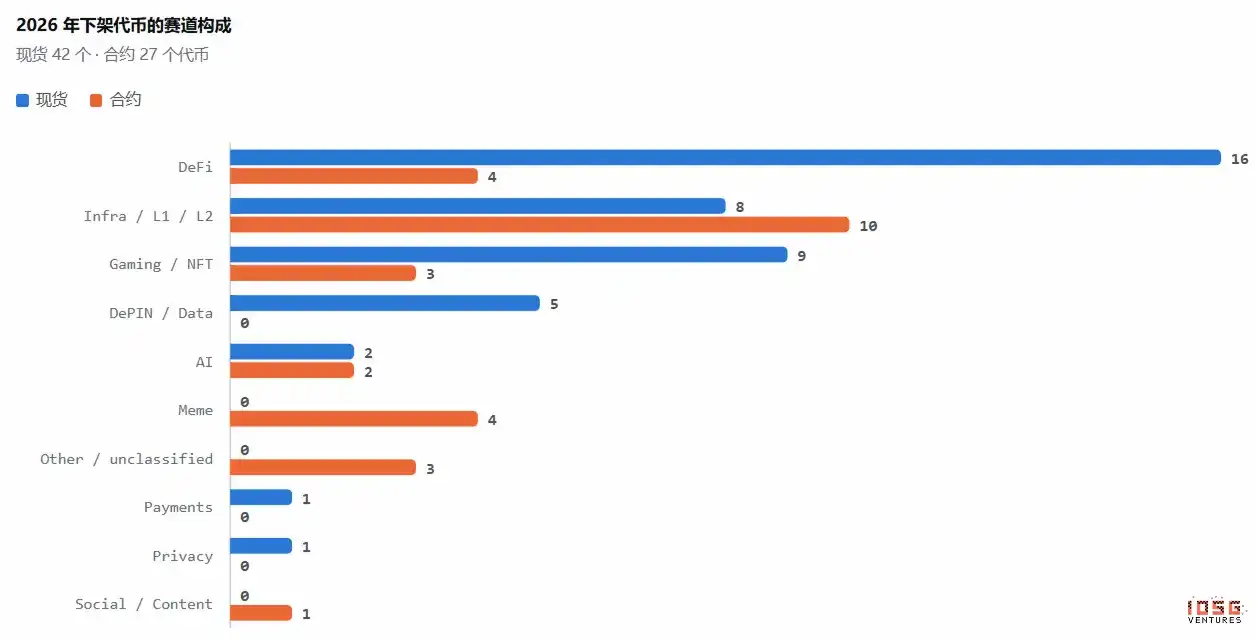
For spot delistings in 2026, DeFi accounted for 16 tokens, or 38%. Gaming/NFT made up 9, or 21%. Infra/L1/L2 contributed 8, and DePIN/Data added 5. The first two groups together were close to 60%, and most of those assets had been listed in 2020 or 2021. Out of the 42 spot removals, 20 came from those two listing years alone.
The contract side looked different. Infra/L1/L2 led with 10 delistings, followed by DeFi with 4 and Meme with 4. The report says the derivatives cleanup has been aimed mainly at narratives from the last two years.
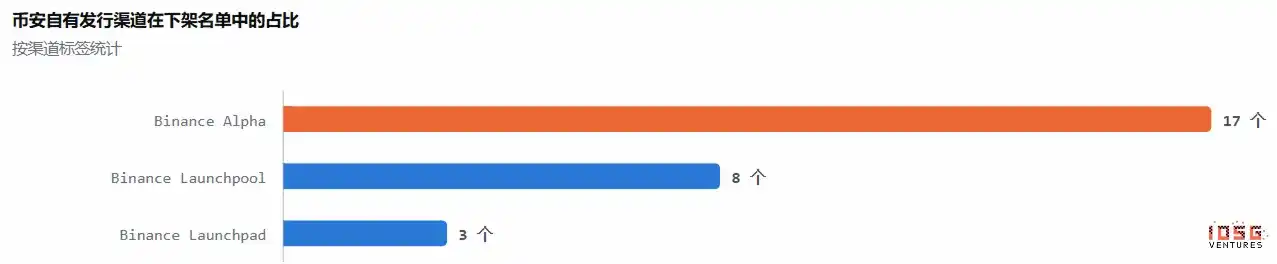
Binance’s own issuance channels did not provide lasting protection, according to the study. Among contract tokens delisted in 2026, 63% came from Binance Alpha Spotlight, including ZKJ, PUFFER, TANSSI and YALA. On the spot side, 11 of the 42 delisted tokens, or 26%, had come through Launchpool or Launchpad, including NTRN, RDNT, HIGH, MBOX and HFT.
The most extreme example cited in the report is A2Z. It was a Launchpad project, listed on spot in July 2025 and delisted in April 2026, surviving eight months. Ethan’s point is that Alpha, Launchpool and Launchpad can deliver distribution and attention, but not a permanent seat on the exchange.
FDV and OI separate survivors from removals better than volume does
For spot, the report compares tokens delisted in 2026 with tokens that remained listed at the time, placing both groups into the same FDV and average daily trading volume buckets.
Its conclusion is that FDV stands out clearly. Spot tokens with FDV below $10 million had a 49% delisting rate in 2026. Tokens above $100 million had a 0% delisting rate. Using $10 million as the threshold, the delisting rate drops from 49% to 16%, a gap that spans two orders of magnitude.
Trading volume did not show the same separation. In the $100,000 to $3 million average daily volume range, the delisting rate was nearly flat at 10% to 18%. The quartile comparison points in the same direction: the median FDV of the delisted spot group was $10.53 million, versus $56.88 million for the still-listed group, a 5.4x difference. Median trading volume was $650,000 versus $1.19 million, only a 1.8x gap.
For contracts, the report focuses on open interest. USD-margined contracts with OI below $1 million had a 31% delisting rate. Those above $20 million had a 0% delisting rate. The median OI of the delisted group was $1.21 million, compared with $3.13 million for the non-delisted group.
Volume again looked less decisive. Even in buckets above $100 million in average daily contract volume, 2.8% were still delisted. The report names COMMON, which had $29.35 million in average daily volume before the announcement, and RVV, which had $2.854 million, as examples of contracts Binance still removed.
Ethan argues that volume is easy to distort through wash trading, high-frequency strategies or rapid turnover. A market can print millions of dollars in daily trades and still be little more than low-cost self-matching noise inside a shallow capital pool. FDV, by contrast, reflects the project’s capital base and ability to absorb selling pressure. OI reflects real margin and capital committed to the derivatives market, which matters for depth and risk controls.
What the report says this means for teams and investors
For project teams, the paper offers three takeaways.
- Artificial volume cannot hide a liquidity drain. Trading generated by market makers or quantitative self-matching is not a shield if capital retention is weak.
- Spot projects need to maintain market value and capital depth. The report gives $10 million in FDV as a reference line. Contract listings need real hedging and speculative capital, with $1 million in OI used as the reference line.
- Exposure from Binance Alpha, Launchpool or Launchpad is only an initial boost. Without a real ecosystem and capital pool after listing, a token can still be removed quickly.
For investors, the report also lists three points.
- Be cautious with assets that show high trading volume but low FDV or low OI.
- Treat spot FDV below $10 million and contract OI below $1 million as high-risk delisting warning lines.
- For older DeFi and Gaming projects, shrinking FDV may signal spot delisting risk. For newer narrative-driven projects from the last two years, weak contract OI may point to derivatives delisting risk.
The report’s main argument is that Binance is removing tokens faster in 2026, but spot and contracts are not being judged by the same standard. Spot is clearing older assets. Contracts are cycling out newer narratives. And in that process, FDV and OI appear to carry more weight than raw trading volume, while Binance’s own launch channels do not guarantee long-term survival.