
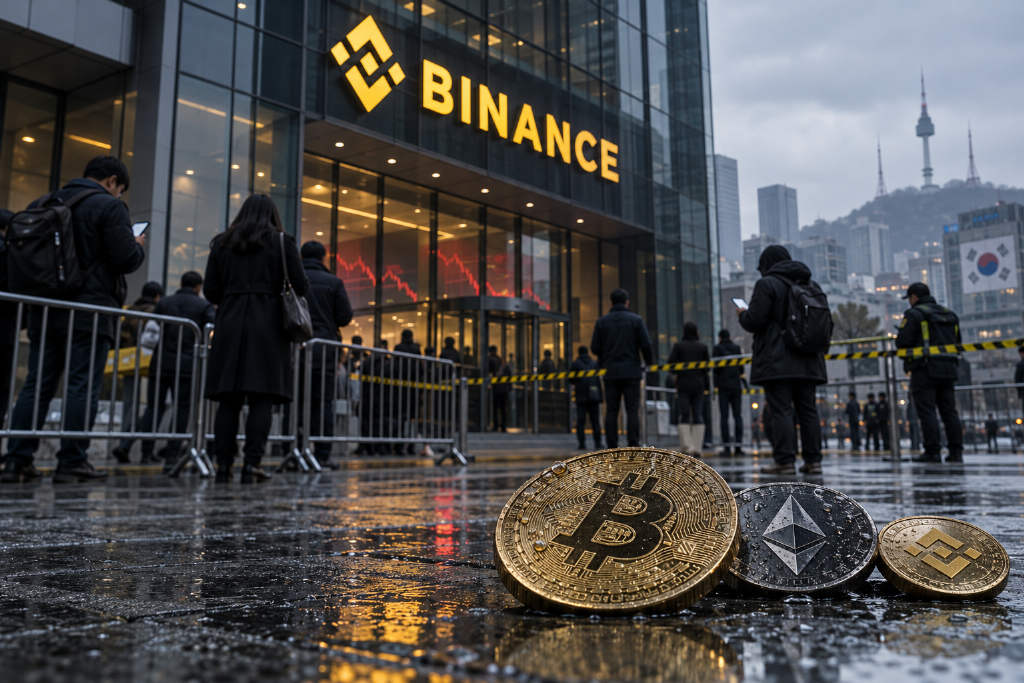
Bitcoin dropped from above $80,000 to an intraday low of $76,460 after a major security incident at Binance shook the crypto market overnight. The move left BTC trading in the $77,000 to $78,000 range after a swing of nearly 5% on the day. The source article said the breach involved an estimated $6.3 billion in assets, and cited blockchain intelligence firm TRM Labs and on-chain investigator ZachXBT as being highly confident that North Korean hacking group TraderTraitor was responsible. The market fear index fell to 30, its lowest reading since August.
Bitcoin tests key support as traders watch the $75,000 area
On the charts, Bitcoin is sitting on a critical zone. A well-known trader cited in the report said BTC is defending its weekly 21 EMA and 365-day moving average, both around $77,000. Below that, the next major support levels were identified near the 50-week moving average at $75,800 and the 200-day moving average around $73,000. Resistance remains stacked at $81,400 and $82,200.
Technical analyst Rekt Capital warned that if Bitcoin fails to reclaim $81,400 on a weekly basis, that level could turn into a firm medium-term ceiling. The article added that a weekly close below $78,200 or $76,800 could open the door to another leg lower. At the same time, it said there has not yet been a true wave of panic selling, and that BTC at $77,000 still leaves 64% upside to the record high of $126,000 referenced in the piece.
Derivatives and options markets also flipped quickly from extreme greed to defensive positioning. Put premiums rose sharply, and the $72,000 to $75,000 strike range drew heavy demand for downside protection. Trader Astronomer said $75,000 is only the first liquidity target for shorts taking profit, while a more durable structural bottom may require a retest of the macro range midpoint at $72,000.
Buyback thesis clashes with caution over unresolved stolen assets
Market views split on what the breach means next. Doctor Profit and Nachi argued that roughly $3 billion in frozen stablecoins will be re-minted and returned. Under their framework, if Binance fully covers losses with its own balance sheet and the SAFU fund, it may be forced to buy back about $1.4 billion to $3.3 billion worth of crypto assets in the spot market. They framed the hack as a source of involuntary net buying and kept a long-term bullish stance.
Geoffrey Kendrick, head of digital assets at Standard Chartered, took a different view. He warned that the market may not be done searching for a bottom until the stolen assets are fully identified and the disposal process is complete.
The immediate focus is the timetable for Binance withdrawals to resume. According to the article, if withdrawals reopen within the next 48 hours without triggering a second wave of runs, the long lower wick formed during the panic could end up marking a major washout low in the broader trend.
Ethereum, BNB and Aave face pressure as on-chain swaps distort pricing
If Bitcoin still has a possible exchange buyback narrative behind it, Ethereum and altcoins were hit more directly by laundering-related flows and capital flight. After Tether and Circle froze more than $2.39 billion in stolen stablecoins, the Binance hacker reportedly began aggressive on-chain repositioning to avoid assets that could be frozen. The article said large amounts of stablecoins, along with tokens such as UNI and PEPE, were swapped into ETH, which could not be frozen in the same way. That pushed localized on-chain ETH pricing close to $5,000 at one point, while gas on a single transaction climbed above $800.
That distorted buying quickly turned into heavy selling pressure. The report also pointed to a separate $2.6 million hack at prediction market Polymarket, which paused trading, adding to the negative tone. ETH fell below the key psychological level of $2,200, while spot Ether ETFs posted $105 million in net outflows on the previous day. Trader Merlijn said ETH is now testing support between $2,100 and $2,300, with resistance at $2,538 and $2,725. A weekly break below $2,100, he said, could send the asset toward $1,850.
BNB fell more than 8% on the day to around $680. Aave dropped 11% to a low of $115 after the article said the hacker used stolen USDT as collateral to borrow ETH, creating bad-debt risk and forcing the protocol to halt new deposits and borrowing. The report added that the hacker still holds more than $1.1 billion in unfrozen ETH and is laundering funds through Tornado Cash.
DEX narrative gains traction as Hyperliquid jumps
While centralized exchanges were under pressure, decentralized trading platforms drew fresh attention. Kendrick said the Binance breach could accelerate a migration of funds toward DEXs that have never been hacked, and that view underpins his conviction that UNI could reach $100 by 2030, a target he said may even be too low.
Hyperliquid stood out as the market’s strongest mover. Its token rose about 20% over 24 hours, broke above $97 and approached its all-time high of $97.96. The catalyst cited in the article was an announcement by Intercontinental Exchange, the parent company of the New York Stock Exchange, that it had invested in Trade[XYZ], a venture backed by Stanley Druckenmiller. The plan, according to the report, is to offer U.S. retail investors crypto, equities and commodities perpetual contracts built on Hyperliquid within a compliant framework. Elon Musk also reposted the news and commented, 「Interesting」.
A Dco report mentioned in the article said Hyperliquid is moving into global traditional finance markets. If it captures 3% market share, HYPE could reach $128 by 2029, with a bullish scenario pointing to $165.
Key market items for the day
- LayerZero Labs’ DVN and Executor stopped providing services for Metis
- Balancer liquidity pools stopped operating, with pools only supporting withdrawals
- Kamino (KMNO) unlocked about 229 million tokens worth about $9.1 million
- Collector Crypt (CARDS) unlocked about 59.26 million tokens worth about $18.4 million
- Upbit 24-hour trading volume ranking: XRP, BTC, ETH, ENA, NEAR
- Spot Bitcoin ETFs: +$17.0719 million, extending net inflows to four straight days
- Spot Ether ETFs: -$105 million, extending net outflows to four straight days
Among the top 100 tokens by market capitalization, the biggest gainers listed were HYPE up 14.1%, ZRO up 3.5%, SKY up 2.7%, QNT up 2.1% and HTX up 1.8%.
Asian chip shares tumble, China growth boards sink, Hong Kong consumer stocks buck the trend
In equities, chip and technology shares across Asia-Pacific came under heavy selling pressure after losses tied to AI spending at major U.S. tech companies and weak guidance from Intel. South Korea’s KOSPI fell as much as 5.6% intraday before closing down 3.53%. Concern over a slowdown in AI infrastructure spending intensified. SK Hynix fell about 7% after Intel warned that demand for AI servers was crowding out the PC memory market, raising the prospect of continued weakness in PCs over the next two years. Samsung Electronics closed about 3% lower after third-quarter chip profit missed expectations and the company still raised capital spending by 60% in the current environment.
Tokyo was hit by the same tech selloff, compounded by a policy turning point at the Bank of Japan. Japanese equities lost about $160 billion in a single day, and the Nikkei 225 closed down 2.12%. The BOJ left rates unchanged at 1.25%, but for the first time in 13 years said inflation had reached its 2% target. It also raised the annual scale of stock ETF sales from JPY 330 billion to JPY 860 billion. Governor Kazuo Ueda tried to play down the significance of the move, and analyst Justin Low said the cautious tone left December rate-hike odds uncertain. Even so, faster BOJ equity selling and the slump in U.S. tech shares combined to hit Japanese electronics names hard.
Mainland Chinese equities also sold off. More than 4,600 stocks fell on the day. The Shanghai Composite lost 1.44% and slipped back below 3,600, while the Shenzhen Component dropped 2.73%. The ChiNext Index and STAR 50 fell 4.13% and 5.48%, respectively. The article said both growth-heavy indexes are down more than 23% this month, and ChiNext has been cut in half from its June high. The market also saw reports that AI unicorn DeepSeek completed a second-round fundraising worth CNY 105.5 billion, drawing participation from state capital as well as nearly 30 major investors including Tencent and CATL. People familiar with the matter, as cited in the article, said the larger raise reflected higher Nvidia chip prices and a defensive response to AI bubble risks, underscoring pressure on computing hardware costs.
Hong Kong stocks diverged. The Hang Seng Index reversed higher in the afternoon and closed up 1.46%, while the Hang Seng Tech Index edged up 0.29%. Domestic consumption names surged, with Mao Geping up more than 13%, Mengniu Dairy up nearly 9.5%, Sinopec up more than 6% and Pop Mart up more than 4%. Technology hardware names remained weak. Lenovo fell more than 7%, GigaDevice dropped more than 8%, Hua Hong Semiconductor lost more than 6%, and Evergrande Property fell more than 17% on its first day back to trading.


