The first thing the market wanted to know was the obvious one: how much did Binance lose.
But the more telling issue in the public record is not the big headline figure. Based on Binance’s preliminary investigation described in the source article, the main risk focus right now is not a confirmed leak of wallet private keys. The trail points somewhere less obvious instead: the signing and authorization path. In that view, the custody race is moving away from raw technical toughness alone and toward a simpler question: can institutional controls be checked by outsiders. And for RWA structures built on off-chain registration, that control layer reaches all the way to the registry itself.
What happened: attention shifted to the signing and authorization chain
The article sets out a timeline drawn from public reporting by Reuters, the Associated Press and TechCrunch. At about 20:30 UTC on Oct. 29, or about 04:30 Beijing time on Oct. 30, Arkham’s CEO said on-chain data was showing unusual activity. Zhao Changpeng, known as CZ, then said the incident “looks like a hacker attack targeting Binance.” Binance said it was investigating. At the stage of those reports, it had not clearly confirmed that funds had been stolen.
After that disclosure, Binance paused withdrawals across multiple networks. Roughly two hours later, the verified amount frozen had climbed to $2.54 billion. Tether and Circle also announced freezing actions. By Oct. 30, Binance said frozen assets had reached $3 billion, and that number could still go higher.
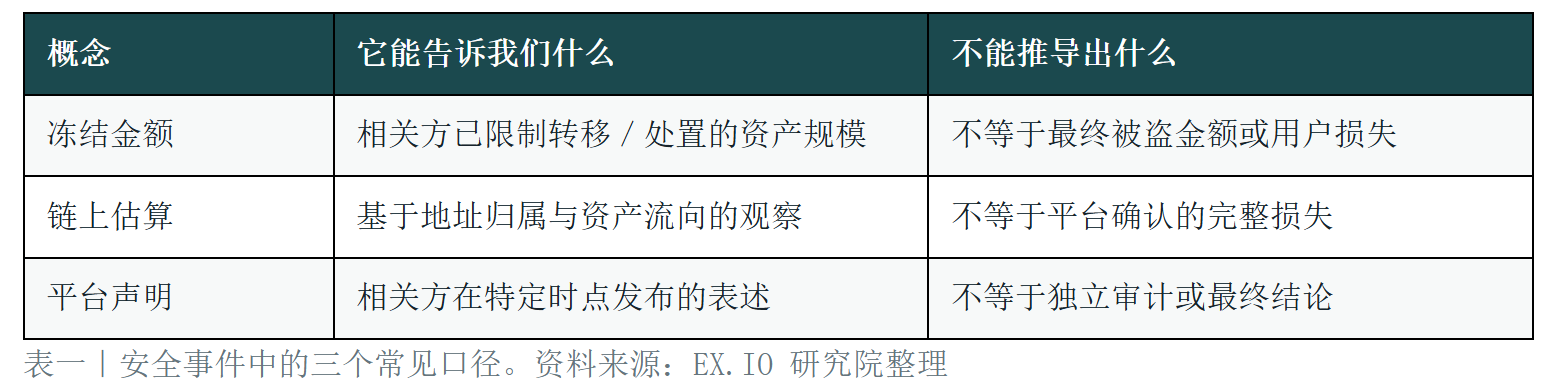
A later preliminary account from Binance, cited by Cointelegraph in an update time-stamped 02:44 UTC on Oct. 30, filled in more detail. The estimated amount of affected assets was about $6.3 billion. The article makes a sharp distinction here: that figure is not the same as final net loss, and it is not the same as user loss. Of that total, about $3 billion had been frozen.
The early lead, the article says, pointed to a DevOps engineer whose laptop had been compromised. From there, the attacker got access to a service container and submitted unauthorized withdrawal transactions. Binance said it had found “no evidence of wallet private key leakage.”
Blockaid’s CEO offered a separate read from the industry side, saying the incident appeared to involve a compromise of signing infrastructure and that he did not think keys had been leaked. But the article is very plain about the status of that remark: it is industry opinion, not an official finding, and the full attack path still has to be confirmed by the final investigation.
Before getting into the figures, the article draws a hard line between ideas that people often mash together. The amount frozen is not the same as actual loss. Taking numbers from different moments, different entities and different counting methods, then calling the sum user losses, is described as the weakest reading of the situation. Start with definitions. That, the article says, is where any serious risk analysis has to begin.
The more lasting takeaway, in the article’s view, is the technical risk focus now exposed by the case. Binance’s preliminary disclosure said there was no evidence of wallet private key leakage. Based on what is public so far, attention shifts to an operational chain running from people to endpoints to containers to withdrawal authorization. Cold storage can lower the chance that private keys are exposed online. It cannot, by itself, wipe out operational risk tied to endpoint security, permission settings and authorization workflows.
Why the fallout may not stop with Binance
Market makers may revisit settlement and counterparty risk
The article argues that market makers may need to rethink how they view settlement and counterparty exposure. Their quotes, collateral and liquidity positions can involve major centralized exchanges. Once a counterparty’s settlement security is in doubt, the issue stops being only how much was lost. It also becomes a question of whether settlement can still happen as expected.
If major market makers grow less willing to quote, bid-ask spreads in related markets could widen and order book depth could shrink. The article frames this as market microstructure scenario analysis, not as an established fact, and says it would have to be tested against spread, depth and position data. Still, the broader point is blunt: the market is being dragged back to the trust layer of infrastructure, and price volatility is only one possible sign of that shift.
Freezeable stablecoins are both a safety net and a limit on power
Tether and Circle both disclosed freezing actions in this incident, and the frozen lists included major stablecoins such as USDT and USDC. The article uses that fact to point out a structural difference that public debate often flattens: assets on the same chain do not all come with the same level of built-in intervention.
For victims and platforms, freezeability can act as a safety net. It buys time. Time for investigation, maybe time for recovery. But for users who care deeply about censorship resistance, the very same feature means the issuer holds a switch that can affect whether an asset stays usable. The article’s point is not that freezing is abstractly good or bad. It asks a narrower, tougher question: does that power come with clear rules, auditable procedures and accessible remedies. The bigger the emergency power, the tighter the institutional limits should be.
A cross-institution loss containment network is starting to appear
The response did not stop at one exchange. Withdrawals were paused, stablecoin issuers froze addresses, custodians cooperated and on-chain analytics teams tracked fund flows. In the article’s telling, risk containment is moving from isolated action to coordinated action across institutions. In this case at least, sector security is shifting from each platform defending itself to a shared push to limit damage.
That kind of network brings its own governance problems. What evidence is enough to trigger a freeze. Who confirms address attribution. How do institutions avoid harming innocent parties. When should users and counterparties be told. If those answers are fuzzy, emergency efficiency can turn into a governance risk all by itself. The article says expectations around custody are changing in the process, from “the exchange says it is safe” to “a third party can verify it.”
The base layer of loss containment is institutional design: EX.IO as the article’s example
If the preliminary facts really point to the signing and authorization chain, then the security boundary of a licensed custodian should not be defined only by heavier cold-wallet architecture. It should also be defined by controls that outsiders can check. The article uses EX.IO, a Hong Kong Securities and Futures Commission-licensed virtual asset trading platform, as its example. It says the discussion relies on public company materials, and that licenses, insurance, audits and control measures should be judged against the latest valid documents.
Authorization governance
Permission tiers, operational logs, withdrawal approvals and limit controls are presented as the core due diligence items for judging authorization and operational risk at a custodian. In the article’s framework, this is the first institutional gate.
Asset segregation
Under SFC requirements for client asset custody at VATPs, client assets are to be held separately through independent accounts or trust arrangements. Whether those assets appear on a company balance sheet should be determined independently under the relevant accounting standards.
Cold storage
The article cites the SFC’s Guideline for Virtual Asset Trading Platform Operators, which says platform operators and their associated entities should, in principle, store 98% of client virtual assets in cold storage, except in cases specifically permitted by the SFC. EX.IO’s public custody page also says 98% of assets are stored in offline cold wallets.
Insurance and audits
According to the article, digital asset custody insurance is provided by OneInfinity, part of OneDegree, with actual aggregate coverage of up to $250.45 million, subject to policy terms and exclusions. It also says a third-party accounting firm carries out regular asset and financial audits.
Expansion of business scope
The article cites a June 2026 EX.IO announcement saying its custody authorization had been expanded to cover virtual assets and tokenized securities that were not traded on its own platform.
The article’s main argument is simple: the trust shock around a major exchange has pushed five due diligence categories closer to the center of institutional decision-making: licensing, segregation, insurance, audits and authorization governance.
It also says Binance’s commitments on loss allocation and any later disclosures should be judged by formal announcements and actual execution. Even if proof of reserves is published, the article says, that would provide only partial asset information. It would not replace a full financial audit. And it would not replace verification of authorization governance. In that sense, disclosure quality is treated as part of the security infrastructure itself. Better, the article argues, to separate confirmed facts, party assessments, third-party estimates and items still under review, while attaching a time and source to each number, than to make some sweeping claim of absolute safety.
When institutional design reaches the registry: the off-chain ledger in RWA structures
If custody answers the question of whether assets can be held safely in one place, some RWA products that use off-chain rights registration raise a different kind of risk question. In those structures, losing control of an on-chain token does not automatically mean the underlying legal claim disappears.
Transfers of native on-chain assets depend mainly on private key control. Lose a private key and the asset may become unusable. Have it stolen and an unauthorized transfer may follow. But in some RWA structures, the legal claim is recorded instead in an off-chain registry maintained by a fund administrator, registrar, or licensed trust or corporate service provider. The on-chain token is a digital representation of the underlying interest, while legal recognition of the right still depends on the registry, the issuance documents and the applicable law.
Under that setup, a lost or stolen private key first appears as a loss of on-chain control. Whether tokens can then be frozen, canceled or reissued, and whether the related rights can be restored, depends on the registry, reconciliation, the terms of the issuance documents and the governing law. It also requires the relevant verification and judicial procedures. Even where those arrangements exist, the article says, they do not guarantee recovery. Different structure. Different risk.
The article says that logic rests on three conditions. First, there must be a verifiable legal link between the token and the underlying asset. Second, the registry must be maintained by an independent third party and reconciled regularly against on-chain balances. Third, the issuance documents must include clauses covering freezing, cancellation and reissuance. If any one of those conditions is missing, the conclusion falls apart. And even if all three are present, recovery is still not assured.
The article is just as clear on the other side: this does not make RWA risk-free. Default by the issuer or manager, the authenticity of the registry, judicial enforcement and secondary-market liquidity risk all remain in play. The difference is that the risk profile stretches beyond a single private-key point of failure and into institutional and counterparty risk.
For RWA products that use off-chain registration, the article says the key distinction is this: tokens may circulate on-chain, but recognition of rights still goes back to the registry and the issuance documents. That may be one of the main reasons this incident could push the market to reassess such structures against native on-chain assets.
Three due diligence questions for institutions
The article ends with a short checklist for institutions weighing custody and RWA exposure. A mature market, it argues, is not one where accidents never happen. It is one where facts can be verified, risk can be ring-fenced and responsibility can be traced when they do.
- Who holds the private keys, and who can authorize withdrawals on a unilateral basis? Are there multisig controls, limits and separation of authorization?
- Who pays if something goes wrong, how much is covered, and what are the policy exclusions? Can the backstop be verified externally?
- Where is the legal claim to the asset recorded? Does it depend mainly on private key control, or on a structure combining an on-chain token, an off-chain registry and a reissuance mechanism?
The source article also carries a disclaimer saying the content was prepared by the EX.IO Research Institute based on public materials for general market information and educational reference only. It says the piece does not constitute investment advice, legal advice, compliance advice, trading advice, an offer, solicitation or recommendation. Information involving third parties, including Binance, was based on public sources and was not independently verified. Some products mentioned, including tokenized securities, are limited to professional investors. The data cut-off was 02:44 UTC on Oct. 30, 2026, and the event was still evolving at that time.