
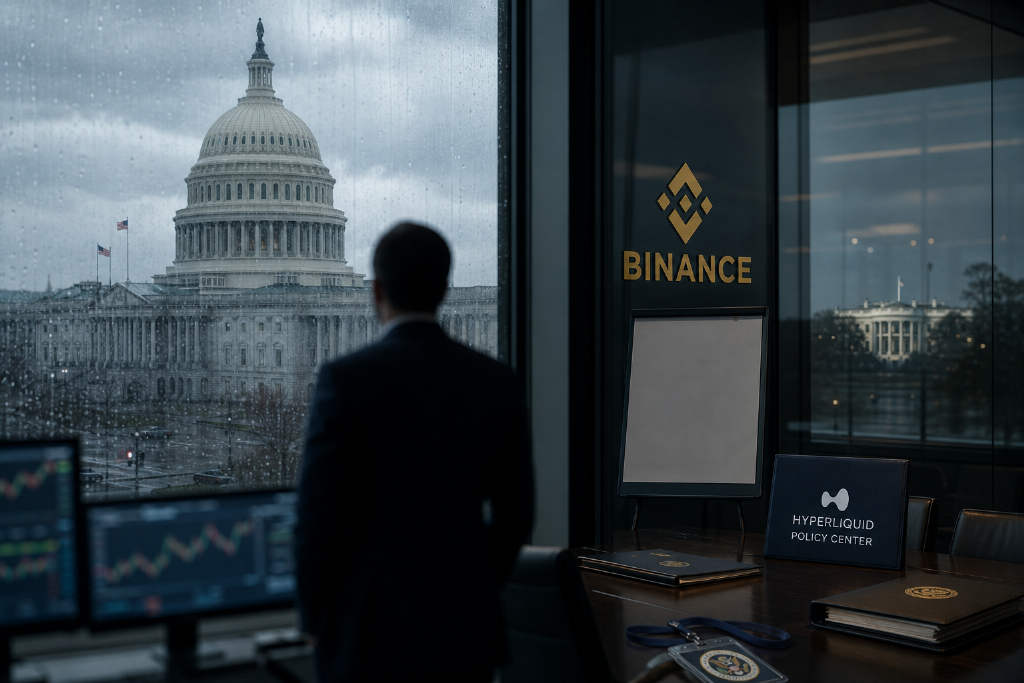
MarsBit contributor Zuoye Waiboshan argues that Binance will not lose to Hyperliquid. It will lose to time.
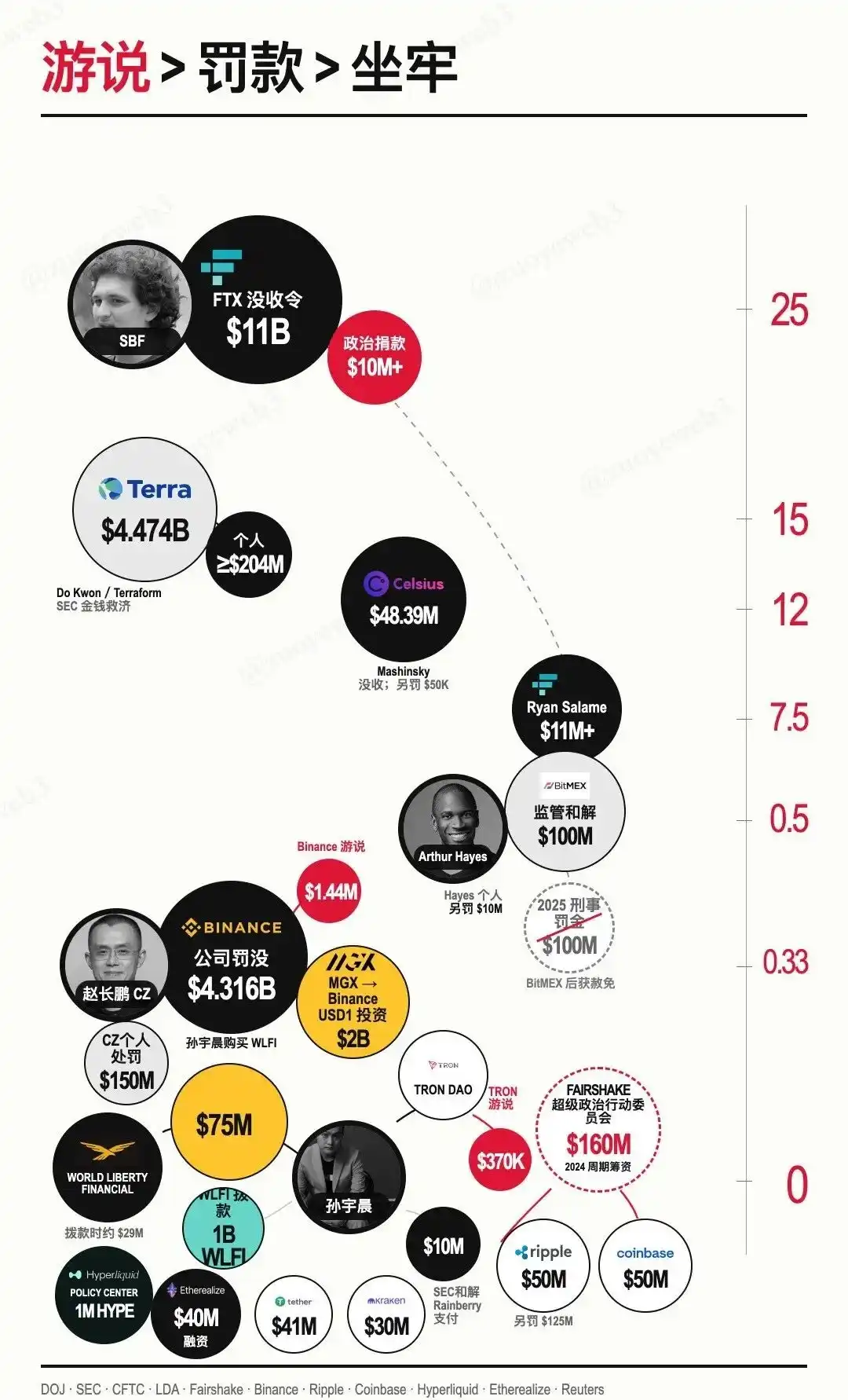
The article frames the issue around shifting ties between U.S. politics and the crypto industry. It says Donald Trump’s second term features a different inner circle from his first, with Natalie Harp and Witkoff replacing the roles once associated with Ivanka Trump and Jared Kushner. According to the piece, Witkoff has acted as a private envoy on matters involving Israel and Iran as well as Russia and Ukraine, while also helping manage family business interests. The author writes that Witkoff also helped Donald Trump Jr. operate the WLFI project, which sold a $500 million stake to the UAE royal family, while CZ invested $2 billion to issue USD1.
The commentary says Witkoff has recently been caught up in a dispute with Justin Sun. One side accuses Sun of trying to dump tokens after an early unlock, while the other says WLFI violates decentralization principles. In that narrative, CZ is pulled in from the side: USD1 is working with Aster on an RWA Perp product, while Binance Wallet has launched the second phase of the Tron Carnival and has tried to delay restrictions tied to HTX.
The article then claims CZ has made a choice, and that Binance’s absence from the CFTC’s IAC meeting reflects it. The author describes that meeting table as a form of official recognition from Washington to the crypto sector, one where attendance and absence both send a message.
From punishment to the fight over compliance
The piece revisits how Justin Sun and CZ started from different positions in 2017. It says Sun went to the United States after finishing Tron’s ICO two days before China’s September 4 crackdown, while CZ moved Binance’s servers to AWS two months after that event. The author presents both stories as examples of cross-border founders shaped by years of operating under shifting power centers, and as people who developed a deep mistrust of authority.
From there, the argument broadens. The article says many people resist order before getting rich, then seek protection from order after getting rich. It also argues that newly wealthy founders have a hard time being accepted by old-money circles in the United States. To illustrate that point, the author mentions Amazon founder Jeff Bezos and Kushner waiting for membership approval from Indian Creek Country Club in Miami, and says the challenge is even steeper for Chinese founders, crypto entrepreneurs and newly rich outsiders.
The commentary also brings up SBF, Arthur Hayes and CZ as three figures who represent different experiences in the U.S. system. It says that although SBF ended up with a 25-year sentence, FTX was once Binance’s largest threat by far, and that even Hyperliquid has not reached that level.
Its central line is simple: if compliance is the game, it has to be played by American rules. The article goes on to say that Justin Sun is still Justin Sun, but Trump is not Warren Buffett. It adds that lawsuits do not necessarily decide political outcomes, because politics is not built around right and wrong. The author sums that up with a sharper line, writing that Sun and Witkoff are not merely fighting a legal case; they are fighting over Trump’s face.
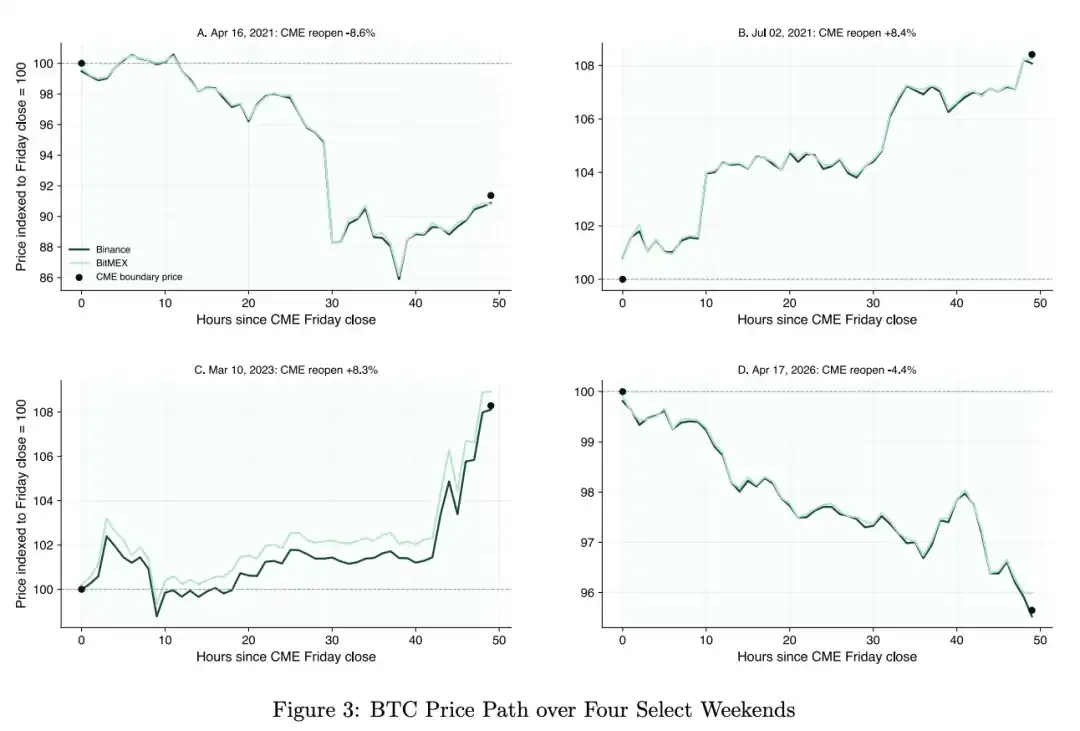
Why the U.S. market still matters most
The article asks whether a license from Abu Dhabi should already be enough. Its answer is no. It describes the proof-of-work era of crypto as manufacturing and the proof-of-stake era as finance, then argues that while earlier fortunes could be made by staying close to China, the current cycle rewards those who can move through the White House and the U.S. regulatory system.
According to the piece, starting in mid-August CZ repeatedly used meme coins such as MarsCoin and Giggle on X, while Justin Sun used the platform to defend the decentralization case for USDD and to attack the team-controlled nature of USD1. The article says the story changed after Trump mentioned Hyperliquid. It openly states that it does not understand why CZ appears to be standing with Sun, but argues that Binance’s first-stage attempt to use Aster against HL has already failed, and that the next contest, access to the U.S. compliance market, will be even harder.
The author also says that even with friction between Binance and the current U.S. administration, the U.K. and the European Union later moved in step against HTX, while Binance delayed related restrictions several times until there was little room left. In the article’s telling, that was not simply an operational issue. It was about alignment and relationships.
Hyperliquid’s lobbying push and Binance’s defensive position
The commentary contrasts Hyperliquid’s policy strategy with Binance’s. It says that in February 2026 the Hyper Foundation donated 1 million HYPE to establish HPC, the Hyperliquid Policy Center. Beyond standard lobbying, the piece says HPC aims to defend compliant U.S. market access for the broader perpetual futures sector and to advocate for crypto under the banner of strengthening American innovation.
The article points to one example. After CME criticized TradeXYZ at an IAC meeting, HPC released a report arguing with data that perpetual products complement CME options rather than displace them. The author says that is what a lobbying organization is supposed to do: not merely open doors, but combine social media work, business development, government relations and coordination across the industry.
Against that backdrop, the piece says CZ has been focused on building BSC in Bhutan while watching HL gain ground in Washington. It does not claim Binance ignored lobbying. On the contrary, the author says CZ’s pardon must have been helped by lobbying spending in the millions of dollars. Even so, the article argues that the more Binance spends, the worse the outcome often looks, because Washington is not its home field. It says Binance provided the largest liquidity support to Trump’s family network, yet still did not secure even a seat at the IAC table, much less a place near the president.
The author’s view is that without the White House there is no real enthusiasm from Wall Street. In that framing, the global financial system is divided into China, the United States and everyone else. The article says U.S. market access is gated in the name of compliance, but the deeper issue is control, one the author compares to the TikTok debate: Washington wants key systems in American hands.
It then turns to Coinbase and Kraken, saying those firms are not especially strong on competition or innovation but can still hold protected ground because of access barriers. That does not make the U.S. market less important. The article argues that Binance cannot give up its share of U.S.-linked liquidity, because otherwise HL will eventually overturn Binance. Binance can operate offshore, it says, and so can HL. But if Binance cannot operate in the United States, HL still will.
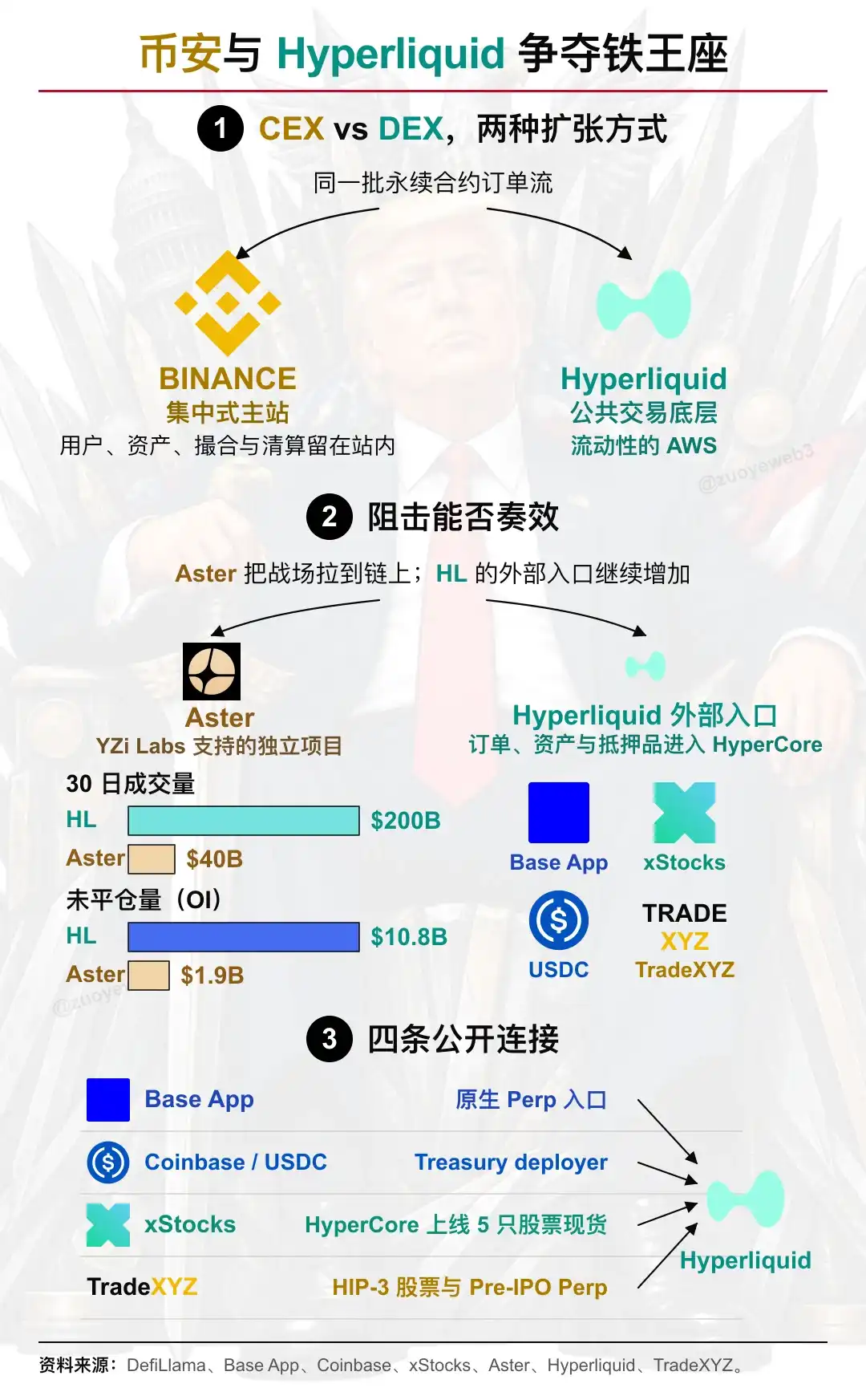
Liquidity, defense and the shape of a post-Binance challenge
The article says that if Binance cannot enter the United States through a compliant route, it at least has to defend its liquidity base. In the author’s telling, Aster is not capable of carrying that burden, Binance.US sits at what the piece calls the “kids’ table” with Coinbase, and the main Binance platform remains shut out of the U.S. market in the near term.
From that point of view, the author says CZ looks increasingly reactive, at times pushing meme coins just to keep attention alive. The article goes further and describes what it calls a de facto anti-Binance alliance: OKX, led by Xu Mingxing, is paired with ICE to fill out derivatives and related trading products for the latter, while HL and Coinbase are trying to use compliance to cap Binance’s momentum.
The commentary says Binance has become “like Alibaba,” meaning the core platform still has fighting power but cannot create a broader group advantage. It adds that Binance has sponsored nearly every major crypto KOL, contributed more than $4 billion in non-tax revenue to the United States, and did so at 40 times the scale of BitMEX, yet received neither recognition nor status in return.
The article also notes that HL’s Jeff is Chinese, and that Trump still gave Justin Sun a chance to face his case in court. For that reason, the author says, it is hard to reduce the issue to simple racism. The piece closes this section with a line that reads more as irony than analysis: perhaps all Chinese are equal, but some Chinese are more equal than others.
The pressure to choose sides in a world that no longer wants a “Peace Hotel”
The final part places Binance in a more polarized international setting. The author says that no matter where the Binance-HL story ends, CZ cannot return to the position he held before “10·11.” At that earlier moment, the article says, Vitalik had already moved with a16z toward what it calls the endgame of L2, while Wall Street is now becoming crypto’s new owner.
The piece says that after the big rally on August 20, every exchange began moving into TradFi under one label or another, whether RWA or DEX. In that market, the author argues, the old rotation between BTC and altcoins no longer defines the cycle. Binance, its wallet and Aster are instead pushed into the USD1 and USDC market from a defensive posture.
The article says the loss of BUSD was Binance’s first visible crack, while HL has already secured a commitment tied to USDC buybacks of HYPE. The author says that at one point the market expected the Coinbase-Circle pairing to use that framework to expand liquidity and check USDT, but the latest picture looks different: the target was Binance liquidity all along. If HL needs a motive, the article says, revenge for JELLYJELLY is the neatest one available.
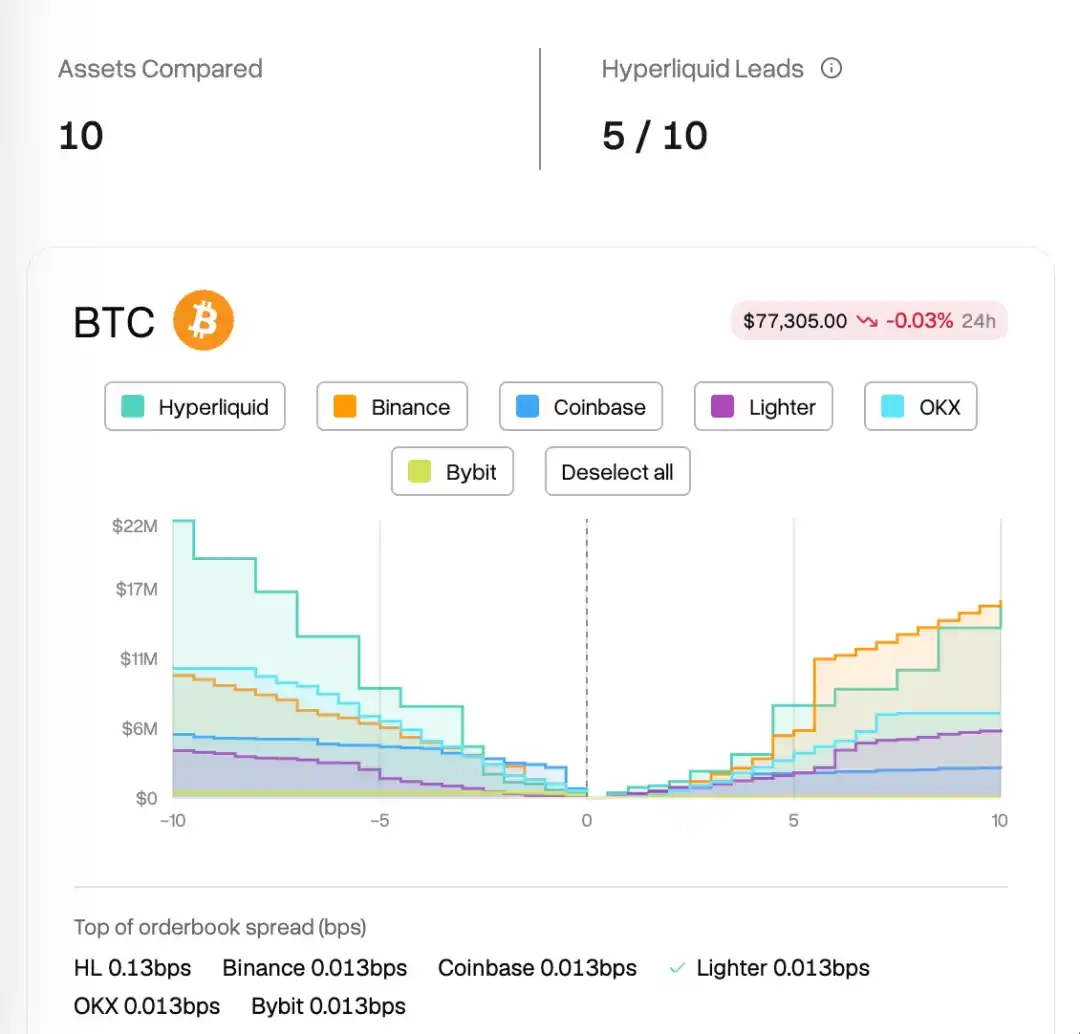
It adds that HL’s depth and spread relative to Binance are no longer novel talking points. HL has already gathered committed supporters, while Binance has to confront a direct liquidity fight. At the same time, the article says Binance has repeatedly lowered VIP standards, the European Union rejected its MiCA license application, and the platform now faces constant pressure to state its position while trying to stay open to all partners.
The author lists several examples: Binance provides user information to Russia, cooperates with inquiries from the UAE involving employees, and faces collective litigation in the U.K. This is not just the ordinary trouble of being large, the piece argues. It is the pressure of alignment. Binance’s strongest asset, its liquidity, also creates the taboo. If it wants to be a “Peace Hotel,” it must receive all kinds of guests.
The article goes on to say that while providing user information to Russia may look unacceptable in the West, Witkoff has visited Moscow more than eight times since 2025. That, for the author, captures Binance’s dilemma. A world that is becoming more divided no longer wants a neutral meeting ground, but no one wants the blame for breaking the peace either. Others would prefer CZ to make the choice first and then absorb the anger that follows.
In that atmosphere, the author says CZ’s only move has been to spread resources across multiple sides. The result, in this reading, is that Justin Sun can strengthen the narrative legitimacy of replacing USD1 with USDD, while the Trump family grows even less satisfied with Binance.
The article adds that compared with failed efforts such as AB Finance, or exchanges like BitMart that faded and later resurfaced, Binance is still extraordinarily strong, almost too strong for the rest of the industry to counter directly. Even so, the market itself has become harder to read. In the author’s words, the old BTC four-year cycle, the quantum-risk debate, and Ethereum L1 mainnet upgrades no longer sit at the center of attention.
Pressure still needs an outlet. During that shift, the article says, Jeff’s task is to concentrate resources on building perpetual futures liquidity, and control has already begun to change hands. The conclusion returns to the opening line: Binance will ultimately lose to time.
The author’s closing note
The article ends on a more reflective note about founders and the eras that shape them. It wonders what would have happened if CZ had retired after leaving prison, and whether Giggle might then have been something more than a meme coin. It also asks whether, faced with old money, Trump, Jeff, Justin Sun and the Abu Dhabi royals, CZ ever misses the card table in Shanghai, the first time he heard about Satoshi Nakamoto’s Bitcoin, and the feeling of precision and elegance he found in the white paper before crypto became, above all else, a road to wealth.
The piece does not offer an answer. Instead it leaves the question open, saying perhaps there is never an answer, and perhaps everything that comes next becomes one. For the author, the market may still search for opportunities in any historical process that could see HL replace Binance. But if Binance does fall, CZ’s story will still be remembered.