
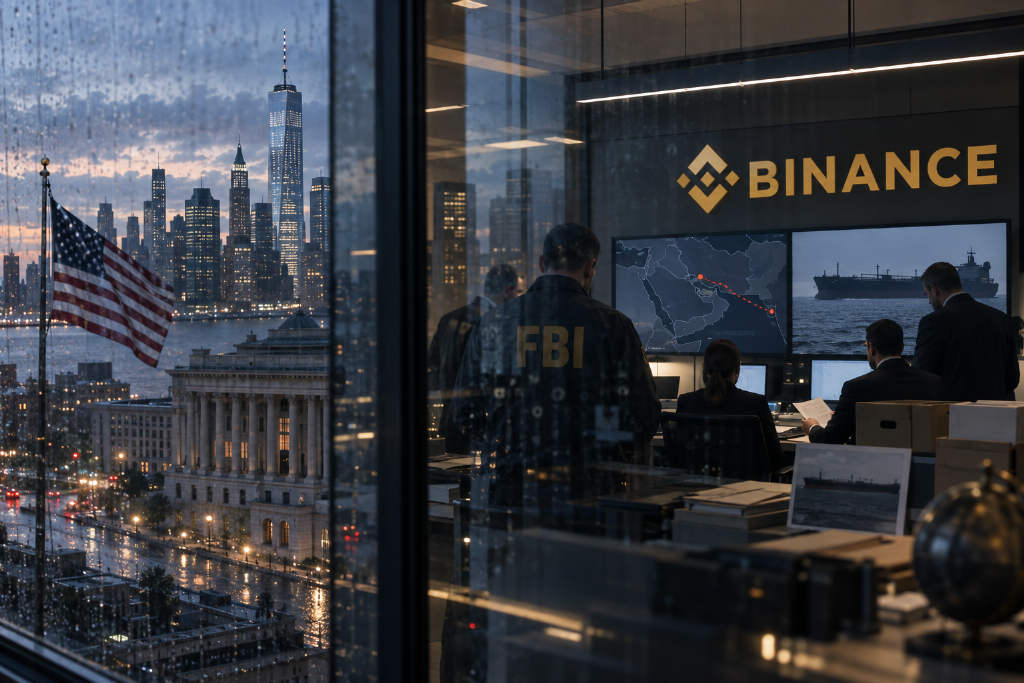
The U.S. Department of Justice is once again investigating Binance, examining whether the exchange knowingly allowed transactions involving Iran to pass through its platform. Bloomberg reported that federal prosecutors are reviewing whether Binance violated U.S. sanctions on Iran by failing to block some trades.
Manhattan prosecutors and the DOJ Criminal Division are involved
The probe is being led by the U.S. Attorney’s Office for the Southern District of New York in Manhattan, with the DOJ Criminal Division also taking part. According to the report, investigators are centered on one question: whether Binance knowingly permitted the transactions at issue.
Bloomberg, citing people familiar with the matter, said prosecutors are examining Binance’s compliance controls, though the specific transactions under review have not been made public. The report added that the investigation could still end without any charges being filed.
Spokespeople for the Manhattan U.S. Attorney’s Office and the Justice Department declined to comment. Binance said in a statement: 「We have zero tolerance for sanctions violations and fully cooperate with law enforcement, continuing to root out and block malicious actors.」
A $61 million forfeiture case surfaced last week
The new probe did not emerge in isolation. Last week, the Manhattan U.S. Attorney’s Office filed a civil forfeiture action seeking to seize $61 million allegedly derived from Iranian black-market oil sales and laundered through Binance.
That filing did not accuse Binance itself of wrongdoing. Instead, prosecutors targeted two Hong Kong-registered companies and alleged that they misrepresented their business activity.
After that action was filed, Binance reiterated that it does not allow transactions involving sanctioned parties and said it would continue cooperating with law enforcement. The two matters arrived close together in time, and both center on Iran-linked money flows.
Binance points to its post-2023 compliance buildout
Bloomberg’s report said this is another round of federal scrutiny tied to Iran sanctions after Binance’s 2023 guilty plea and $4.3 billion resolution in the United States.
In 2023, Binance pleaded guilty after investigations by multiple U.S. agencies, admitting it failed to comply with U.S. banking and sanctions laws. The company agreed to pay a $4.3 billion penalty and operate under the oversight of two corporate compliance monitors. Co-founder Changpeng Zhao, or CZ, also pleaded guilty over failures to maintain an effective anti-money laundering program, stepped down as CEO, and served four months in prison before receiving a pardon from former President Donald Trump last year.
Since then, Binance has repeatedly highlighted its law-enforcement cooperation and compliance spending. The company has said its compliance team has grown to more than 1,500 people, or about 25% of its global workforce.
In a March blog post this year, Binance wrote: 「No exchange can guarantee that risk will never touch the platform. What matters is whether that risk is detected, investigated, mitigated, and reported once it appears.」
Earlier 2026 reporting pointed to more than $1 billion in Iran-linked flows
Another backdrop to the company’s compliance push was an internal investigation reported in February this year. Fortune, The Wall Street Journal, and The New York Times reported that Binance’s internal review found more than $1 billion had moved through the platform to entities linked to Iran.
Binance disputed parts of those reports while also saying it had cooperated with law enforcement and maintained that its compliance systems were robust.
The report also noted that the DOJ has recently taken several enforcement actions tied to Iran as the U.S. and Israel continue to increase pressure on Tehran. For Binance, the world’s largest crypto exchange, any compliance lapse tied to sanctions remains a matter of ongoing legal and regulatory attention.