PANews on Nov. 2 published a daily roundup spanning regulation, protocol incidents, exchange updates, fundraising and market data, with Binance’s expanded fiat withdrawal support and a Talis Protocol exploit among the main items.
Regulation and macro
According to China Fund News, Chinese Foreign Ministry spokesperson Mao Ning said at a regular press briefing that China was "not aware of the situation" when asked by Yonhap about U.S. allegations that North Korea took part in an attack on Binance, the world’s largest cryptocurrency exchange, resulting in about $6.3 billion in stolen assets. The report said the FBI issued related accusations on Oct. 31, and Donald Trump said he would communicate with North Korea if the claims proved true.
Xinhua reported that a decision adopted on Oct. 29 at the fifth plenary session of the 20th Central Committee called for resolute action against corruption carried out through the internet, virtual currencies, cross-border funds and blockchain. The document said authorities should dig deeper into expected-return arrangements, proxy holdings, "white gloves," and revolving-door ties between government and business, while focusing on collusion between officials and businesses and capital infiltration into politics. It also called for deeper development of digital discipline inspection and supervision systems, advancement of big-data oversight platforms for public power, and stronger handling of cross-border corruption cases.
Agence France-Presse reported that Madagascar’s Justice Ministry said 148 Chinese nationals suspected in romance scams, cryptocurrency scams and fake investment fraud in the country had been extradited to China. Earlier reports said Madagascar carried out raids from August to September this year, dismantling 13 scam compounds operated by Chinese nationals. In a single-day operation, authorities seized cryptocurrency worth as much as $52 million and confiscated more than 3,200 electronic devices.
The U.S. Secret Service said it is still investigating a cryptocurrency theft case targeting Binance involving more than $6 billion. The agency said investigators began working with industry partners within minutes of the incident and managed to identify and freeze a large portion of the stolen cryptocurrency. The investigation remains ongoing, with participants including the FBI, IRS Criminal Investigation, the U.S. Attorney’s Office for the District of Columbia, the U.S. Attorney’s Office for the Central District of California, the Department of Justice’s Computer Crime and Intellectual Property Section, and the DOJ National Security Division. It also released a list of addresses that hold or previously held assets tied to the case.
Yonhap reported that the Bank of Korea has started monitoring the market and asked banks and securities firms to provide updates on crypto-related business progress and risk assessments. On the 23rd of last month, the central bank sent requests to 18 banks and 13 securities firms, including the five major banks KB, Shinhan, Hana, Woori and NH Nonghyup, for a survey on the status of financial institutions entering the virtual asset market. The survey covers organizational structure and budgets, market entry status, business risk assessments and risk management measures. It also asks about the potential impact on financial institutions if the country’s largest virtual asset exchange suffers a major hack and operational disruption, if assets such as bitcoin see sharp price declines and prolonged volume contraction, or if other financial institutions incur major losses from virtual asset-related events.
CoinDesk reported that crypto industry super PAC Fairshake has spent nearly $56 million to block former Senate Banking Committee chair Sherrod Brown, a Democrat, from winning Ohio’s Senate race. Adding $7.2 million from a PAC backed by the Winklevoss twins, the industry’s spending tied to Tuesday’s vote stands at about $63 million. Over the past two years, total industry spending against Brown has exceeded $100 million. Polling showed Brown narrowly ahead of incumbent Senator Jon Husted within the margin of error, while Kalshi put Brown’s win probability at 68%. Analysts cited in the source said that if Democrats retake the Senate, Brown could chair the Agriculture Committee and Elizabeth Warren could lead the Banking Committee, affecting progress on market structure legislation.
Project updates
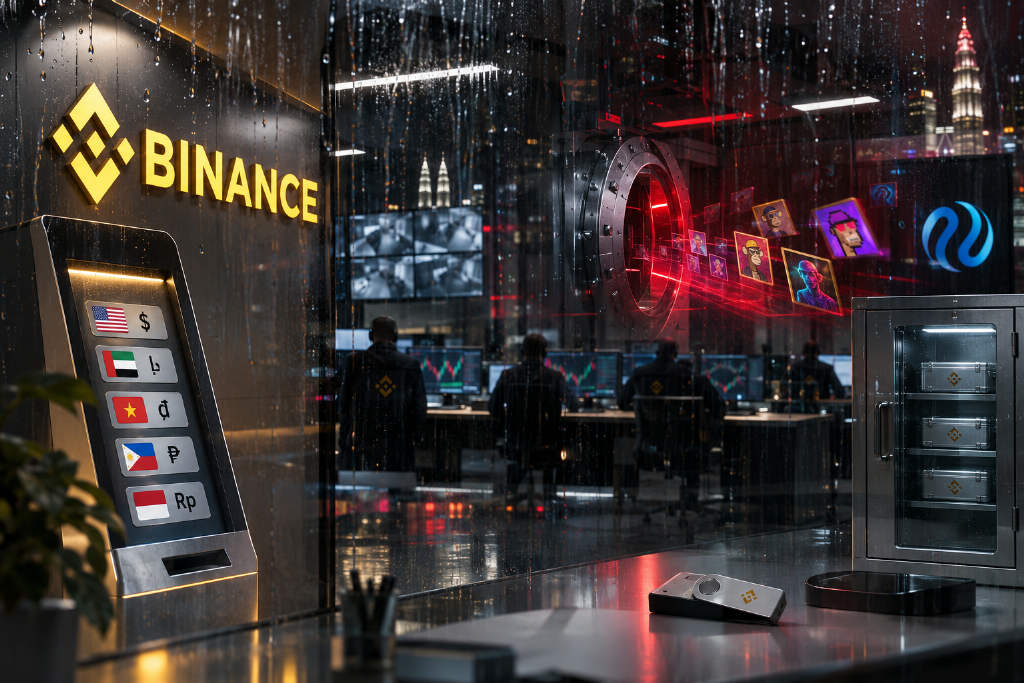
Binance said fiat withdrawals now support USD, AED, VND, PHP and IDR. Existing supported currencies include JPY, VES, BRL, MXN, ARS, BHD, KZT, EUR, CHF, CZK, HUF, KWD, PLN, RON, SEK, CDF, KES, SLE, UGX, XAF, XOF, ZMW and KGS.
Elon Musk said in a reply on X to a user asking why Grok Bot usage limits were being exhausted so quickly that Grok Bot’s operating costs are unsustainably high relative to its revenue. Earlier reports said xAI’s Grok now supports payments through China UnionPay and Alipay, with users saying the first month of subscription is offered at half price.
THORChain said a one-block Ethereum reorganization on Oct. 31 caused it to mistakenly pay out 10 ETH that had never actually arrived. Its automatic solvency check was triggered immediately and paused ETH swaps. Within about two minutes, node operators halted ETH transaction signing, then paused all related chain transactions as a precaution. THORChain said the 10 ETH has now been voluntarily returned by the user and the vault is solvent again. Trading remains active for AVAX, BASE, RUNE and XRPL, while ATOM, BCH, BSC, BTC, DOGE, ETH, LTC, SOL, TRON and ZEC are paused. The development team is working on a fix, and node operators will decide whether to re-enable each chain after confirming safety. THORChain added that the emergency pause mechanism is controlled by node voting and does not give nodes control over assets.
Talis Protocol said attackers exploited a vulnerability on Oct. 31 in its marketplace and auction contracts on Injective, stealing about 5,700 escrowed NFTs and selling them through public collection bids. The team has paused new listings and auctions on Injective and returned more than 26,000 NFTs from the contracts to their original owners. New listings and auctions on other chains have also been paused while fixes are being deployed. Talis said it has recorded all affected NFTs, the owners before the theft and the executed bid information, and is preparing a plan to return NFTs to original owners and compensate bidders. A full post-mortem will be released later.
Binance said it has restored withdrawals for the following networks and assets: BTC on the BTC network; ETH, USDT and USDC on the ETH network; BNB, USDT and USDC on BSC; XRP on the XRP network; and ETH and USDC on Base. The exchange said other assets and networks will be restored in phases after security checks are completed, with updates to be published through official channels.
Binance co-founder He Yi posted twice on X warning users about new scams and phishing tactics appearing during the current disruption. In a post she reposted, scammers were said to be using Telegram’s GRAM transfer function to send small amounts of GRAM to users, attaching a fake "Binance official announcement" in the transaction details claiming Binance had been hacked and user assets were unsafe, then urging users to move funds into a supposed "Binance vault." She also warned that after Binance resumed withdrawals for some tokens, attackers sent "poisoning" transactions to many addresses using lookalike beginning and ending characters. Users who copy addresses directly from transaction history, or whose clipboard is altered by malware, could send assets to attacker-controlled addresses. She said withdrawal addresses should be checked in full before transfers are made.
BTCPay Server said on X that it has received reports that hot wallets on multiple BTCPay Server instances are being drained by unauthorized attackers. It advised users running instances to shut down servers immediately before the investigation is completed by executing ./btcpay-down.sh. The cause of the attack and the scale of losses have not been disclosed. On Oct. 29, BTCPay Server released emergency update 2.4.7 to fix one critical and several medium-severity security vulnerabilities.
He Yi also denied rumors that a Binance engineer was robbed because of a romantic relationship with a North Korean spy. In a post on X, she said the claim was "more dramatic, but not true," and that ZachXBT had not said that. Earlier, the X account AlphaWire posted that there were unverified allegations that a Binance DevOps engineer had a romantic relationship with a North Korean operative and left a laptop unattended on the day of the attack. The claim circulated online as if it came from on-chain investigator ZachXBT, but the original statement had not been independently verified. The post had been viewed more than 220,000 times.
StandX said DUSD airdrop claims opened at 8:00 on Nov. 2 and will close at 16:00 on Dec. 31. Earlier reports said StandX had launched an airdrop query portal.
He Yi said Binance community reward activities still require regulatory approval before launch and that there is currently no voucher campaign.
Binance said on X that withdrawals for SOL, USDT and USDC on the Solana network have now resumed. It had previously restored withdrawals for selected assets on BTC, Ethereum, BSC, XRP, Base, DOGE, Optimism, Arbitrum and TRON, and said other assets and networks would return in phases after security checks.
OKXICE TSV, the tokenized securities trading platform jointly launched by OKX and Intercontinental Exchange, said in an Oct. 30 update that the number of issuers opposing tokenized trading of their shares on the platform had risen to 50. That compares with 33 disclosed on Oct. 27. Newly added companies include Nvidia, Walmart, Eli Lilly, Micron, Costco, Nike, CrowdStrike, Palo Alto Networks, Reddit, Hewlett Packard Enterprise, Corning, Cigna, Carnival Cruise, Arcos Dorados, IREN, USA Rare Earth and Bloom Energy. Earlier, crypto reporter Eleanor Terrett cited sources saying Nasdaq representatives had advised listed companies to oppose tokenized trading on OKXICE.
Symbiosis said it detected an attempt by the Binance hacker to move funds through the protocol and is in contact with Binance.
Binance also restored withdrawals on the DOGE and Optimism networks.
Fundraising
RoboScience announced the completion of an A2 round worth several hundred million yuan, co-led by Amber Capital, Hongruida Investment and Shanghai Semiconductor Industry Investment, with participation from Shuang Capital, 360 Strategic Investment, Guolian Tongbao, Jinding Capital and platforms tied to multiple listed companies.
On-chain stock trading platform StableStock recently completed a new strategic financing round at a $75 million valuation. Participants included Amber, Nomad Capital, Flow Traders and Gate. In August last year, StableStock completed YZi Labs’ Easy Residency incubation program and closed a seed round backed by YZi Labs, Matrix Partners and Vertex Ventures.
Views and analysis
One analysis said previous bitcoin cycle bottoms all appeared shortly after U.S. midterm elections, making the period from the end of this year to early next year a possible bottom window.
Galaxy Digital head of research Alex Thorn said bitcoin has closed above its 50-week moving average for a seventh straight week despite a hack of more than $6 billion at the world’s largest cryptocurrency exchange.
Key data
CryptoRank data showed ETH fell 16.1% in October 2026, making it the second-worst October for ETH since 2016. The decline also ended a three-month streak of gains.
Spot bitcoin ETFs recorded net outflows of $203 million last week, with Fidelity’s FBTC leading the outflows at $166 million.
Spot ether ETFs recorded net outflows of $432 million last week, marking a fifth consecutive week of net outflows.
Binance said on X that it resumed withdrawals in phases starting at 14:00 Beijing time on Nov. 1, and by 20:36 all 15 networks and assets in the first phase had been fully restored. From 14:00 to 23:30 on Nov. 1, Binance processed $4.649 billion in withdrawals and $1.01 billion in deposits, for net outflows of about $3.64 billion. It said that represented 2.10% of its $171 billion in total assets, based on proof-of-reserves data from Oct. 28. Binance said withdrawal volume spiked at first and then eased and stabilized, while deposits remained elevated. A new proof-of-reserves snapshot was completed at 8:00 on Oct. 31, and an updated report is expected on Nov. 2. Remaining networks and assets are still being tested, and the next phase will be announced as soon as possible.
Token Unlocks data showed BTW, KITE, ENA, MMT and AVAX are set for major unlocks next week. BTW will unlock about 101 million tokens at 16:00 Beijing time on Nov. 2, equal to 3.37% of circulating supply and worth about $114 million. KITE will unlock about 640 million tokens at 21:00 on Nov. 3, equal to 17.42% of circulating supply and worth about $75.6 million. MMT will unlock about 252 million tokens at 8:00 on Nov. 4, equal to 294.38% of circulating supply and worth about $32.3 million. ENA will unlock a combined roughly 134 million tokens next week, worth about $25.4 million. AVAX will unlock about 1.67 million tokens at 8:00 on Nov. 8, equal to 0.30% of circulating supply and worth about $14.7 million.
Another analysis said the Binance hacker laundered about $242 million through TRON within two days.
Unitree Technology at one point fell by more than 10%.
Hyperliquid’s total withdrawals surpassed $100 billion.