
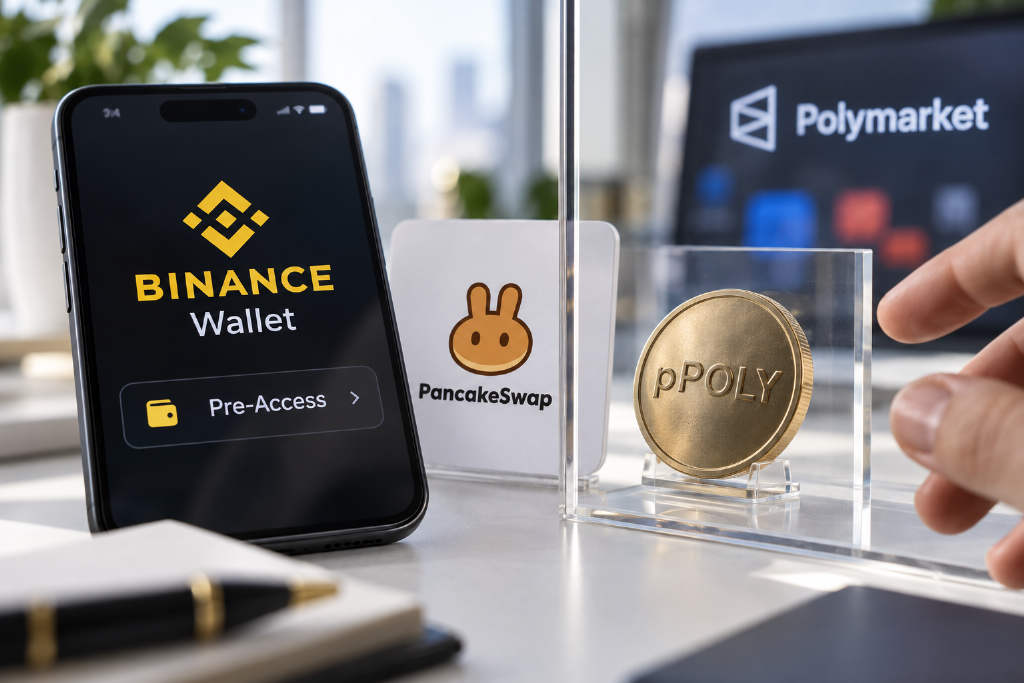
Binance Wallet said on Sept. 20 that it had launched Pre-Access through PancakeSwap, describing the feature as a way for users to gain indirect exposure to companies that may go public. The first project is pPOLY, a token issued by Paimon Finance and linked to Polymarket-related assets.
The announcement quickly triggered discussion around a crypto version of IPO subscription. Several crypto KOLs described it as Binance’s next innovation narrative, with parts of the primary equity market moving on-chain. Some users also argued that the model extends token launch-style allocation from crypto projects to pre-IPO exposure, and could intensify competition around Alpha Points.
Still, Binance’s own wording was narrower. In its post, the company referred to pPOLY as offering "indirect exposure." The token’s full name is Paimon Polymarket SPV Token. Binance Wallet also said it only provides an access point, and does not issue the token, facilitate the transaction, or grant equity or IPO rights.
What buyers receive is not equity
The central question raised by the launch is straightforward: what exactly does a buyer get after purchasing this token?
According to the official FAQ, a Pre-Access Token is a tokenized asset provided by a third party. It offers only contractual, synthetic, or indirect economic exposure. It does not represent shares or equity in the target company, and it is not equivalent to a fund interest, SPV ownership interest, or any underlying asset.
On the rights side, holders do not receive voting rights, dividend rights, information rights, shareholder rights, or governance rights. They also cannot bring claims directly against the target company or its affiliates. A PancakeSwap blog post makes a similar point, saying the activity does not imply endorsement or cooperation from the target company, and does not mean the company has confirmed any IPO plan.
Pricing is another area where the official materials draw clear limits. Binance says it does not verify the subscription price or the implied valuation. Both may differ significantly from the company’s latest private-market valuation, any later market price, or any redemption price. As for exits, redemption, repurchase, and conversion may open later than expected, or may never open at all.
Even if the company eventually completes an IPO, the token may still face lock-up periods and transfer restrictions. Its price would be determined by secondary-market supply and demand, and could trade at a premium or discount to the listed stock price. Binance also says it does not guarantee that the company will go public, and users may lose part or all of the assets they commit.
bStocks and Pre-Access do not carry the same issuance responsibility
The article contrasts Pre-Access with bStocks because both sit within the broader Binance ecosystem, but the issuance structure is different.
bStocks are stock tokens within Binance’s system. Users can buy them with spot USDT and then withdraw them to Binance Wallet or other wallets compatible with BNB Chain. On-chain, they can be traded on platforms such as PancakeSwap.
Binance directly issues bStocks, with each token corresponding to one real share on a 1:1 basis. The company also discloses collateral through its Proof of Collateral page.
Pre-Access is set up differently. Official materials say Binance Wallet does not issue, sell, host, operate, or manage the relevant tokens or the campaign. It serves only as a technical entry point into the PancakeSwap page. Product structure, purchase rules, allocation methods, claim procedures, and settlement are not controlled by Binance, according to those materials.
The token itself may be issued and managed by third parties, including a fund vehicle, SPV, protocol, or smart contract. Subscription, allocation, claiming, and refunds are handled by PancakeSwap or the third-party provider.
For the first project, the provider is Paimon Finance. The article describes it as a tokenization platform for private-market assets, covering private credit and private-company exposure, with support from YZi Labs.
If something goes wrong, the remedy also sits downstream. Official materials say that if the underlying exposure cannot be delivered, or if a share seller in the chain defaults, refunds, compensation, or recovery would be handled by the third-party provider or PancakeSwap. Binance Wallet provides no guarantee and does not verify whether third-party agreements can be enforced.
The risk disclosures also say that if the relevant private company or a third party objects to or restricts the structure, users may face delays, forced liquidation, and partial or total losses. The article points to Robinhood’s OpenAI token launch as a reference case, noting that OpenAI publicly said those tokens were not OpenAI equity, and that the company neither participated nor endorsed them.
Brickken CEO Edwin Mata also said in February that tokenizing company shares without the issuer’s knowledge and consent could damage investor protection and market credibility.
Allocation is tied to Alpha Points, badges, and bStocks tiers
After the announcement, one of the biggest questions in the community was how users could secure an allocation.
Official materials say Pre-Access allocation is determined by Alpha Points, Trencher Badge status, and bStocks on-chain tier. Higher scores and higher tiers lead to larger allocations. Users holding a Trencher Badge receive an additional boost, while the final rules are set by PancakeSwap.
For the first pPOLY round, allocation mainly depends on a user’s Alpha Points tier at the time of the announcement and the user’s bStocks on-chain activity tier. The calculation is based on bStocks holdings and trading volume during the 15-day period from Sept. 6 to Sept. 20. All users with Alpha Points are eligible to subscribe, and points are not deducted.
The bStocks component specifically looks at on-chain holding and trading activity. According to bStocks, holding and trading bStocks in Binance Wallet can unlock a larger Pre-Access allocation.
That also means the measurement window closed at Sept. 20, 24:00 UTC. Any bStocks purchased after that point cannot be counted toward the first project’s allocation. Binance has not said whether later projects will use the same measurement method.
To participate, users must enter the event page through Binance Wallet inside the Binance app. Only Binance Keyless Wallet is supported. Users must also pass an eligibility check and acknowledge the risk disclosures, which mention KYC review and sanctions screening.
For pPOLY itself, the subscription price is $15.5, with a total size of $4.8 million, or about 309,700 tokens. The subscription window lasts 72 hours and ends at 09:00 UTC on Sept. 24. Token claiming, refunds for unallocated funds, and the start of trading all begin at the same time. In an oversubscribed round, allocations may be reduced, prorated, rejected, delayed, or canceled.
The article argues that, taken together, the allocation criteria come from Binance-linked systems such as points, badges, and bStocks tiers, and are disclosed externally by Binance Wallet. On that basis, it says the arrangement does not fully match the claim that Binance does not control the allocation method.
Can Pre-Access become Binance’s next narrative?
Although the first target matched what parts of the market had expected, the launch has also drawn criticism. Some observers argue that Polymarket has already received billions of dollars from institutions including ICE, and may not need Binance Alpha to complete any so-called IPO path.
The article also notes that if Polymarket eventually does go public, it would most likely not issue a token as well. In that case, retail traders and studios that had positioned around Polymarket token expectations could end up with nothing.
At the same time, the conversation quickly moved beyond the first project and toward the broader narrative. CZ had previously said that IPOs would move on-chain. Many users now see Pre-Access as the first practical expression of that idea, with token-based IPO structures potentially giving early private-market holders a way to exit sooner.
Others say an event with Polymarket’s scale and traffic is unlikely to remain exclusive. In their view, other exchanges will also try to capture part of the demand and may roll out their own allocation plans.
Crypto KOL Yuanshan Dongjian said wallets are shifting from transaction gateways to asset-distribution gateways. When a new asset appears, the platform that can bring the first users, capital, and liquidity controls the more important entry point.
The article ultimately asks whether pPOLY should be treated as an on-chain IPO product or as a token riding Polymarket’s market attention.
Based on the official materials, Binance and PancakeSwap are referring to an indirect-exposure token issued by Paimon Finance. pPOLY is not an official Polymarket token, and the issuer is a third party.
The article also places Pre-Access alongside existing on-chain pre-IPO products. On Hyperliquid, pre-IPO perpetuals are continuously matched by traders and create ongoing price discovery for private companies, but the contracts do not contain real shares, voting rights, or IPO allocation rights. SPV tokens such as PreStocks, by contrast, claim that an SPV holds the relevant shares, and the tokens trade on DEXs such as Jupiter and Raydium based on supply and demand, with the order book effectively open at all times.
In that comparison, the article says Pre-Access is closer to the latter category, but with a different sales method. The subscription price is set by the provider and not verified by Binance, while allocation is distributed according to Alpha Points tiers and bStocks on-chain activity.
Whether Pre-Access becomes Binance’s next innovation narrative, the article concludes, will depend on whether later projects can add target-company participation, clearer underlying asset arrangements, and payout structures, and whether exits can rely on more than secondary-market trading alone.