
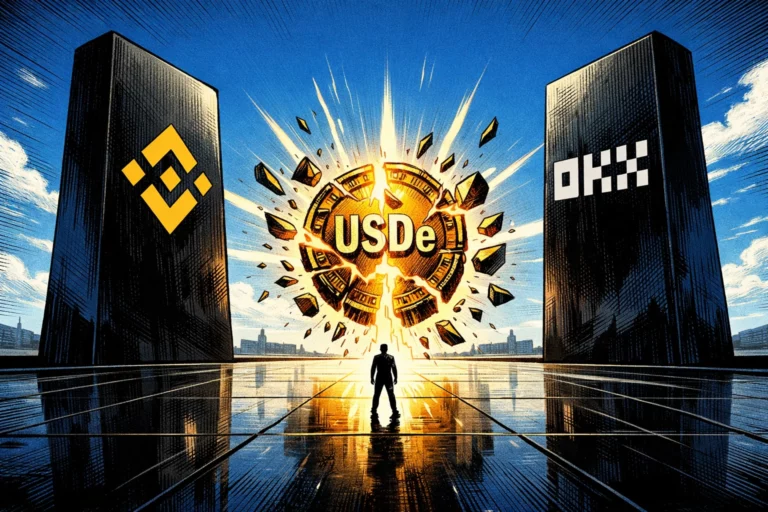
Binance has published its postmortem on the “1011” flash crash and rejected claims that it was the main cause of the selloff. In the exchange’s account, the sharp market drop on October 10-11, 2025 began after the Trump administration announced a 100% tariff on Chinese imports, sending risk-off sentiment through global markets. At the same time, crypto derivatives open interest had climbed above $100 billion, leaving prices highly sensitive to any outside shock.
Binance points to macro pressure, leverage, and a sudden liquidity drain
In its January 31, 2026 report, Binance said the crash was not triggered by one exchange or by a system-wide technical failure. It described the event as the result of macro news colliding with heavy leverage and rapidly thinning liquidity. Once volatility surged, multiple market makers cut quotes and reduced positions under their risk controls. Order book depth deteriorated fast.
The report also said Ethereum became severely congested as transaction activity spiked, delaying confirmations for some trades and adding to the panic. In a thin-liquidity window, even modest price moves were enough to trigger broad liquidations and a full deleveraging cascade.
Exchange admits two technical issues but says they came later
Binance acknowledged two operational problems during the event. One involved delays in the user interface and order handling under heavy load. The other was a temporary deviation in internal price feeds for some collateral assets, including USDe, wBETH, and BNSOL, which caused visible dislocations on the platform for a period.
Still, Binance said those issues appeared after the market was already in violent motion and should be viewed as amplifiers rather than the original cause. The exchange also denied accusations that it altered candlestick data, manipulated prices, or suffered a full failure of its core systems.
Star Xu says irresponsible USDe promotion was the real spark
OKX founder and CEO Star Xu took a sharply different position in a post on X shortly after Binance released the report. He argued that the 1011 crash was not an isolated accident or a simple case of market volatility. In his view, the real trigger was systemic risk created by irresponsible marketing.
Xu pointed to a temporary Binance campaign offering up to 12% APY on USDe and said the token was allowed to serve as collateral on terms comparable to USDT and USDC, without effective limits. He said that setup led many users to treat USDe as a low-risk stablecoin and repeatedly lever it, while the underlying risk was being seriously underestimated.
He also described USDe as a tokenized hedge fund product issued by Ethena, with a risk profile higher than a tokenized money market fund. Once markets turned, he said, USDe depegged quickly and the shock spread through risk-control gaps tied to assets such as WETH and BNSOL, ending in liquidations across the market worth tens of billions of dollars. Xu added that his comments were aimed at the roots of systemic risk, not at attacking Binance.
Wintermute founder pushes back on the single-villain narrative
Wintermute founder wishful cynic disagreed in a post on X, saying the “1011” event was not a software failure but a classic flash crash in a high-leverage market hit by macroeconomic news during a period of weak liquidity. He said blaming one exchange alone ignores the broader market microstructure and the shift in risk appetite.
The argument around Binance’s report has now widened beyond one violent selloff. It has turned into a dispute over marketing boundaries, collateral standards, and how fragile crypto markets can become when leverage is already stretched.