
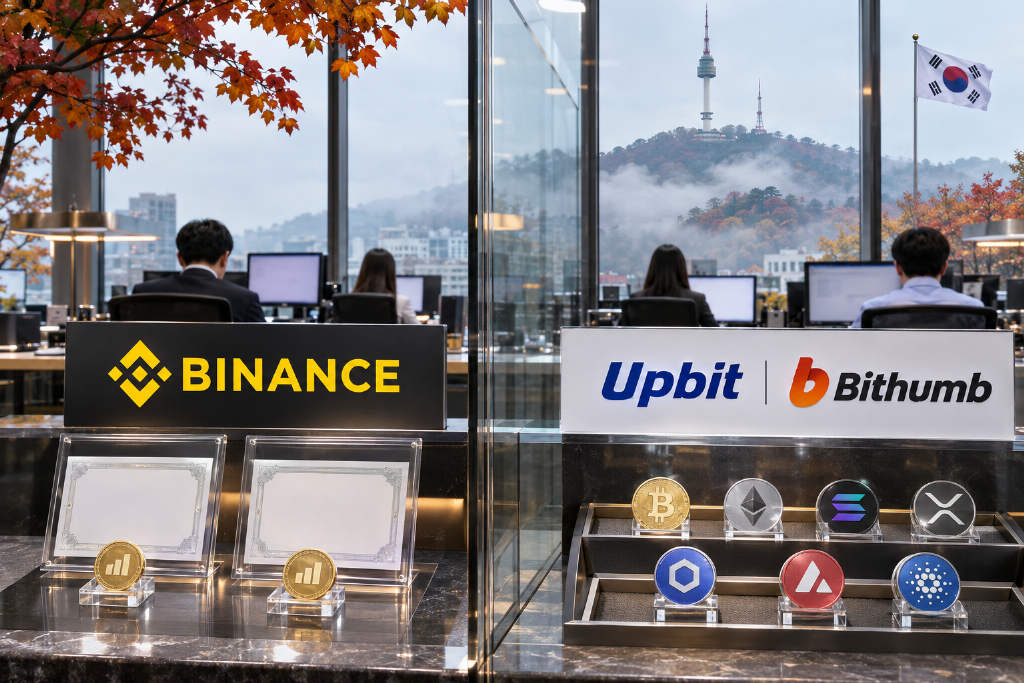
South Korea’s largest crypto exchange, Upbit, opened trading for Hyperliquid’s native HYPE token on November 10, with Bithumb following on the same day. On that date, OKX listed xORCL, a tokenized Oracle stock.
The contrast with other major exchanges has become harder to miss. Over the preceding week, HTX listed 20 US stock tokens and ETFs in one move. Gate opened trading for Taiwan Semiconductor Manufacturing Co. and MediaTek shares. Bitget brought Morgan Stanley and India’s Reliance Industries into its perpetual futures market and announced plans to open an IPO subscription channel for Anthropic. Exchange announcements increasingly resemble brokerage product menus, while new crypto tokens have become a smaller part of the pipeline.
Global exchanges move toward tokenized equities
At the end of 2025, Binance established a listing sequence that moves from Alpha to futures and then spot markets. Binance said that, as of April this year, 99 of the 200 tokens displayed on Alpha had reached its futures market, while only 35 had reached spot trading. Speculative demand for newer tokens has remained in Alpha and futures, and spot listings have slowed.
Binance Research counted 87 new projects added to Binance spot markets in 2025. Data from flexe.io showed only 26 new tokens listed on Binance spot markets as of November 11 this year.
The same data set showed that Binance announced 49 delistings this year and placed 64 tokens under observation. The corresponding figures for 2025 were 27 and 42. Fewer listings and more removals point to a rapidly contracting spot main market at Binance.
Market conditions have also changed. CoinGecko data showed that total crypto market capitalization fell 20.4% in the first quarter of this year, while spot trading volume on centralized exchanges declined 39.1%.
Regulation is another consideration. In June, Binance withdrew its application for a MiCA license before Greece’s regulator issued a formal decision. A compliance monitor appointed by the US Financial Crimes Enforcement Network remains in place.
For an exchange dealing with regulators across markets, a large rollout of high-risk new tokens on the spot main market can become an area of scrutiny.
More importantly, Binance is putting greater effort into bringing traditional financial assets onchain. After Abu Dhabi Global Market’s Financial Services Regulatory Authority approved an issuer prospectus, Binance launched bStocks, tokenized securities linked to US stocks and ETFs. Since late September, new instruments have appeared almost every week.
Binance is not alone in taking this route. In March this year, OKX received a strategic investment from Intercontinental Exchange, the parent company of the New York Stock Exchange, at a valuation of $25 billion. Tokenized stocks began appearing on OKX in batches after that, while its stock X-futures offering continued to expand. Bitget now supports 408 stock perpetual futures instruments. Gate and HTX are also adding more equity-linked assets.
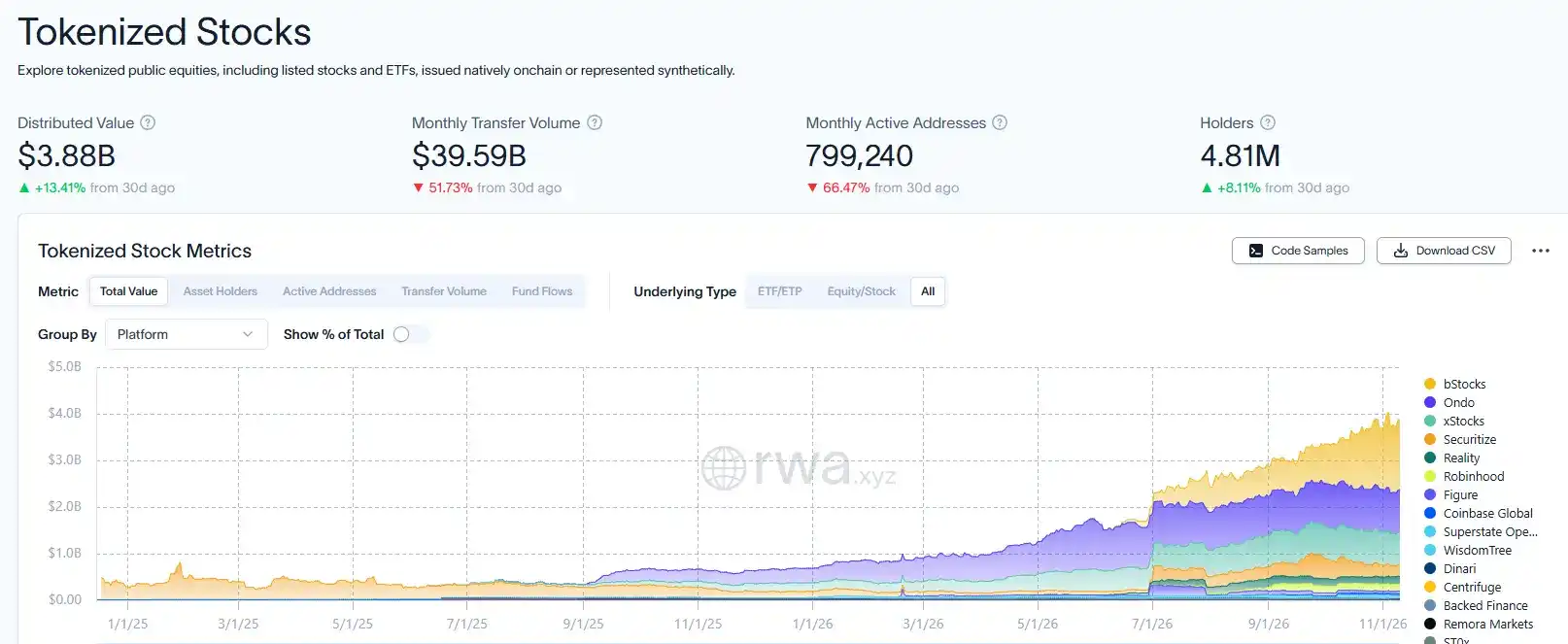
The tokenized stock market is still small. RWA.xyz data showed that the total value of tokenized stocks onchain was about $3.88 billion as of November 10.
Exchanges are looking at the market behind that figure. Bloomberg data put the total value of global equity markets at about $165 trillion in the third quarter of this year. The entire crypto market was worth about $2.59 trillion, meaning global equities were more than 60 times larger. The value of tokenized stocks was still less than one ten-thousandth of the global equity market.
Even moving a very small portion of the stock market onto blockchains would give exchanges access to a market far larger than native crypto assets.
Upbit relies on listings because it is confined to spot crypto
South Korean exchanges matter because they may represent the last sizable stronghold for native crypto assets on centralized exchanges.
Viewed across a full year, the listing lines for Binance and Upbit have crossed. Binance added 87 spot projects in 2025, clearly above Upbit’s 59. This year, the pattern reversed. Binance has so far added only 26 new tokens, while South Korean newspaper Today Economy reported that Upbit had opened 59 new Korean won trading pairs by mid-August. In less than eight months, that matched Upbit’s total for the previous full year.
The difference is sharper over the most recent three months. ChainCatcher’s count of official exchange announcements found that Binance had announced only four crypto listings from early August onward: MARSCOIN, Niu Lai, HYPE and PREDICT. PREDICT later announced that its opening would be delayed. During the same period, Upbit listed 39 assets and Bithumb listed 29.
The dependence of Korean exchanges on native crypto assets is tied to South Korea’s regulatory framework. In 2017, the Financial Services Commission issued administrative guidance restricting financial institutions from holding and operating crypto assets. The separation between finance and crypto has continued, and crypto exchanges have found it difficult to enter traditional finance.
South Korea still has no domestic crypto derivatives market established within its regulatory system. Users seeking derivatives trading have to move to overseas platforms.
Tokenized securities also follow a separate route. In January this year, South Korea’s National Assembly passed legislation covering tokenized securities and placed them within the Capital Markets Act framework. Distribution was assigned to securities firms and over-the-counter trading intermediaries. The law takes effect on February 4, 2027.
Global peers can offer futures and list US stocks. Korean exchanges are left mainly with crypto spot trading, making their revenue structures unusually concentrated.
South Korea’s Financial Supervisory Service electronic disclosure system showed that platform transaction fees accounted for 97.49% of total revenue at Dunamu, Upbit’s operator, in the first quarter of this year. The ratio at Bithumb was close to 99.99%.
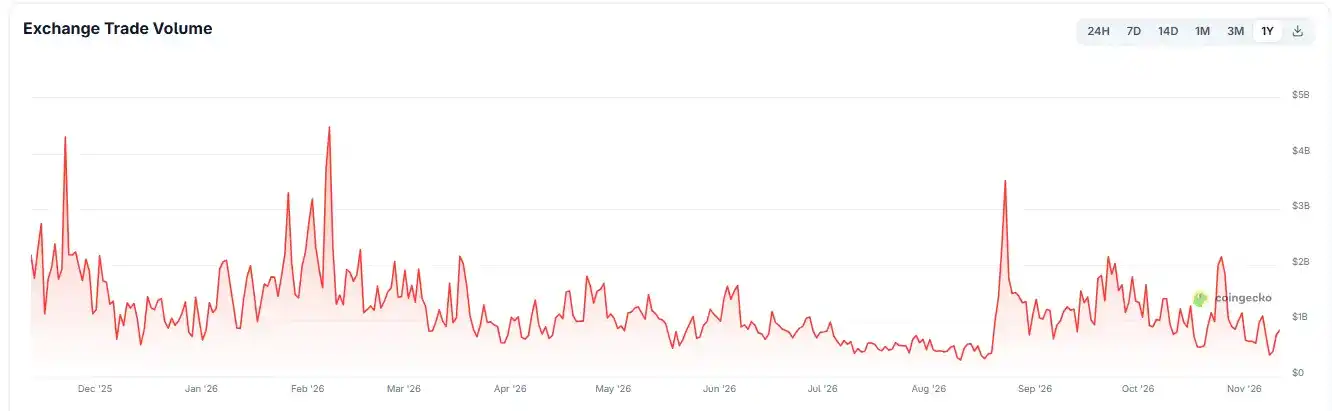
The broader crypto market, meanwhile, remained weak this year. CoinGecko data showed that total trading volume at South Korea’s five won-based exchanges fell by about half year over year in the second quarter. Upbit’s volume fell 54%.
With fees serving as almost the only revenue source, adding new assets is the most direct way for exchanges to generate trading activity.
It is also a fight for market share. Crypto trading in South Korea is largely divided between Upbit and Bithumb. CoinGecko data showed that Upbit accounted for 65.44% of trading volume among Korean exchanges in September, while Bithumb accounted for 26.87%.
In a two-player market of this kind, the exchange that lists more assets, and lists them faster, has more opportunities to keep users on its platform.
Korean exchanges sit at the end of the listing chain
Tokens newly listed on Upbit are rarely meeting the market for the first time. That too is a product of regulation.
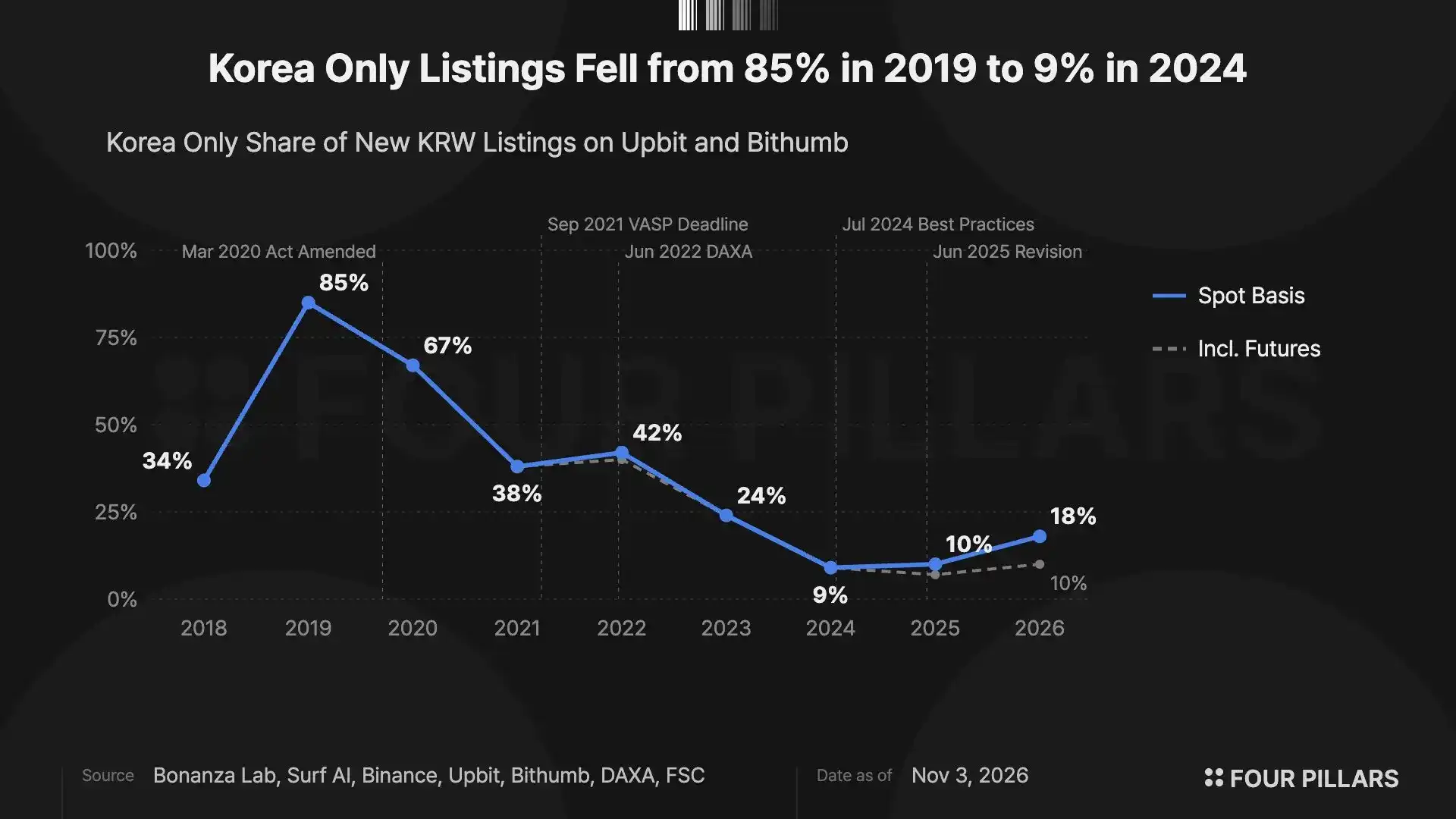
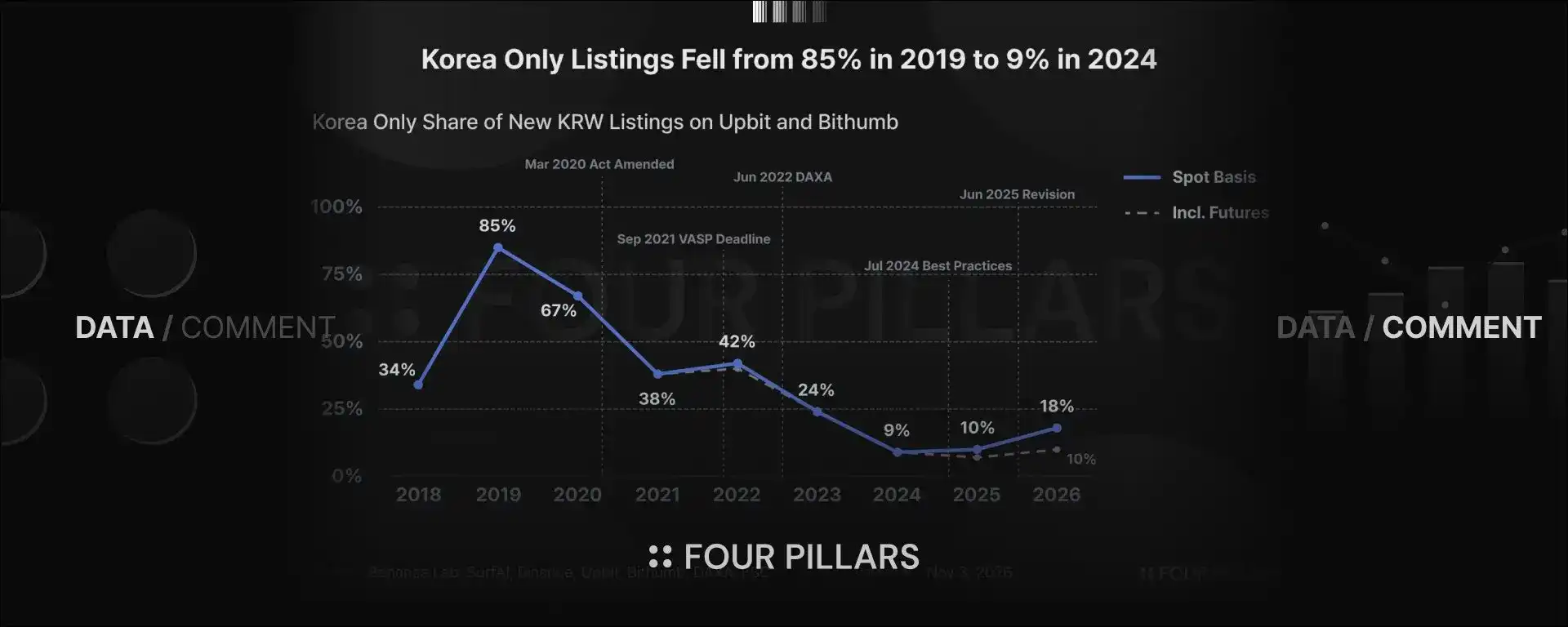
Researcher tranks of Four Pillars found that the share of assets first listed in Korea on the Korean won markets of Upbit and Bithumb before appearing on the spot markets of Binance, OKX, Bybit and Coinbase fell from 85% in 2019 to 9% in 2024.
The decline broadly matched the formation of South Korea’s regulatory framework. In March 2020, a revised Act on Reporting and Using Specified Financial Transaction Information required exchanges to register and meet anti-money-laundering obligations. The registration deadline was September 2021. During that quarter, the number of assets first listed in Korea fell from 19 per quarter to three, and the full-year share fell to 38%.
In 2022, five won-based exchanges formed the Digital Asset Exchange Alliance, or DAXA, and created common listing review standards. Listing best practices that took effect in July 2024 said that assets traded for at least two years on qualified overseas exchanges could be treated as meeting white-paper and disclosure requirements. By 2024, the share first listed in Korea had fallen to 9%. It recovered to 18% this year, but stood at only 10% after assets that had previously traded on overseas futures markets were excluded.
The usual route has gradually become overseas trading first, followed by a Korean listing.
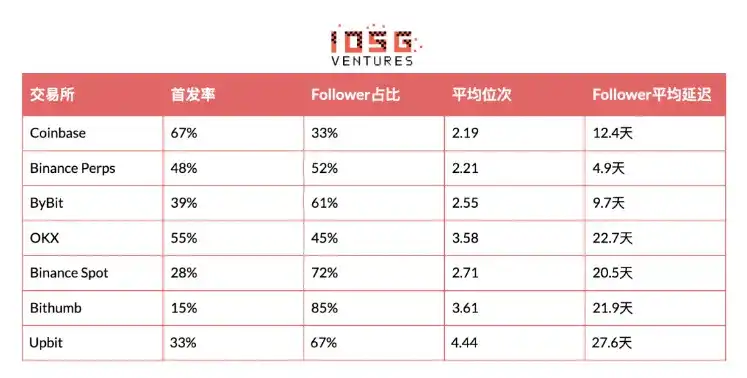
IOSG Ventures previously described the sequence this way: Coinbase and Bybit handle early price discovery, Binance futures then test liquidity, Binance spot confirms the asset after a pullback, and Korean exchanges sit at the end of the chain. Upbit lists assets an average of about 28 days after the first exchange. HYPE, which Upbit listed on November 10, had already been available for spot trading on Binance since September 24. Upbit followed a month and a half later.
Being at the end of the chain means taking on the final stage of the market move. IOSG data showed that tokens arriving on Upbit carried an entry premium of 27.4%, while their 30-day decline after listing was also the deepest, at 25.7%.
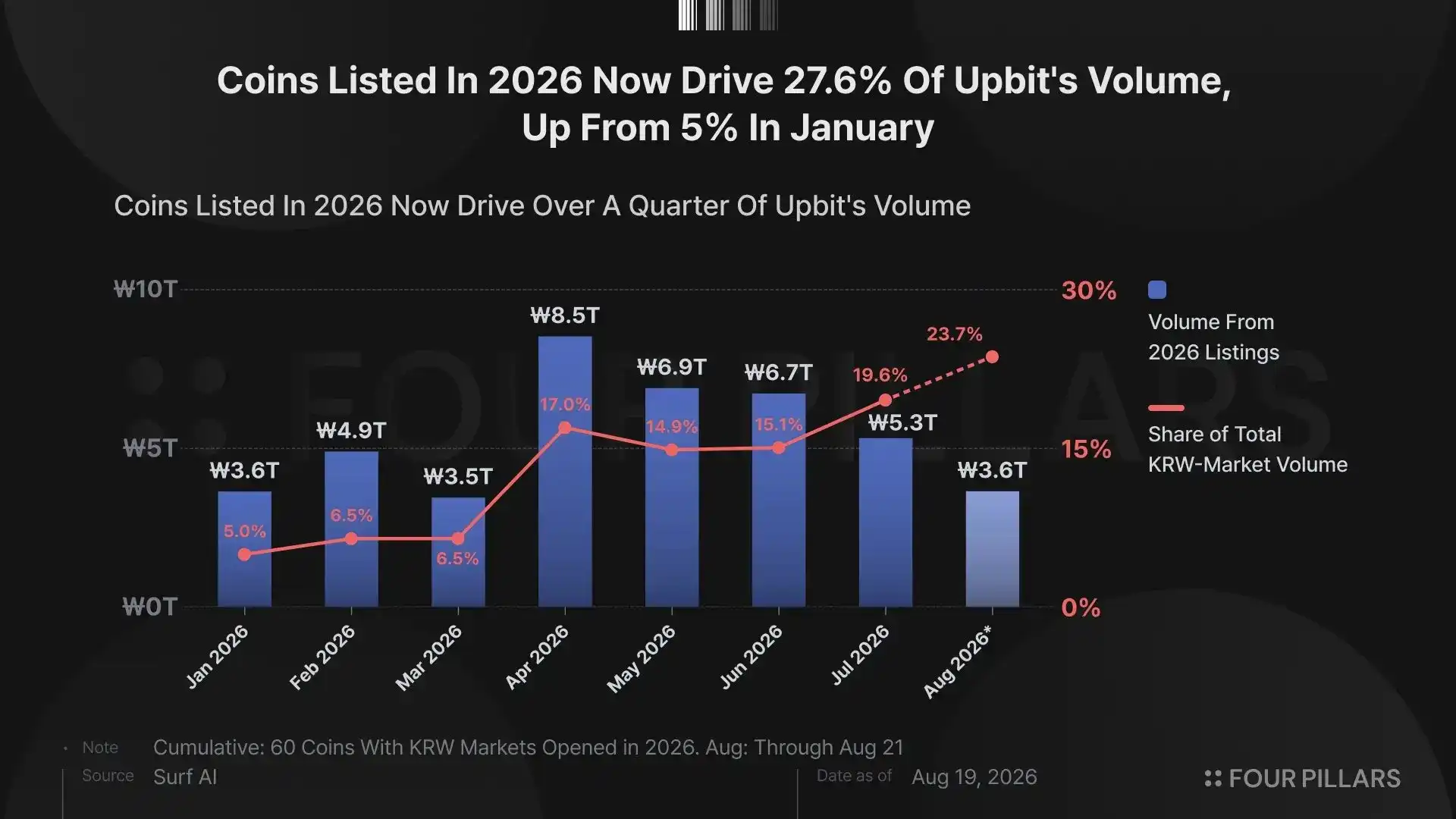
This defensive strategy is also consuming Upbit’s own listing premium. Four Pillars found that newly listed tokens’ share of total Upbit volume rose from 5% in January to 27.6% in August. The firm said the scarcity of Upbit’s listing premium was being spent defending volume during a bear market.
Older tokens have also made up a growing share of new listings at the two Korean exchanges this year. In 2025, 47% of new tokens were added within 30 days of their overseas listing. In 2026, assets that had traded overseas for more than a year became the largest category, accounting for 31%. CRV and RSR, which had traded overseas for more than six years, also reached Korean won markets this year.
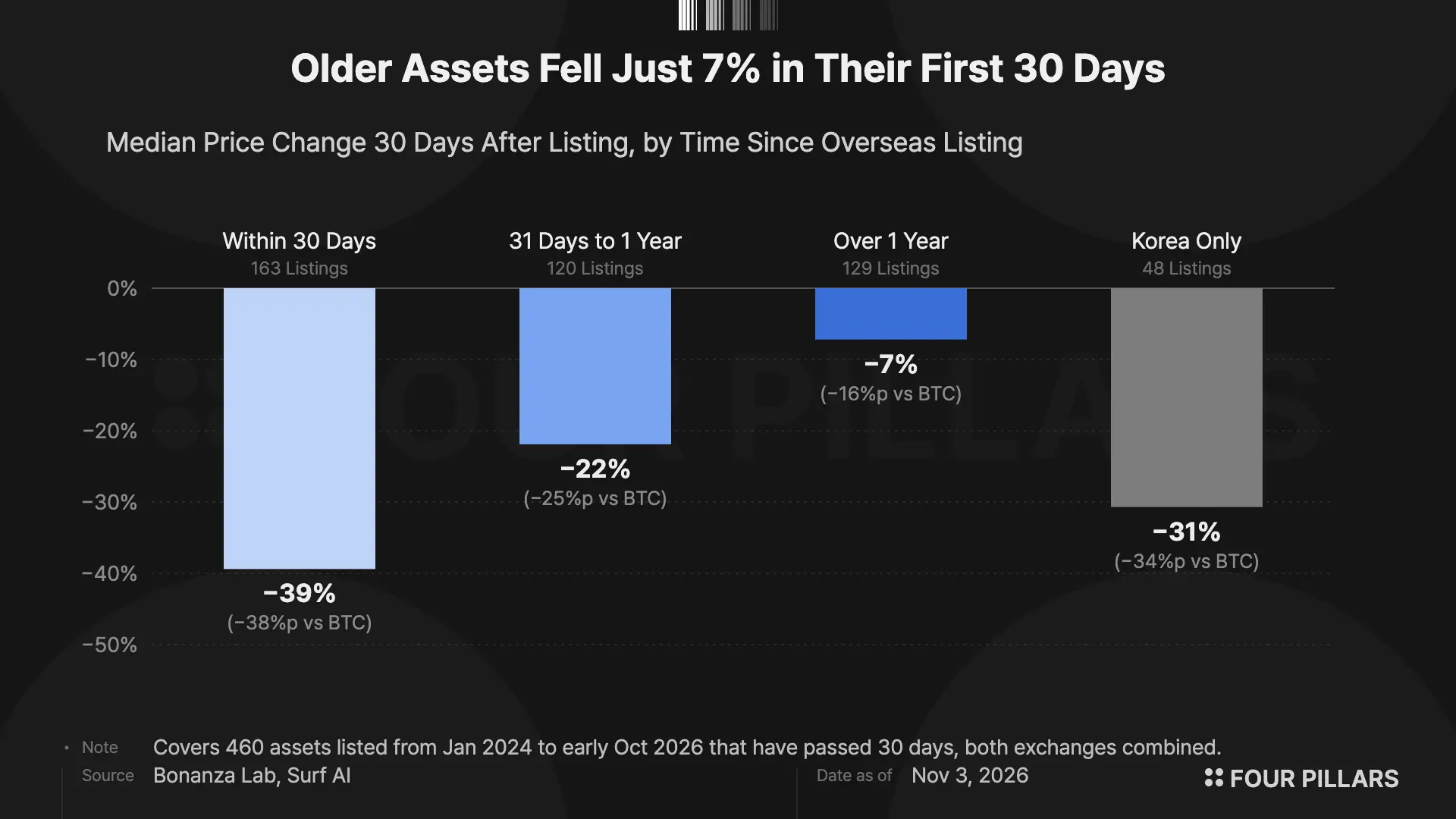
Older assets have one drawback: they bring less traffic. Tranks’ data showed that assets traded overseas for more than a year had a median 30-day decline of only 7% after listing, making them less damaging for investors. Their median share of first-day volume on Upbit, however, was only 5.7%. For new tokens that Upbit followed within 30 days of their overseas listing, the figure was 10.3%.
Could South Korea’s regulatory wall shift?
This structure may not last indefinitely. Korean exchanges now face the task of finding new trading demand and revenue sources beyond token listings.
At DICON, a digital asset policy conference held in Seoul’s Yeouido on November 10, Dunamu Vice Chairman Kim Hyung-nyeon discussed tokenized stocks. He said it was painful that representative Korean stocks such as Samsung Electronics and SK hynix could be traded in tokenized form only on overseas exchanges.
Kim also said Dunamu would make every effort to become a global player representing South Korea if the regulatory framework were designed properly.
The regulatory position has already started to shift. The chair of South Korea’s Financial Services Commission said officials would study whether, and by how much, to relax the separation between finance and crypto alongside the Digital Asset Basic Act.
Min Byung-deok, a lawmaker from the ruling Democratic Party of Korea, said the bill must pass during the current regular session of the National Assembly, no later than January 18 next year. He also called for institutions and corporations to be fully allowed to invest in virtual assets.
Original author: Zhou, ChainCatcher.



