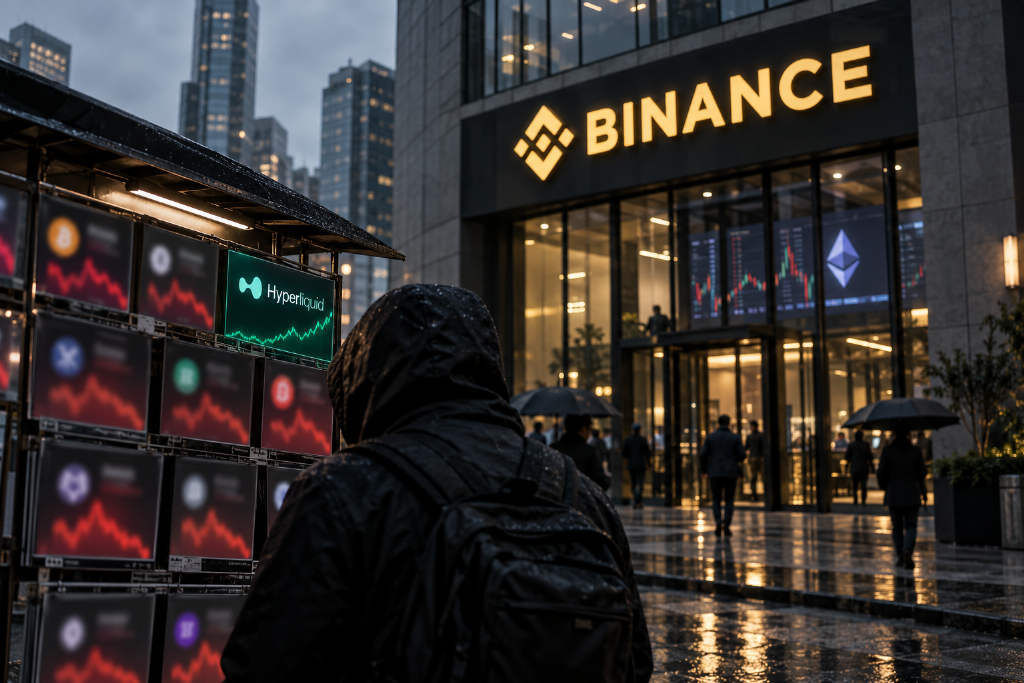
Hyperliquid was the only top-50 asset to rise in the trading window after Binance disclosed a security incident and paused withdrawals, according to a market analysis written by CoinMarketCap research head Alice Liu.
The data in the note was timestamped at 16:10 Beijing time on Oct. 30, 2026, or 08:10 UTC. Liu wrote that all figures came from CoinMarketCap, with the Fear and Greed Index, Altcoin Season Index, community trending board, narrative rotation, and relative-strength screens based on CoinMarketCap’s own readings.
Bitcoin traded at $78,010, down 2.26% over 24 hours and down 4.31% over seven days. It had fallen into the $76,000 range intraday, and its spot price sat at the 3rd percentile of its 30-day range. Total crypto market capitalization stood at $2.61 trillion.
The note said the market had just gone through what it described as the largest recorded exchange security event. Binance disclosed an incident that it estimated at about $6.3 billion, halted withdrawals, and said it would cover all user losses. Liu added that the surrounding figures were external information that CoinMarketCap could not verify, including the $6.3 billion estimate itself, a third-party estimate of $5.9 billion stolen, roughly $3 billion frozen, claims that the entry point was a compromised operations laptop, and reports that withdrawals would resume within 48 hours. Those figures were mentioned only when necessary and were not used as the basis for the report’s conclusions.
Only one asset in the group was up
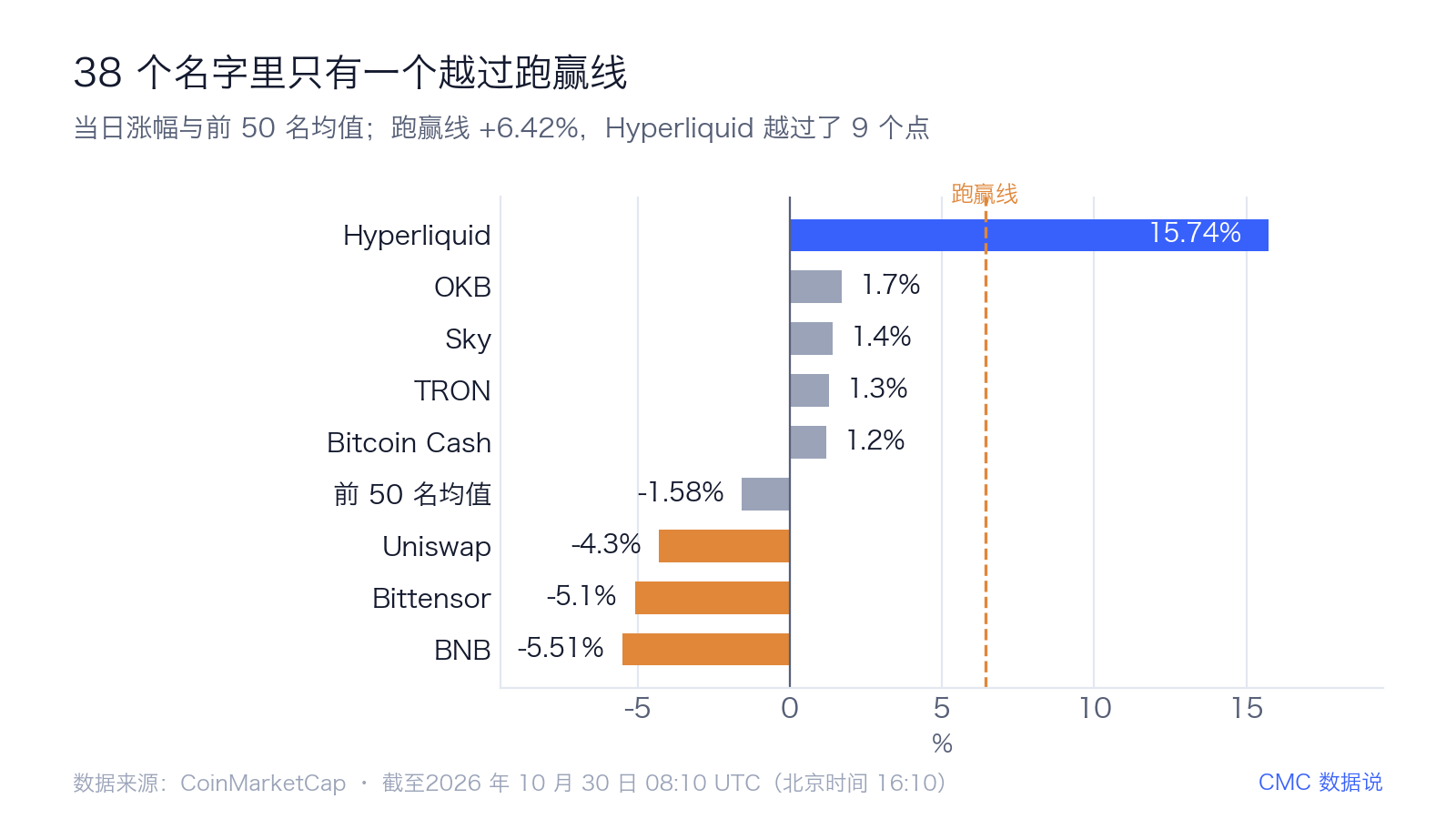
The top-50 universe covered 49 ranked assets. After removing stablecoins and gold-backed tokens, 38 names remained. Their average 24-hour decline was 1.58%, the median drop was 2.37%, and dispersion widened to 3.38 percentage points, the broadest reading in seven days.
The report placed the outperform line at +6.42%. Only one token cleared it, and it did so by another 9 percentage points.
Hyperliquid traded at $91.12, up 15.74% over 24 hours. The next best performers were OKB, up 1.7%, Sky, up 1.4%, TRON, up 1.3%, and Bitcoin Cash, up 1.2%. Hyperliquid was the only one of the 38 names to gain more than 2%.
The weakest side of the board told the same story. BNB fell 5.51%, the worst performance of the day, and it was the exchange token tied to the venue at the center of the incident. Bittensor dropped 5.1% and Uniswap lost 4.3%. Outside the list, Celestia fell 11.0% and PancakeSwap dropped 8.4%, with PancakeSwap identified as a protocol on BNB Chain.
Liu’s reading was that this was not indiscriminate selling. It was directional repricing: the chain linked to the incident and its ecosystem were sold, while the asset tied to an alternative custody venue was bought.
ICE’s planned build on Hyperliquid was the clearest catalyst
The report said the rally in Hyperliquid had a catalyst that could be checked against public information, and that the catalyst matched the scale of the move.
Intercontinental Exchange, the parent company of the New York Stock Exchange, said it would work with trade.xyz to deploy a regulated U.S. perpetual futures venue on Hyperliquid infrastructure. The planned venue would cover equities, indexes, commodities, foreign exchange, and crypto, subject to approval from the Commodity Futures Trading Commission.
On the official developments side, the note classified that announcement as a high-significance partnership with high confidence and said the announcement and the price move were “fully aligned.” In the same window, it also flagged two product developments: the launch of Pump.fun perpetual contract access and a new XTEN-USDC trading pair.
Liu said those were announcements and that the article did not independently verify their terms. What could be checked, she wrote, was volume and positioning.
Hyperliquid posted $3.70 billion in 24-hour trading volume, up 346%, equal to 16% of its $23.1 billion market capitalization. Perpetual open interest stood at $890.5 million, or 3.86% of market cap. That was below the 10% threshold the note used to classify derivatives as the main driver, so the move was labeled spot-led.
Open-interest growth still stood out. Over 14 days, open interest rose 27.9% while price gained 15.6%, meaning positioning expanded faster than price. In the most recent hour, the note recorded another 29.5% increase.
One more signal mattered. Covered centralized spot venues showed negative aggressive buying while the price was rising.
The report’s interpretation was direct: the buying that lifted the token did not show up on the spot books of major centralized exchanges. It either came from passive resting orders or from venues outside the coverage set. For this token, the first place outside that coverage set would be its own chain. Liu wrote that this was both a risk warning and a coverage gap, and that the current data could not separate the two.
Funding was slightly positive at 0.0054% every four hours. A three-day heat map looked balanced. The largest long pool sat at $84.23, 7.6% below spot, and the largest short pool was at $97.68, 7.1% above spot.
That move also pushed the Hyperliquid ecosystem category into the top five on the trending board, ranking fourth. The category was valued at $33 billion, up 10.79% over 24 hours, with volume up 280%. It was the only one in that top-five group that was not a mega-cap basket, replacing the music category.
The note ended that section with a caution: a venue token rose on the same day a rival venue halted withdrawals, and it did so on the back of an exchange partnership. Those were two separate tailwinds, and only one of them was likely to repeat.
Ethereum DEX volume surged, but stablecoin balances did not follow
The second layer of the story was on-chain.
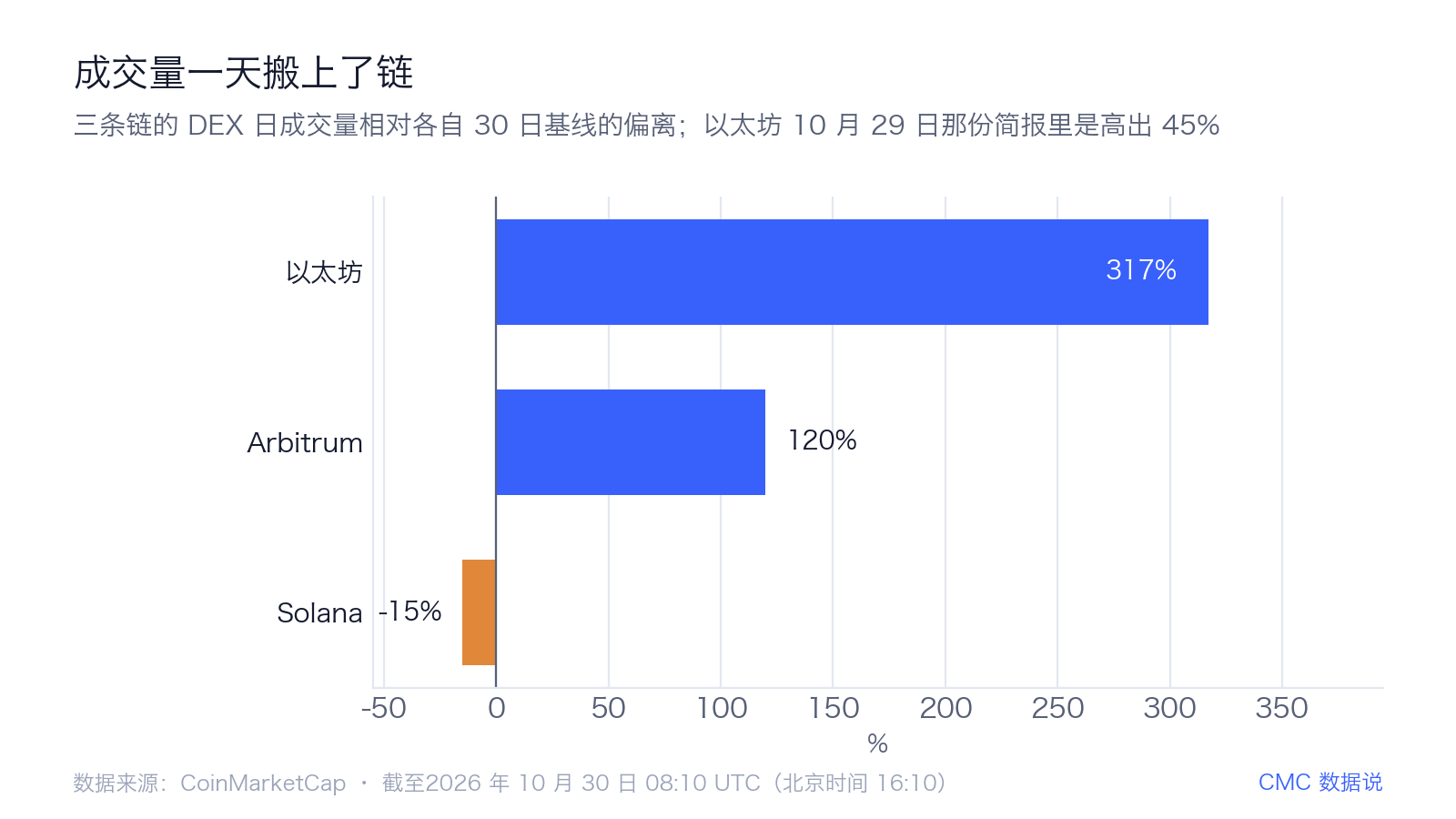
Ethereum DEXs processed $7.42 billion in volume on the day, more than 317% above a 30-day baseline of $1.78 billion and close to five times the $1.56 billion reading cited for the Oct. 29 edition. The report labeled the shape of that move a “spike,” with an intraday max-to-min ratio of 10.5, which Liu said fit a one-day rush rather than a trend.
Arbitrum handled $403 million, 120% above baseline. Solana processed $1.26 billion, 15% below baseline. The report’s conclusion was that this burst of on-chain trading went to Ethereum and its layer-2 networks, not to Solana.
Ethereum itself also captured more fees and revenue. Over the past 24 hours, fees reached $44.2 million, up 197% over seven days, while revenue hit $21.7 million, up 726% over the same period. Yet total value locked on Ethereum was $43.2 billion, down 18.7% over 30 days. Ether traded at $2,230, down 3.50% on the day, below its 20-day and 50-day moving averages, and underperformed Bitcoin by 1.3 percentage points.
The clearest sign that “the money has not moved yet,” in Liu’s framing, came from stablecoins. Ethereum held $142 billion in stablecoins, down 2.55% over 30 days, with USDT accounting for 50.0%. The total market stablecoin snapshot was $272.8 billion, versus $273.4 billion in the Oct. 29 reading. The report said the freezing actions mentioned in news coverage left no visible mark on that aggregate supply figure.
The conclusion in that section was simple: trading volume moved on-chain, but capital stayed where it was.
The note also singled out Aave. Before any event-related effect, Liu wrote, the protocol had already been marked “fragile” on the protocol-health side. Total value locked was $15.66 billion, down 18.2% over 30 days and 20.4% below its peak. Thirty-day fees were $37.7 million, equal to 24 basis points of TVL, and daily fees were positive on 100% of days. The line’s recommendation was to “raise the threshold for re-underwriting.” AAVE traded at $125.08, down 3.66% on the day and down 16.2% over seven days, the third-worst seven-day performance in the top 50, ahead of only Worldcoin and Polkadot.
The report added that the batch of meme tokens sold by the attacker was absorbed by the market. PEPE fell only 0.27% on the day and was still up 5.4% over seven days. Ethena fell 3.61%.
BNB was the day’s weakest major token
BNB fell 5.51%, making it the worst performer in the top 50.
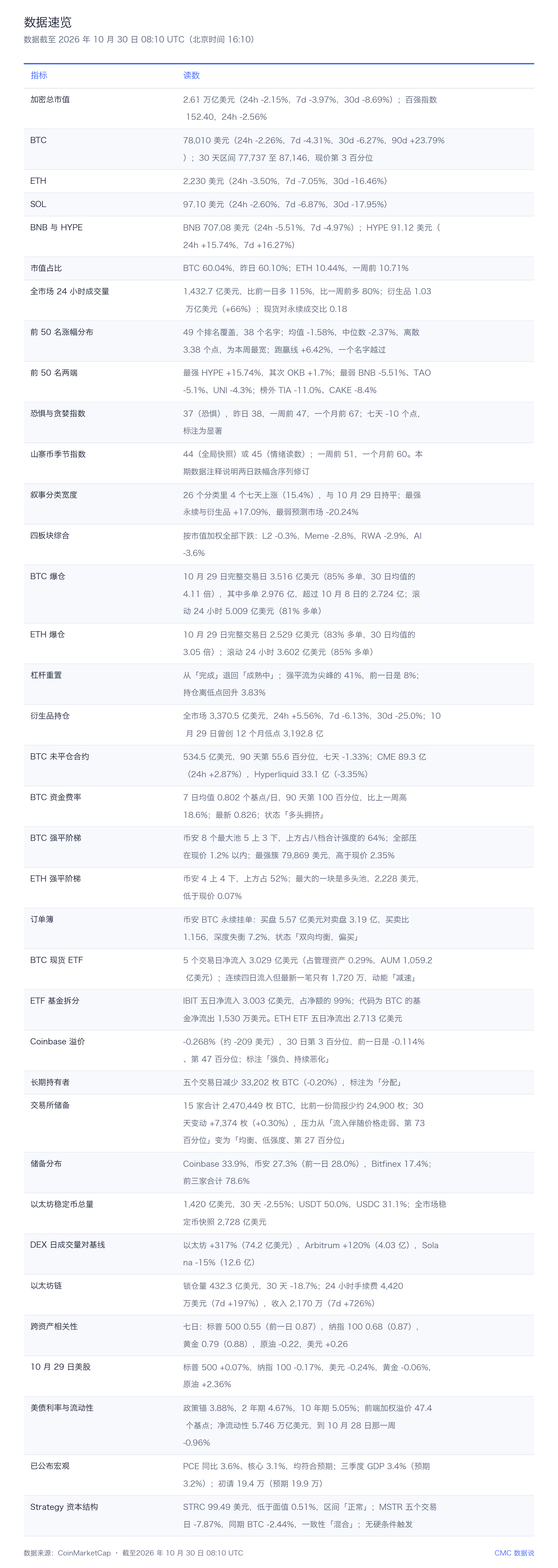
The report classified BNB under Layer 1, with a secondary tag as a centralized exchange token. Among 87 liquid peers, it lagged the median by 2.75 percentage points on the day, falling 5.85% against a peer median decline of 3.10%. Over a seven-day window, though, it outperformed by 4.84 percentage points, down 5.21% versus 10.05% for peers. Trading volume rose 144%.
The location of the selling was clearer than the motive. Covered spot venues showed $117 million in aggressive net selling, with the imbalance equal to 6.0% of turnover. The report’s judgment was that “aggressive spot selling is confirming weakness, not absorbing it.” Perpetual open interest was only 0.82% of market cap and funding was slightly negative, so Liu said the pressure came from spot selling rather than derivatives.
On the three-day heat map, the largest short pool above the market sat at $766, or 8.5% above spot. Its pressure score was twice that of the largest long pool below the market, which sat at $677, or 4.1% below spot.
A 72-hour social scan put BNB in an “alert” state with high confidence. The driver was discussion of the security incident itself, not the token’s fundamentals. The note said the hard conditions for clearing that alert were the resumption of withdrawals and a full incident explanation.
Six details deeper in the tape
Positioning, fund-flow, and cross-asset data were current as of 08:10 UTC on Oct. 30.
- Fear and Greed Index: It fell to 37, the first “fear” reading of the month. It was 38 the day before, 47 a week earlier, and 67 a month earlier. The seven-day drop of 10 points was marked “significant.”
- Altcoin Season Index: It hit a 30-day low, though the report said the comparison needed caution. The global snapshot was 44 and the sentiment track was 45, versus 55 for the sentiment track in the Oct. 29 edition. The data note said part of the two-day decline came from series revisions rather than market movement, so Liu used only the current level and did not treat “down 11 points in two days” as a conclusion.
- Narrative breadth: Breadth was unchanged, but leadership shifted. Four of 26 categories were up over seven days, the same as on Thursday. Meme, which ranked first on Thursday, slipped to second. Perpetuals and derivatives moved to first with a 17.09% gain, while DEX ranked third with a 10.83% gain. All three categories were lifted by the same token, and Hyperliquid appeared in two of them. On a market-cap-weighted basis, the four composite sector scores were all lower: L2 down 0.3%, Meme down 2.8%, RWA down 2.9%, and AI down 3.6%.
- Strongest versus weakest: The spread reached 37.3 percentage points. Perpetuals and derivatives rose 17.09%, while prediction markets fell 20.24%, finishing last for a third straight edition. Liu wrote that the market was paying for venues while selling the things traded on those venues.
- Trending mega-cap baskets: The four mega-cap baskets on the trending board all fell between 4.6% and 4.8% over seven days. They were digital commodity regulation, Layer 1, U.S. strategic crypto reserve, and digital commodities, all baskets dominated by Bitcoin, Ether, and XRP. Attention was concentrated in majors, and majors had fallen more than average over the week.
What the report said to watch next
For Oct. 30, a Friday, the note said Binance had stated withdrawals would resume within 48 hours after an upgrade to withdrawal services and that a technical post-mortem would follow, though Liu said that point was unverified. The same day also carried roughly $10.8 billion in notional options expiry, with $78,000 identified in news coverage as a key positioning level. That claim, too, was attributed to news reports. Federal Reserve official Musalem was scheduled to speak at 00:30 Beijing time the next day.
For Oct. 31, a Saturday and month-end, the note said Bitcoin had closed September at $83,567 and was now at $78,010, about 6.7% lower. At that level, October would be the second straight down month, though Liu said that statement came from news coverage rather than CoinMarketCap’s own closing series.
For Nov. 5, a Thursday, the report listed initial jobless claims, with a consensus estimate of 195,000 and a prior reading of 194,000. It also noted that a chief financial officer change at Strategy would take effect that day, citing external reporting.
The note highlighted two rolling watch points. One was Hyperliquid’s open-interest growth: up 27.9% over 14 days against a 15.6% price gain, with positioning rising faster than price while the buying that lifted price was absent from major spot books. The other was how much of Ethereum’s on-chain volume surge would stick. The day’s reading was more than four times baseline and was labeled a spike. If it held, that would point to a change in behavior. If not, it would look more like a one-day emergency response.
Final read from the tape
Liu’s closing argument was that the day’s selling had direction. It was not broad liquidation. Thirty-seven of 38 names were down, yet none broke the laggard line. The biggest loser was BNB, the token tied to the exchange at the center of the incident, down 5.51%. PancakeSwap, a protocol on its chain, fell 8.4%. The only asset to clear the outperform line was Hyperliquid, up 15.74%, the token tied to an alternative custody venue.
The report also said Hyperliquid’s rally had one part that could be checked and one part that could not. The ICE partnership was a high-significance announcement. At the same time, covered centralized spot books showed negative aggressive buying. The money lifting the token was not visible on those books. It was either passive liquidity or activity outside the coverage set, and the current data could not separate those possibilities.
On-chain, Ethereum DEX volume climbed to more than four times baseline and fees were up 197% over seven days, but stablecoin supply was still shrinking over 30 days. In the report’s wording, volume moved, money did not.
As for the $6.3 billion figure, Liu repeated that it was an external estimate that CoinMarketCap could not verify. What the firm could verify was who got sold and who got bought that day: the token of the exchange at the center of the incident fell 5.51%, a protocol on its chain fell 8.4%, and the venue offering another custody route rose 15.74%. The market did not wait for a full incident explanation. It voted first through price.