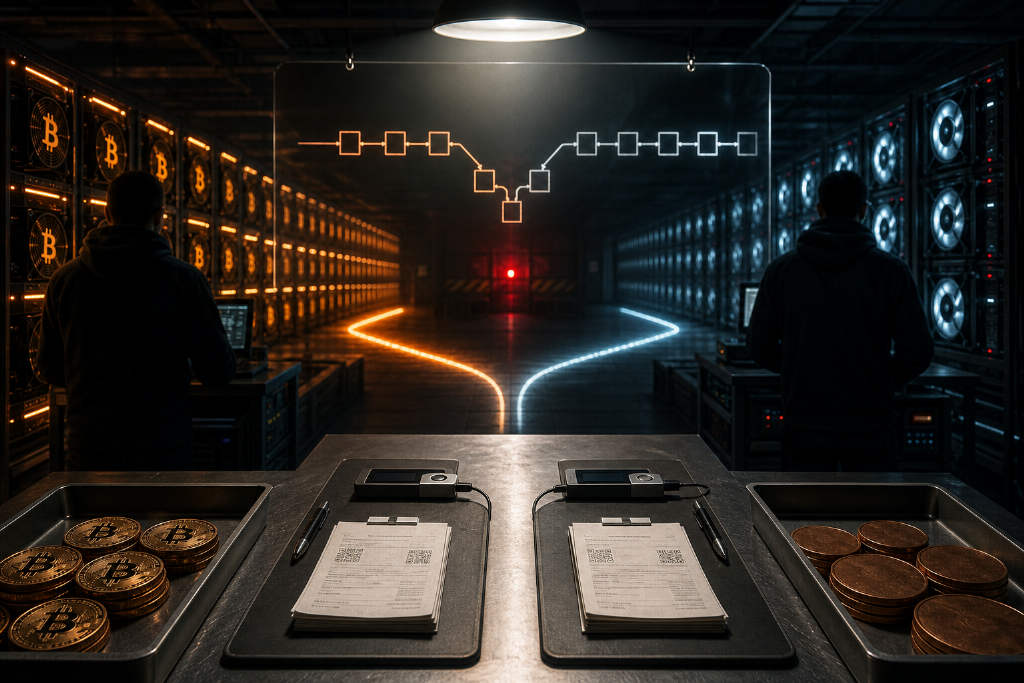
Supporters of BIP-110 are discussing another hard fork that would switch the stalled minority chain’s mining algorithm from SHA-256d to BLAKE2b. The issue drawing the most attention is replay risk: both chains still share transaction history from before the split, and if transaction and signature rules stay aligned, the same transaction could be copied and executed on the other chain. BIP-110’s miner support peaked at about 2.53%, and after the consensus rules took effect on Aug. 8, the minority chain produced only two consecutive blocks before stalling while the Bitcoin main chain continued and widened the block-height gap. The BIP-110 proposal was later marked closed, and discussion shifted to a BLAKE2b proof-of-work approach. Bitcoin Knots plans to add a new signature hash option, but RDTS is expected to keep compatibility with Bitcoin Core’s existing signature hash types. That means ordinary transactions may still remain valid on both chains, leaving users dependent on the new option and on wallets or hardware-signing firmware that support it in order to separate assets. Luke Dashjr said on Aug. 18 that Bitcoin should take responsibility for replay protection, calling it “Spamcoin.” If a BLAKE2b fork moves forward around Sept. 1, exchanges, wallets and holders would need to distinguish between cross-chain transactions and chain-specific ones.
Supporters of BIP-110 are discussing a hard fork that would change the stalled minority chain’s mining algorithm from SHA-256d to BLAKE2b.
Replay attacks are a central concern. The two chains still share transaction history from before the fork, and if transaction and signature rules remain the same, a single transaction could be copied and executed on the other chain.
The minority chain stalled after BIP-110 activation
Miner support for BIP-110 peaked at about 2.53%. After the consensus rules took effect on Aug. 8, the minority chain produced only two consecutive blocks before stalling. The Bitcoin main chain kept running, and the gap in block height continued to widen.
The BIP-110 proposal was later marked closed, and supporters shifted to discussing a BLAKE2b proof-of-work plan.
Signature compatibility could complicate coin separation
Bitcoin Knots plans to add a new signature-hash option, while RDTS would still keep compatibility with Bitcoin Core’s existing signature-hash types.
That leaves open the possibility that ordinary transactions could remain valid on both chains. Users who want to separate assets would need to use the new option and rely on wallets or hardware-signing firmware that support the feature.
Luke Dashjr calls for replay protection
Luke Dashjr said on Aug. 18 that Bitcoin should bear responsibility for replay protection and referred to it as “Spamcoin.”
If a BLAKE2b fork advances around Sept. 1, exchanges, wallets and holders would need to distinguish between transactions that can execute across both chains and those that are valid only on one chain.
The source cited in the report was Bitcoin.com News.
This article was originally published by Bit.Fan. For more cryptocurrency news and market insights, visit www.bit.fan. Disclaimer:
The market information, project data, and third-party content displayed on this platform are for industry information sharing only and do not constitute any form of investment advice or return commitment.
Cryptocurrency trading carries high risks. Users should fully assess their risk tolerance and make independent decisions. All profits, losses, and legal responsibilities are borne by the users themselves.