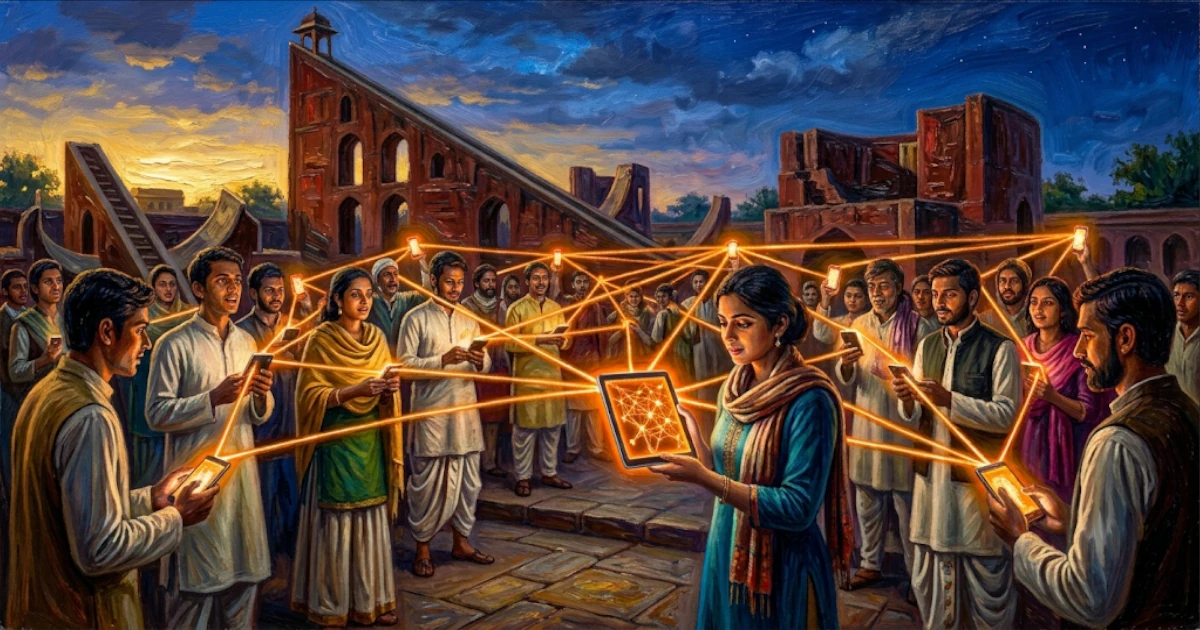
Bitchat, the censorship-resistant messaging app linked to Jack Dorsey, remained available after Indian authorities sought to have its GitHub repositories restricted during student protests and reported network disruptions.

Bitcoin Magazine reported that the app, built for encrypted peer-to-peer messaging, has again gone viral as India’s government moved against it on GitHub. The publication cast the episode as a clash between a decentralized communication tool and a state effort to limit access to it.
Dorsey introduced Bitchat in July 2025 as what he described as a weekend project. The app was designed to work without internet access, phone numbers, user accounts, or central servers. For local communication it uses Bluetooth mesh networking, allowing nearby devices to discover one another and pass messages over multiple hops. When connectivity is available, it can use Nostr relays for wider reach.
The app supports public local channels, private end-to-end encrypted messages, and location-based channels grouped by geographic zones. It does not require registration and includes a panic feature that clears stored data. Its code is open source, with the main repositories hosted under the permissionlesstech organization on GitHub.
The iOS version is available on the App Store. The Android version is distributed through Google Play, GitHub releases, and other app stores including Nostr’s Zapstore. Recent updates also added direct file-sharing for Android devices over Wi-Fi or Nearby Share, allowing nearby users to install the app without needing internet access.
People tied closely to the project include Jack Dorsey and open-source developer Calle, who is also known for work on Cashu ecash. Bitcoin Magazine said it had previously covered experimental demonstrations of offline Bitcoin-related payments moving across the same mesh network.
Government notice in India
One of the lead developers behind the Android version, Calle, treated the Indian government’s language as proof that the app was doing what it was built to do. He posted on X: “India forces GitHub to take down Bitchat ‘Bitchat enables anonymous communication without mandatory user registration, phone number verification, or centralized logging of communications. The technical architecture of the application significantly impedes interception, attribution, and investigation by law enforcement agencies.’ – Government of India”
Bitcoin Magazine said the app became the subject of a formal takedown request from Indian cybercrime authorities during a period of student protests.
The publication traced the political backdrop to May 2026, when India’s National Eligibility Entrance Test, or NEET-UG, for medical school admissions was canceled after evidence emerged of a major question leak. The controversy involved millions of candidates, damaged trust in the fairness of the exam, and was linked in the report to student suicides. It also fed the rise of a youth-led satirical movement called the Cockroach Janta Party, or CJP.
Protesters demanded accountability from Education Minister Dharmendra Pradhan and called for broader changes to the examination system. By mid-July, demonstrators had gathered at Jantar Mantar in New Delhi and had attempted marches toward Parliament. Reports cited in the article said there were mobile data or internet blackouts in areas around the protests.
On July 24, 2026, India’s Indian Cybercrime Coordination Centre, or I4C, issued a notice directing GitHub to restrict access to three Bitchat repositories within three hours. According to Bitcoin Magazine, the notice pointed to the app’s ability to function during internet shutdowns and network restrictions and argued that the design could obstruct lawful interception and attribution.
Dorsey posted the notice on X on July 24 and wrote: “the government of India does not like technologies like bitchat and wants it taken down.”
Market data from Sensor Tower, cited by TechCrunch and carried across multiple outlets, showed that India made up about 85% of Bitchat’s global downloads from July 17 through July 23. During that five-day span, the app recorded more than 91,000 downloads in India, and daily active users rose above 330,000 at the peak.
Despite the takedown attempt, the GitHub repositories remained accessible in the immediate aftermath. Developers and users circulated mirrors, including on decentralized platforms such as Radicle. The app itself also kept working on phones that already had it installed. The new offline file-sharing feature reduced dependence on GitHub and app stores for additional distribution.
Pradhan resigned on July 25, according to the article.
Prior use in Nepal and Iran
Bitcoin Magazine said this was not the first time Bitchat had gained traction during restricted connectivity. In September 2025, during unrest in Nepal, the app logged nearly 50,000 downloads from the country in a single day, based on data shared by Calle and reported by the magazine.
Similar download spikes were seen during blackouts in other regions. In January 2026, users in Iran turned to Bitchat and a localized fork during internet restrictions, the report said.
That pattern has now repeated across several episodes: when conventional mobile networks or social platforms become unreliable or restricted, tools that can function outside those systems can spread quickly.
From FireChat to Bitchat
The report placed Bitchat in a longer line of protest-era communication tools. During the Arab Spring, platforms such as Twitter and Facebook were widely credited with helping demonstrators coordinate and spread information. Some observers labeled those events “Twitter revolutions” or “Facebook revolutions.”
Still, those services depended on internet access and on corporate intermediaries that could be pressured or blocked. Bitcoin Magazine pointed to a closer technical predecessor in Hong Kong’s 2014 Umbrella Movement, when protesters downloaded FireChat, a mesh-networking app that let devices communicate directly over Bluetooth or Wi-Fi without internet access.
FireChat saw hundreds of thousands of downloads and millions of chat sessions in a short period as users dealt with network congestion or prepared for possible disruptions. The magazine argued that Bitchat extends that line of development, but with tighter links to Bitcoin-adjacent technology through its use of Nostr, stronger cryptographic defaults, and fully open-source code.
The response to India’s GitHub notice also marked a shift in distribution. Mirroring appeared quickly, and the app itself could be passed directly from phone to phone. In the magazine’s telling, that meant the project was no longer dependent on a single company or platform for survival once it had been distributed.
Cypherpunk framing
Bitcoin Magazine tied the episode to older cypherpunk ideas. In 1993, Eric Hughes published A Cypherpunk’s Manifesto, which opens with the line: “Privacy is necessary for an open society in the electronic age.” The manifesto argued that individuals should not depend on governments or corporations to preserve privacy and that the practical answer was to write and deploy code that makes surveillance and control harder.
The article described Bitchat as one expression of that approach in communications. It does not need user information to function. Identity is based on cryptography rather than a central operator. It can keep working when traditional infrastructure is restricted.
Bitcoin Magazine also said the GitHub request showed the limits of platform-level takedowns once a project becomes popular and gains offline distribution methods. At the same time, the article did not claim that the technology is inherently tied to any single political outcome. It did say this was now the third time Bitchat had gone viral in the context of democratic demonstrations as a response to government-driven internet censorship.
From FireChat in Hong Kong to Bitchat in Nepal, Iran, and now India, the report said the same demand keeps appearing: communication that does not vanish when the network does.
This article first appeared in Bitcoin Magazine and was written by Juan Galt.