
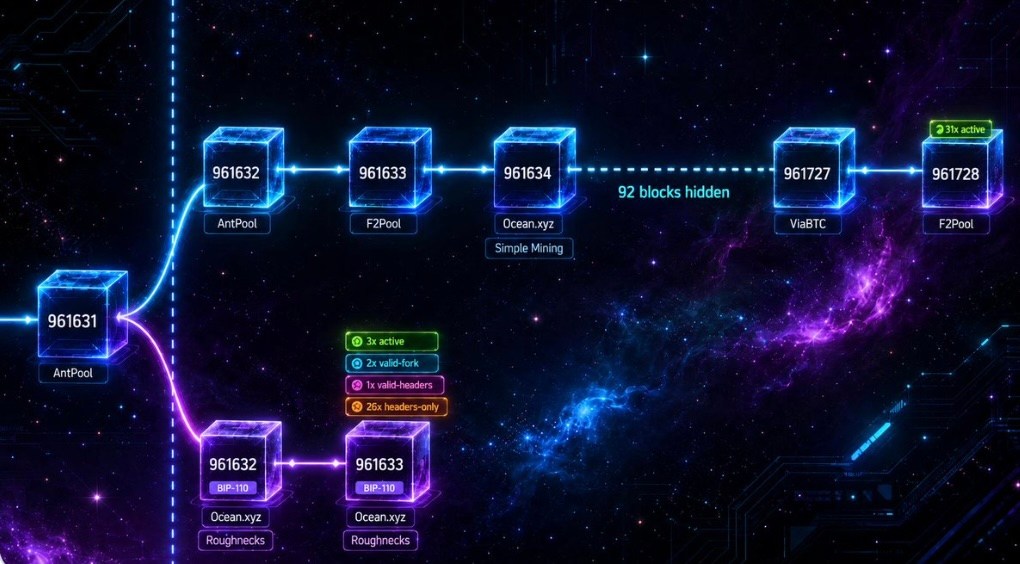
BIP-110, a proposed Bitcoin soft fork, failed to win majority support from the community. The dispute around it was larger than a failed protocol vote: it turned into a direct fight over whether Bitcoin should filter non-financial data at the consensus layer, whether miners should have censorship powers, and how far a minority faction can push a rule change without broad agreement.

At a private Bitcoin gathering in Los Angeles, engineers who supported BIP-110 explained their case with a simple question: if some criminal proceeds are obscured and miners do not know it, should those flows be subject to community review? Even after the proposal was rejected by most of the Bitcoin community, that line of argument remained central to the camp backing it.
How BIP-110 became a public Bitcoin fight
BIP-110 was pushed by a small group of developers and node operators as a soft fork meant to restrict non-financial data and preserve what supporters described as Bitcoin’s “pure” nature. One of the best-known advocates was Luke Dashjr, founder of the OCEAN mining pool. OCEAN previously raised a $6.2 million seed round led by Block CEO and Twitter co-founder Jack Dorsey.
The proposal met immediate resistance. Strategy founder Michael Saylor and Blockstream CEO Adam Back both spoke out against it, and the two sides soon carried the fight onto X.
OCEAN’s profile on X states: “On a mission to radically decentralize Bitcoin Mining.” That slogan placed BIP-110 inside a larger argument about who controls block templates, what belongs on-chain, and whether decentralizing mining infrastructure should include transaction filtering.
Luke Dashjr, Bitcoin Knots and the OCEAN stack
Dashjr is a veteran U.S. software engineer who has been involved in the Bitcoin Core open-source community since the early 2010s and has maintained nodes for years. During the 2013 chain split bug tied to version 0.8, he helped with the emergency fix that restored mainnet operations.
In 2023, he also co-founded OCEAN, a Bitcoin mining pool launched at the Future of Bitcoin Mining conference in El Salvador with funding from Dorsey. OCEAN’s stated goal was to break the grip centralized mining pools have over block template construction and return that power to individual miners.
Dashjr has long opposed Ordinals, BRC-20 and inscriptions. He argues that these products exploit loopholes to inject non-financial data into Bitcoin, congest the network and waste resources. That view is reflected in Bitcoin Knots, the alternative Bitcoin client he maintains. Knots limits data carriers above 42 bytes and is used to filter what he considers “data garbage.”
Bitcoin Knots is also the node software used by OCEAN for mining, making it the technical base for the pool and the main platform behind Dashjr’s push for BIP-110.

Dashjr has also argued that the Bitcoin node count is much higher than common estimates suggest. In a research paper written at the University of Bristol, he said many estimates, including BitNodes, undercount non-listening nodes. BitNodes reports about 10,000 active Bitcoin nodes, while Dashjr believes the real total exceeds 100,000 once non-listening nodes are included.
Why Jack Dorsey backed OCEAN
According to past media reports cited in the article, Dorsey backed OCEAN because he wanted to counter the growing centralization of Bitcoin mining pools. In that view, traditional pools hold too much custody-related power and too much control over block template construction, creating counterparty risk.
OCEAN’s model uses a non-custodial design and the DATUM protocol, sending rewards directly to miners and handing block construction power back to them. The argument for the model is that it improves transparency and reduces dependence on pool operators.
Still, the article says the market response to OCEAN leadership’s support for BIP-110 has been cold. Its hashpower share has fallen from an earlier peak to about 1%, suggesting that most miners have not lined up behind that position.
Critics said paying users should keep access to block space
The central dispute was whether Bitcoin should filter non-financial data such as Ordinals, BRC-20 tokens and unnecessary witness data at the consensus layer. Supporters said this material bloats the chain, raises the cost of running nodes and pulls Bitcoin away from its role as peer-to-peer electronic cash.
Critics took the opposite position. Their view was simple: if a user pays the required fee, that user has the right to use block space.
Saylor said trying to decide which paid transactions are valid amounts to imposing purity through administrative command and would damage Bitcoin’s permissionless neutrality. Back also argued that subjective filtering would hurt the network’s predictability and create a dangerous precedent for censorship at the network level.
Back’s warning on governance and compatibility
Back’s objections were not limited to principle. He also argued that forcing a user-activated soft fork with support from only a very small share of hashpower lacked broad social consensus.
He added that the restrictions introduced by BIP-110 could make some pre-signed transactions that rely on specific script paths unspendable, raising the risk of frozen funds. He also said the proposal could impair BitVM or Taproot-related functions and cause serious collateral damage.
The proposal also faced criticism over technical limits. Bitcoin engineer Peter Todd ran an experiment showing that non-financial data could still be wrapped into formats that complied with the rules, highlighting the possibility that BIP-110’s filtering system could be worked around.
Too little hashpower left the fork near paralysis
One of the biggest practical obstacles for BIP-110 was support at the mining level. The article says the main chain retained about 97.4% to 97.5% of hashpower and remained stable, while nodes supporting BIP-110 controlled only about 2.5% to 2.6%.
With hashpower spread that thin, block production on the forked chain stretched from hours to as much as half a day. Because Bitcoin adjusts difficulty roughly every two weeks, the article says it could take nearly three years for that fork to complete a single adjustment cycle under those conditions.
That would leave the chain in a near half-paralyzed state, with sharply lower confirmation efficiency and growing difficulty for miners trying to collect block rewards. Over time, that also raised the risk that the chain would be pushed to the margins.
More than a technical experiment
The pro-BIP-110 side opposed having Ordinals, images, NFTs, BRC-20 and other non-financial data stored on-chain. Their argument was that miners cannot know the true source of funds or judge whether a flow is legitimate, so some form of review should exist.
Opponents said that reasoning cut against Bitcoin’s original philosophy. Saylor focused on permissionless neutrality. Back emphasized that a fee-paying transaction sender should be allowed to use block space. In their reading, BIP-110 was an attempt to force a censorship regime into consensus rules without securing broad support first.
ABMedia framed the failure as more than a routine governance miss. On the surface, BIP-110 was a soft fork experiment that did not pass. But when a proposal backed by only a very small circle of developers draws public criticism from some of the most prominent Bitcoin figures, the dispute itself becomes part of Bitcoin’s historical record.