

Debate over Bitcoin Improvement Proposal 110 has picked up again as its August mandatory window draws closer. BIP-110 was introduced by Dathon Ohm in December 2025 and is backed by Bitcoin Core developer Luke Dashjr. The proposal would restrict arbitrary and non-monetary data in Bitcoin transactions for one year, aimed mainly at Ordinals, Bitcoin NFTs, and other large data storage uses. Its stated goal is to cut down what supporters describe as “spam transactions” and keep Bitcoin focused on monetary use.
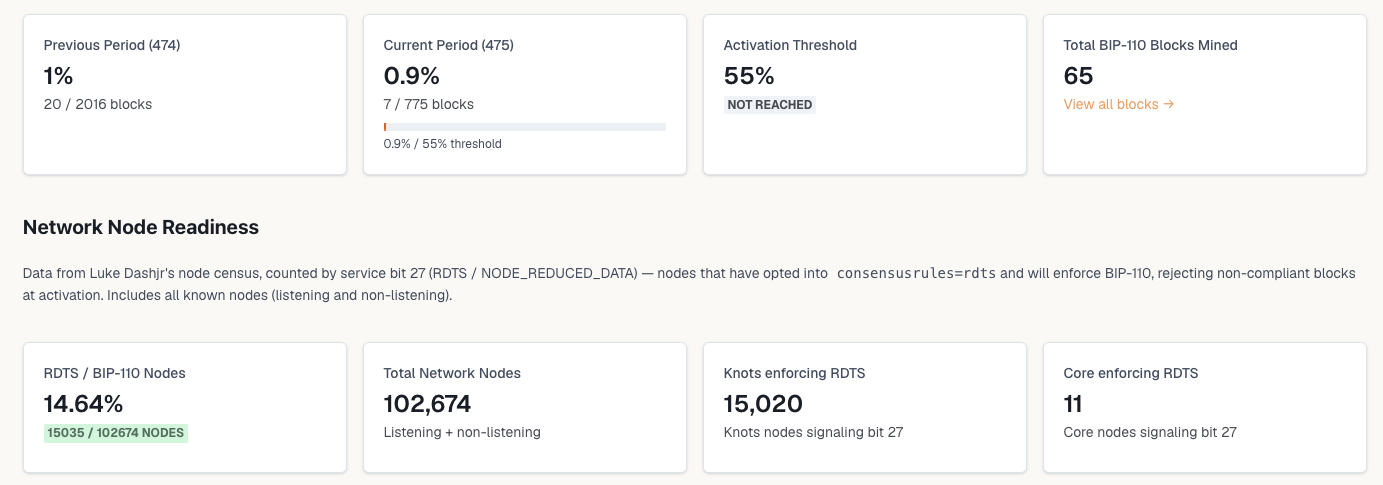
So far, though, BIP-110 has not won broad support from miners or nodes. The activation threshold is set at 55%. Current figures show miner support at below 1%, while only 15,035 out of 102,674 nodes across the network are willing to enforce BIP-110, equal to 14.64%.
Why the activation path has become the center of the dispute
Under normal conditions, a proposal with support this low would not be expected to pass on Bitcoin. What makes BIP-110 unusually contentious is that its supporters plan to enforce it even without broad consensus.
If BIP-110 does not reach the 55% threshold before block height 961632, it moves into a mandatory window covering heights 961632 to 963647. During that period, nodes running BIP-110 would reject non-compliant blocks. Under the proposal’s design, that would force acceptance to 100% among those nodes and lead to activation at block height 965664.
At the current Bitcoin block production pace, that mandatory window would begin in early August. In practice, that means a chain split could appear even though BIP-110 is framed as a soft fork proposal. One chain would follow BIP-110 rules; the other would remain the main chain without them.
Bitcoin’s longest-chain rule still applies. Only if miners backing BIP-110 control a majority of real hash power, more than 50%, could that branch become the longest chain and pull the wider network onto the new rules. That is why forced activation on paper does not settle the issue. Whether BIP-110 survives would still depend on actual consensus. Without it, the proposal could end the way many earlier Bitcoin soft-fork efforts did: by fading out on its own.
Supporters say BIP-110 is not a change but a rejection of change
The best-known supporters of BIP-110 are Luke Dashjr and his mining pool, Ocean. Dashjr has long been one of the more hardline critics of BRC-20 and inscription-based uses in the Bitcoin developer community, and he also contributed draft suggestions to the proposal.
That camp does not want Bitcoin block space used for purposes other than BTC transfers. In the proposal, inscriptions that emerged in 2022 are described as a form of “Bitcoin attack.” The argument is that embedding arbitrary data in transactions places a large and unnecessary burden on nodes, consumes block space, and forces monetary transactions to bid higher fees just to get included.
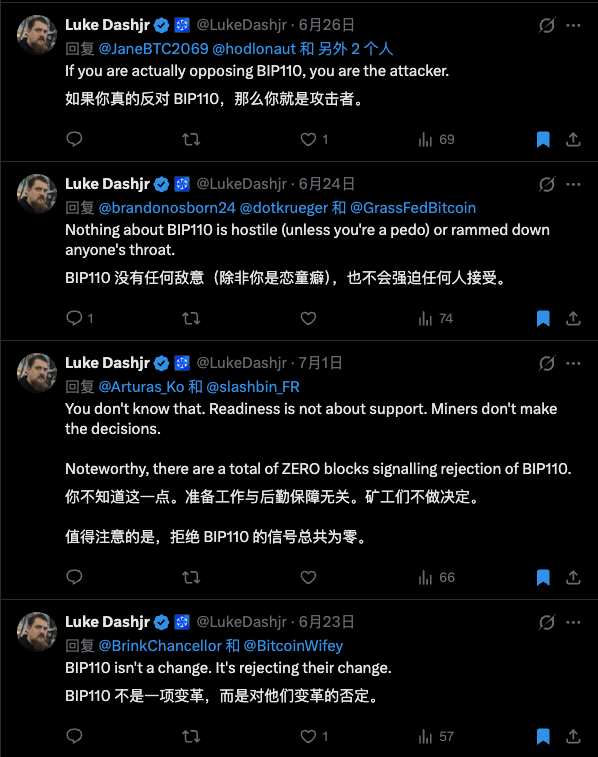
Dashjr wrote on X that BIP-110 is not a change but a rejection of change. In exchanges with critics, he argued on one side that BIP-110 carries no hostility and forces no one to accept it, while also saying those opposing it are the real attackers of Bitcoin.
Even with miner voting support for BIP-110 still below 1%, Dashjr has remained optimistic. His view is that direct miner opposition is also close to zero, suggesting miners are not making the decision themselves and will follow once BIP-110 activates.
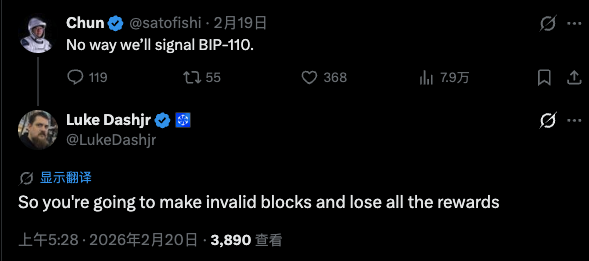
In public terms, the only mining pool openly backing BIP-110 at this stage is Ocean. F2Pool co-founder Wang Chun said as early as February that he would never support BIP-110. Dashjr replied under that post, “Then you’ll mine invalid blocks and lose all rewards.”
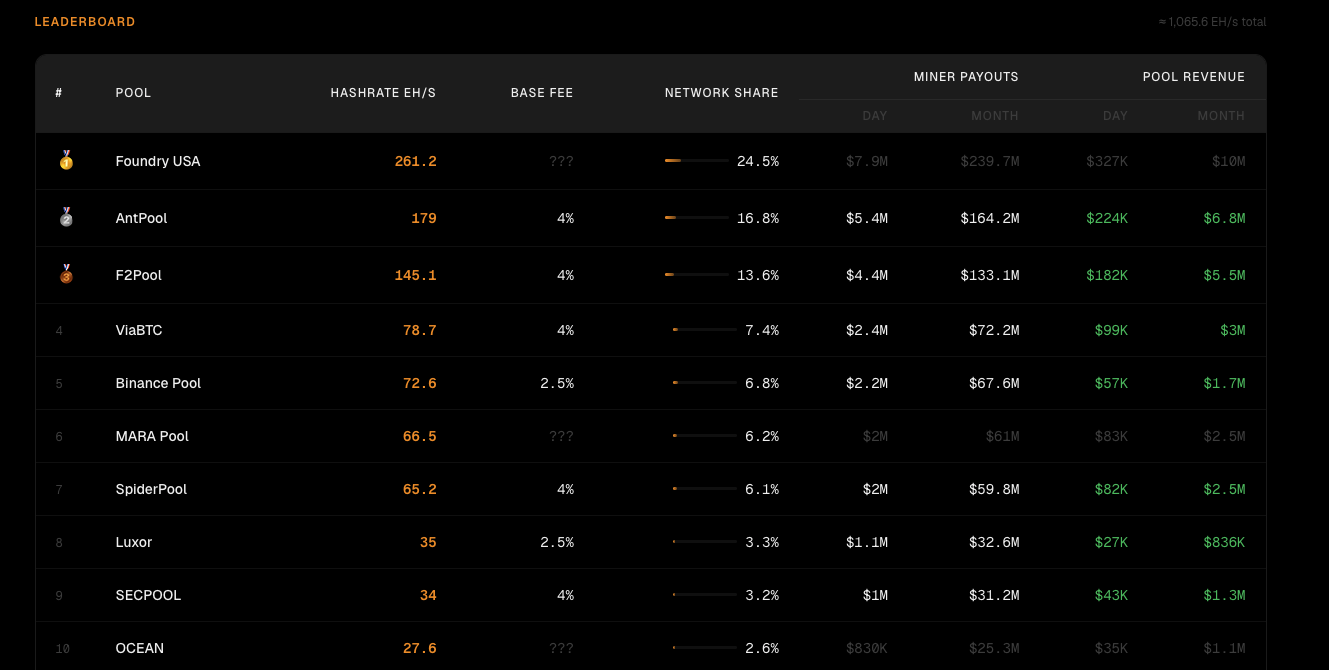
According to miningradar data, F2Pool is the third-largest Bitcoin mining pool, with 13.6% of network hash rate. Ocean currently has 24.6 EH/s, equal to 2.6% of the network total. If Ocean ends up as the only pool supporting the forked chain, it would produce just 3 to 5 blocks per day. That would not be enough to form the longest chain on Bitcoin.
Opponents say the proposal solves little and creates new risks
Criticism of BIP-110 is not limited to whether activation would work. Opponents argue that the proposal does not actually solve Bitcoin’s spam problem and may open the door to more serious issues. The most visible critics include cypherpunk pioneer Adam Back, Bitcoin Core developer Jameson Lopp, and Strategy founder Michael Saylor.
One of their main objections is that BIP-110 would not fully eliminate spam transactions. The proposal itself acknowledges that it could only provide temporary relief. Lopp argues that Bitcoin’s block size limit and fee market already do some of the work of discouraging spam. In his view, Bitcoin remains vulnerable to this kind of attack because too few people are actually using the network, keeping fees low and preventing enough pricing pressure from building up to deter most spam activity.
Another concern is future development on Bitcoin. The proposal states that restrictions on Taproot would hinder advanced functions or complex contracts, including efforts such as BitVM. Although BIP-110 is described as a one-year temporary measure, Lopp argues that this is only a delaying tactic from Dashjr. If such limits materially block future upgrades, the outcome could shift from a soft fork dispute into a hard fork.
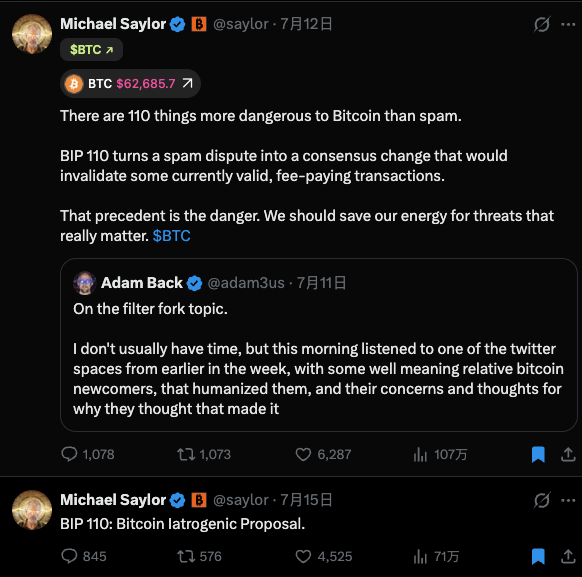
Back has focused more directly on censorship resistance and decentralization. He argues that BIP-110 would introduce subjective filtering of transactions inside blocks, which amounts to regulating what others may do on-chain. In his view, that runs against the neutrality and censorship resistance Bitcoin has held up since its creation. Saylor, for his part, has described BIP-110 as a “Bitcoin Iatrogenic Proposal,” suggesting the treatment itself would injure Bitcoin instead of fixing the existing problem.
Saylor also argues that if BIP-110 becomes consensus, some transactions that are valid today and pay fees would become invalid, and that setting such a censorship precedent is the more dangerous move.
A broader fear among opponents is that activation could fracture the Bitcoin ecosystem. Two competing chains could emerge, each claiming to be the real Bitcoin. In that kind of contest, uncertainty over which chain will prevail could create double-spend risk. Even without double spending, if BIP-110 turns into a separate chain, Bitcoin’s developer resources, hash power, and monetary consensus could all be split.
In that view, BIP-110 is trying to use a technical fix to settle what is really a cultural dispute, and the process could produce more problems than it resolves.
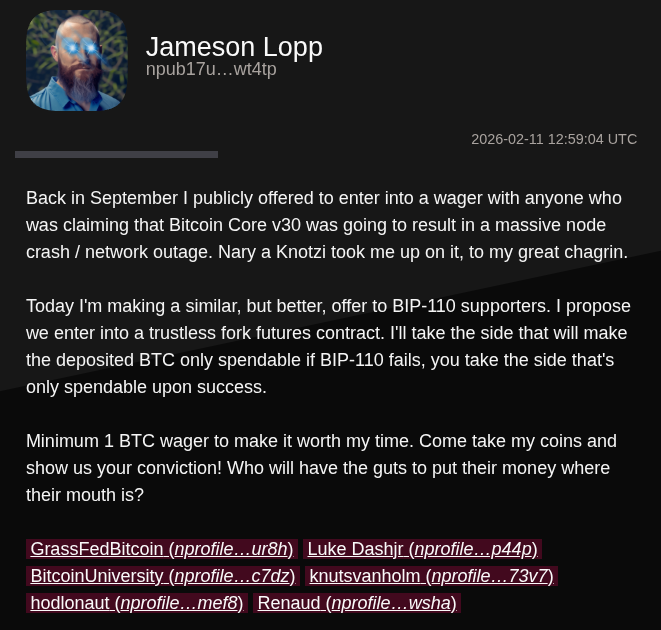
Despite those warnings, opponents appear confident the proposal will fail. Lopp put up a wager on BIP-110 back in February, with a minimum stake of 1 BTC. As of now, no BIP-110 supporter has publicly accepted it.
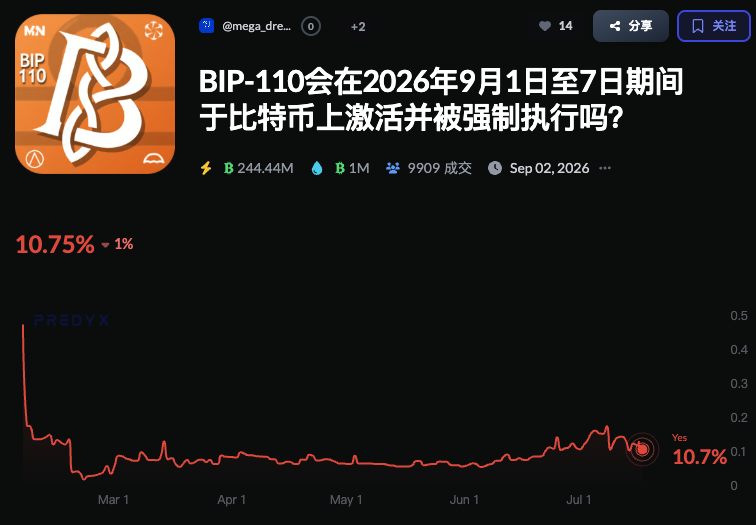
On prediction market Predyx, the probability that “BIP-110 will activate and be enforced on Bitcoin during Sept. 1 to Sept. 7, 2026” stands at 10%. The market’s settlement rule for “Yes” requires the BIP-110 chain to become the Bitcoin longest chain and be accepted by most nodes.
What could happen if activation reaches block 965664
Several scenarios are being discussed for what follows if BIP-110 is forcibly activated at block height 965664, a point the article places in late August to early September.
The first scenario is the simplest. Once the activation height is reached, BIP-110 nodes reject blocks from the main chain, but not enough miners are willing to produce blocks that comply with the new rules. In that case, block production on the BIP-110 chain slows sharply and could eventually stop.
The second scenario is that some miners do support BIP-110. Its backers argue they hold an “asymmetric advantage” because BIP-110 uses stricter rules. Nodes running BIP-110 would reject blocks containing prohibited data such as inscriptions, but mainstream Bitcoin Core nodes that do not run BIP-110 would still consider blocks from BIP-110 nodes to be valid.
They also point to current block space composition. Inscription transactions now account for 5% of Bitcoin block space, while more than 95% remains conventional BTC transfers. That means BIP-110 nodes could still accept a large share of mainstream blocks. This is one reason Dashjr believes BIP-110 could still become the longest chain and unify the network.
The third scenario is that some miners support BIP-110 but the chain never overtakes the existing majority branch in hash power. Miners are generally highly rational: once machines are switched on, they start burning electricity. In a two-chain competition, miners weigh rewards against risk. Those mining on the BIP-110 branch may be more likely to abandon sunk costs and move back to the majority chain, because a minority branch would be shorter and would also yield less BTC in cumulative rewards. If that happens, the outcome circles back to the first scenario.
There is also a more extreme case. If Dashjr’s influence proved strong enough and miners continued to mine the BIP-110 chain despite weak economics, that chain could keep running independently, though block times could be slow and miners would be spending energy with little economic rationale. In that situation, a more plausible end state would be a permanent split into a separate chain backed by BIP-110 supporters, with block difficulty adjusted manually and a new network token introduced.
Dashjr has repeatedly said he does not want BIP-110 to become a hard fork, arguing that the moment for that has not arrived. Even so, if events moved in that direction, outside observers would still be watching whether supporter pressure could force a different outcome.
Technically, a minority chain run by BIP-110 supporters could continue to exist. Whether it could do more than survive would depend on economics and ecosystem support, including wallets, exchanges, and users. Bitcoin has seen many examples in this category. Most have failed. Even among those that did continue as separate assets, the ceiling has largely looked like BCH or BSV rather than Bitcoin itself.