
BIP-110 formally entered a soft-fork phase last weekend, then ran into trouble within hours. The split chain mined only one additional block before stalling, while the gap with the main chain kept widening. Roughnecks, the group that had led the push behind the proposal, later said it would stop mining and urged other miners to step back for the time being.
Ocean, which served as the main source of signaling hash rate, dropped from roughly 36 EH/s to 1.25 EH/s over a single weekend, a decline of more than 90%. That left it nowhere near the 55% lock-in threshold set for BIP-110. Roughnecks did not call the effort a failure, though. It described the setback as an 「upgrade to the next step」 and said it planned to return.
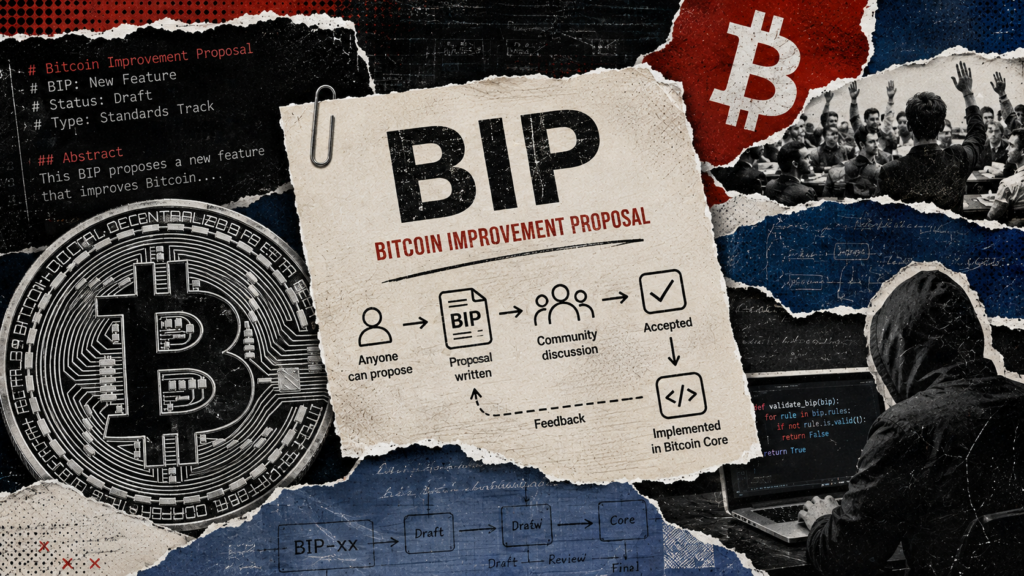
Anyone can submit a BIP
The BIP-110 episode has revived a simple question: who is allowed to submit a Bitcoin Improvement Proposal? According to the article, the answer is broad. Anyone can do it, and the barrier to filing one is low.
A BIP is the formal document structure used by the Bitcoin community for proposals covering consensus rules, peer-to-peer protocol changes, and wallet standards. There is no identity screening built into the process. A submitter does not need to be a Bitcoin Core developer, does not need to hold a certain amount of BTC, and does not need to use a real name. The article notes that Satoshi Nakamoto was anonymous, and that the author of BIP-110 is anonymous as well.
BIP 3 now governs the submission process
The current procedure is defined by BIP 3, which took effect in 2025 and replaced BIP 2 after nine years of use. Under that framework, the process broadly follows three steps.
First comes discussion on the mailing list. A proposer sends the idea to the bitcoindev group at bitcoindev@googlegroups.com and gathers feedback on feasibility and community interest. Many ideas are challenged at this stage, either because similar proposals have already been raised or because the technical path does not hold up.
Second, the idea is written up as a formal draft. The document has to follow the required structure, including a summary, motivation, technical specification, and backward-compatibility analysis. If the proposal changes consensus rules, it also has to explain its activation method.
Third, the proposer opens a pull request to the bitcoin/bips repository. The article stresses that authors do not assign their own numbers. BIP editors review whether the submission fits the format and scope requirements, then assign a number and merge it into the repository.
Up to that point, the threshold is mainly procedural: complete formatting, a reasonable scope, and prior discussion. The article compares BIP editors to journal editors rather than judges. Their job is to filter for document quality, not to decide whether a proposal should win. That is why a highly contentious proposal such as BIP-110 could still receive a number.
The hard part comes after submission
The article argues that filing a BIP is not the real challenge. Getting it through the system is.
First hurdle: editorial acceptance
This is the easiest stage. Clearing it means only that a proposal has been formally registered. Under BIP 3, proposal status is simplified into four categories: Draft, Complete, Deployed, and Closed. Most numbered proposals never move beyond Draft.
Second hurdle: rough consensus
Bitcoin has no board, no formal voting system, and no foundation that can settle a proposal by decree. To move forward, a change has to persuade developers and users across mailing-list threads, technical meetings, and community forums that it is necessary, safe, and worth the tradeoffs.
There is no fixed numeric test for this stage, which is why it is often the hardest one. The article says BIP-110 stalled here: it may have been technically workable, but the community was deeply divided.
Third hurdle: activation
Even if code lands in Bitcoin Core, a soft fork that changes consensus rules still needs real-world network adoption. Miner signaling is a common coordination tool. The article points to earlier examples: SegWit used a 95% threshold, Taproot used 90%, and BIP-110 set its own bar at 55%. In practice, it struggled to reach even 3%.
The article also says miner signaling is only one coordination layer. The final veto sits with economic nodes. If exchanges, wallets, and users do not run software that enforces the new rules, the forked chain does not gain economic value. The BIP-110 branch that mined two blocks and then died is presented as a direct example of that rule in action.
Easy to file, hard to convince the network
By that logic, anyone can begin the BIP process today. Sending an email to the bitcoindev mailing list is the first move.
What the system is designed to do, the article says, is keep proposal submission open while making approval extremely difficult. No individual or institution can change Bitcoin on its own, including the proposer. In the case of BIP-110, the author had a full document, an official number, backing from well-known developers, and even a push toward a forced fork. That still was not enough to overcome the network’s lack of adoption.
The article frames that silent rejection as part of the reason Bitcoin is still standing after 17 years.