
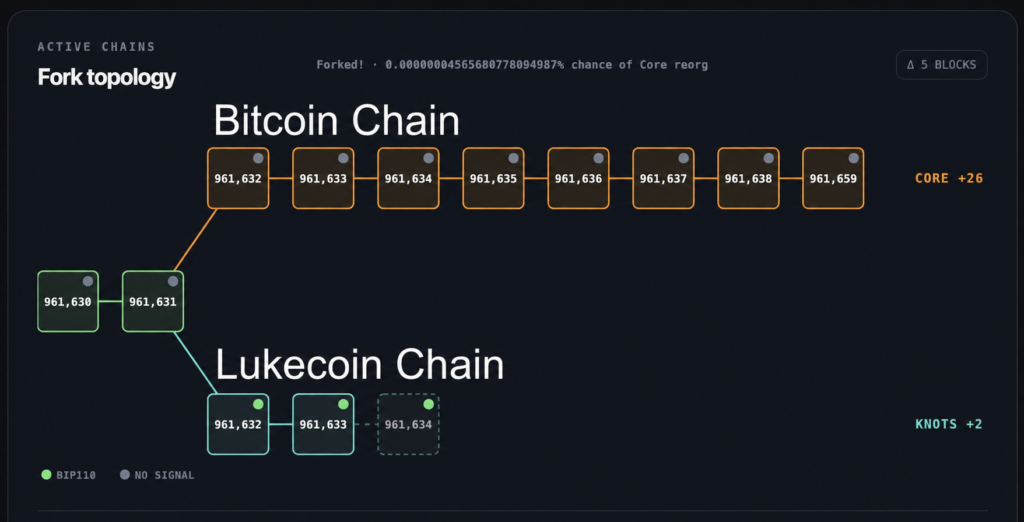
Bitcoin split into two branches early on Aug. 9 at block 961,632 after BIP-110 entered its mandatory signaling phase. The break did not produce two evenly matched camps. Nodes enforcing BIP-110 immediately began rejecting blocks from the main network and moved onto a minority chain of their own. Based on the information provided, BIP-110 has effectively failed as a user-activated soft fork, or UASF.
The fork point was block 961,632. AntPool, one of Bitcoin’s largest mining pools, mined the first block that did not include the BIP-110 version bit 4 signal. The broader Bitcoin network accepted that block without interruption, but nodes running BIP-110 rules rejected it as invalid. By 10 a.m. Taiwan time, the main chain had advanced to block 961,659, while the BIP-110 branch remained at 961,633. It had produced only a second block and was trailing by 26 blocks.
How mandatory signaling led to the split
Bitcoin soft-fork upgrades such as Taproot and SegWit have typically relied on miner signaling. Under that process, miners that support an upgrade add a specific marker to the block header to show they back the change. In BIP-110’s case, that marker is versionbit 4.
The input describes two stages. The first is a voluntary signaling period, during which miners can choose whether to include the support bit in blocks they mine. The second is the mandatory signaling phase. If the voluntary period ends without reaching the required threshold, and the proposal includes a hard deadline, nodes running that proposal begin requiring every newly mined block to carry the support marker. Blocks without it are treated as invalid and rejected.
That is what triggered this split. The main Bitcoin network kept following blocks without the BIP-110 signal, while BIP-110 nodes stopped tracking the main chain and remained on a branch recognized only by themselves.
BIP-110’s rules and timeline
BIP-110 was written by pseudonymous developer Dathon Ohm. Its formal name is “Reduced Data Temporary Soft fork.” The proposal introduces a set of consensus-layer restrictions lasting about a year, with the stated goal of suppressing non-financial data storage on the Bitcoin chain.
- Most new output scripts would be limited to 34 bytes
- OP_RETURN outputs would be capped at 83 bytes
- Some data pushes and witness elements would be limited to 256 bytes
- Certain Taproot functions would be temporarily restricted
- Unspent transaction outputs, or UTXOs, created before activation would be exempt
Those restrictions are scheduled to activate at block 965,664. They would remain in place for 52,416 blocks, or roughly one year, before automatically expiring.
55% threshold versus 2.53% support
Bitcoin upgrades usually require broad miner agreement. According to the source material, BIP-110 uses a modified BIP9 deployment method that asks for 55% miner signaling, equal to 1,109 blocks in each 2,016-block period. That bar is lower than the traditional 95% threshold. If natural signaling falls short, though, the proposal moves into a mandatory signaling window. That is the stage reached early on Aug. 9.
Data from the BIP-110 monitoring page showed that only 51 blocks in the final signaling period before the split carried support, equal to 2.53%. That was far from the 55% needed. The source says most of those signals came from Ocean, which has been the most active supporter since the first BIP-110 block appeared in March 2026.
Adoption of node software that supports BIP-110, described mainly as a Bitcoin Knots variant, was estimated at between 2% and 8%, though the same source noted that those figures are themselves disputed.
Critics warned about chain-split and compatibility risks
The input says opponents of BIP-110 had already warned that this path could lead to a split.
Blockstream co-founder Adam Back wrote on X: “This simply won’t work, it breaks multiple mechanisms, there is no technical consensus and no ecosystem consensus, and it has all four fatal flaws. Everyone hates spam data, but this is not the way. You will hurt yourselves.”
Bitcoin security expert Jameson Lopp also published a detailed analysis calling BIP-110 “reckless and doomed to fail.” According to the source, he pointed to several issues: split risk, the possibility of unspendable UTXOs in Taproot edge cases, the inability to truly stop data storage over the long term because data can be embedded through other methods, and added compatibility burdens for wallets, Miniscript tools, and pre-signed transactions.
MicroStrategy Executive Chairman Michael Saylor published a 110-point argument against BIP-110 in July. His central position, as described in the input, was that consensus rules should address threats that have been proven to exist, not the “perceived purpose” of a transaction. He wrote: “Bitcoin does not need guardians of purity. It needs guardians of neutrality.”
The market barely moved
After news of the split circulated, Bitcoin traded around $65,000 and showed no clear volatility. The source contrasts that with the calm activation of the Taproot soft fork in November 2021. Taproot had broad miner backing before lock-in and did not leave behind a continuing minority chain.
This case is different. BIP-110 entered its mandatory phase with almost no miner support, and the result was a minority fork that fell behind from the start. The branch does not create a separately traded asset on its own. Its survival depends on whether miners continue to support it, and its economic relevance depends on adoption by exchanges, wallets, and infrastructure providers. So far, the source says, those conditions do not look favorable.
What comes next
The split highlights the central problem for BIP-110 supporters: node enforcement can force a divergence, but without mining power there is little chance of maintaining a competitive chain.
- How long the minority chain can survive: if Ocean and Roughnecks keep mining, the branch could continue for several weeks, but difficulty adjustment may stretch block times to several hours and turn it into a low-frequency chain.
- Exchange and wallet decisions: any exchange that supports both chains would face replay-attack risk. The source says most institutions would almost certainly choose the main chain.
- Fallback options: on Aug. 1, BIP-110 supporters discussed a more aggressive backup plan. Bitcoin developer Chris Guida refreshed Luke Dashjr’s earlier proof-of-work modification code, but no activation date has been set.
For now, the chain data described in the input shows a clear picture: BIP-110 supporters are on a branch that has already fallen well behind, while Bitcoin’s main network continues producing blocks on its existing path.