
Bitcoin Magazine has published an opinion piece arguing that the debate around BIP-110 is rooted in a misunderstanding of what a Bitcoin full node is, what it is for, and what it cannot do. The article says that misunderstanding is also why the proposal is likely to fail.
The piece appears under Bitcoin Magazine’s Take section. It states that the views expressed are the author’s own and do not necessarily reflect those of BTC Inc or Bitcoin Magazine.
BIP-110 seeks a soft fork to restrict arbitrary data in transactions
BIP-110 is titled “Reduced Data Temporary Softfork.” As described in the article, it proposes a consensus change that would limit the types and amount of arbitrary data that can be added to consensus-valid Bitcoin transactions by restricting a broad range of Bitcoin scripting capabilities.
The article says the proposal is being led by the pseudonymous developer Dathon Ohm and is widely backed by the Knots community, an alternative Bitcoin implementation associated with early Bitcoin Core contributor Luke Dashjr and his supporters.
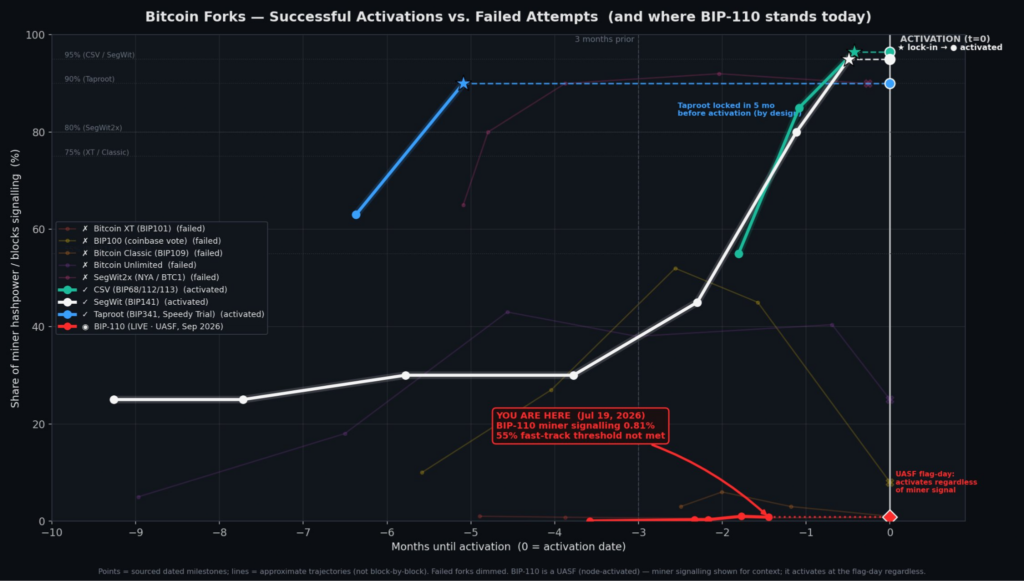
According to the piece, BIP-110 is moving toward a mandatory signaling period in the coming weeks, raising the possibility of a fork from the main consensus rules implemented in Bitcoin Core. To alter Bitcoin consensus, it would need substantial miner support over that period. At the time of writing, miner signaling for BIP-110 was below 1%.
Why the Knots community is rallying behind the proposal
The article says the Knots community includes many Bitcoin users running nodes on devices such as Start9 and Umbrel. It describes their support for Knots as a protest against a series of development decisions made by Bitcoin Core, the main open-source development community and reference implementation for Bitcoin.
It also says that while most senior Bitcoin developers are either opposed to the changes proposed in BIP-110 or largely indifferent to them, the movement has gathered enough momentum to remain a recurring subject on social media. Supporters, the article says, believe that users running Bitcoin full nodes that signal for the proposal can change Bitcoin on that basis alone.
The article’s main argument: full nodes matter, but they have limits
The piece frames much of the current cultural conflict inside Bitcoin as a dispute over the meaning and role of a full node. It points to comments from author and podcaster Knut Svanholm, quoting his post: “Every person on Earth is a node in the Bitcoin network. Most to a minuscule extent, of course, but every node is first and foremost a person, not a machine. Which tools we use to interact with the network (and, by extension, to which extent they influence the network) is entirely dependent on the choices we make.”
The author rejects that definition, calling it technically incoherent and arguing that it dilutes the meaning of the term. In the article’s account, a Bitcoin node is something specific: a full copy of Bitcoin’s entire transaction history, block headers, and transaction-related data. Its job is to let users verify the integrity of Bitcoin’s supply and transaction history against the network’s consensus rules.
From there, the article lays out several concrete functions of a node. One is privacy. Third-party wallet providers generally query their own copy of the Bitcoin blockchain for a user’s balance and send the result back through the wallet app. Most mobile wallets work that way. Only a small number can connect to a locally run user node, in which case the user’s public addresses and balances are not shared with a wallet company.

Another function is checking whether a user remains in consensus with the wider network and stays in sync. If a user mines Bitcoin, or contributes a meaningful amount of hashpower to the proof-of-work network, a node also allows that user to assemble a block and choose which transactions go into it. The article adds that mining a Bitcoin block today is a major challenge because of the network’s difficulty and the level of competition.
The piece also mentions newer mining-pool models such as Ocean, which aim to decentralize block template production and give retail miners more influence over transaction selection. Even then, the article says, those pools still need enough hashpower to win the proof-of-work race, so blocks are mined only sporadically and their influence on the chain remains limited.
Nodes also relay transactions across the network. The article says tens of thousands of nodes communicate in a flood network, allowing even a small number of them to get controversial transactions to miners and bypass filters. It cites Peter Todd’s relay libre as an example. On that basis, the author argues that Bitcoin nodes cannot easily filter what enters the blockchain either.
Why “more nodes” does not equal the power to rewrite Bitcoin consensus
The central claim in the article is that even a large majority of Bitcoin nodes cannot change Bitcoin consensus on their own. The author argues that this cannot happen without large amounts of economic activity flowing through those nodes, as exchanges handle on behalf of millions of users. It also cannot happen, the article says, without support from protocol and application developers, or without backing from investors.
The piece explicitly argues that Bitcoin is not a node democracy. Running a node does not grant what it describes as citizenship in a Bitcoin nation. Citing Satoshi Nakamoto’s white paper, the author says Bitcoin’s ultimate security and governance structure is “one CPU cycle, one vote,” not “one Bitcoin node, one vote.” In that framing, miners performing proof-of-work remain highly sensitive to investor sentiment and to the broader developer community, which is one reason the system is so difficult to change.
As the article puts it, a node ultimately lets a user know whether they are connected to the chain with the most accumulated proof-of-work and whether that chain is following the rules. A node by itself does not let a user alter those rules. The author goes further, saying that users who change the consensus rules of their own Bitcoin node are, by definition, no longer running Bitcoin. That difficulty, the piece argues, is a feature rather than a flaw.
Past fork fights do not prove that retail nodes can win alone
The article says significant work has already been done to map Bitcoin consensus and the groups involved in it. It cites BCAP, an open-source effort by Ren Crypto Fish, Steve Lee, and Lyn Alden that identifies six stakeholder groups: Economic Nodes, Investors, Media Influencers, Miners, Protocol Developers, and Users and Application Developers.
It acknowledges that in past consensus crises, Bitcoin nodes were used to signal support for one version of Bitcoin over another. The 2017 Bitcoin Cash fork and the User Activated Soft Fork are presented as examples often cited by people who argue that economic nodes prevailed against miners. The article recalls that a large majority of mining pools and their corresponding hashpower backed the Segwit2x version of Bitcoin, and many exchanges and companies signed the New York Agreement.
But the author says the node-backed side succeeded because those nodes also had broad support from protocol developers, investors, and media influencers. In other words, they carried economic weight and rough consensus. That, the article argues, is precisely what BIP-110 does not have.
According to the piece, BIP-110 lacks support from protocol developers and does not have enough investors behind it. It notes that Michael Saylor has spoken against the proposal, while many industry leaders have either publicly opposed it or chosen not to engage.
Economic nodes, exchanges, and mining pools do not carry equal influence
The article argues that the Bitcoin Cash split already showed the limits of retail nodes. A node run by an exchange is far more influential than one run by an ordinary user because the exchange introduces large volumes of new transactions to the network. A node run by a major mining pool also has more influence than that of a hobbyist solo miner because it assembles blocks more often and decides more frequently which transactions settle on-chain.
The same logic, the piece says, applies to wallets and exchanges. Most Bitcoin users outside exchanges rely on mobile wallets. In theory, those users and investors can vote with their money by moving their BTC and economic activity to a wallet that reflects their preferred vision of Bitcoin, or to a full node they run themselves. But as long as they remain on mobile wallets that query third-party nodes, their individual influence over consensus stays limited. The article adds that the vast majority of mobile wallets use a Bitcoin Core-compatible back end.
For exchanges, the piece says users effectively delegate consensus decisions to the operators. In some past cases, exchanges have put consensus questions to users and weighted the result by holdings, then reflected that capital-weighted decision back to end users. The author says something similar could happen again around BIP-110.
Foundry has opened hashrate voting, while miner signaling remains below 1%
The article says voting of that kind has already started at Foundry. It identifies Foundry as one of the world’s largest Bitcoin mining pools and says the pool recently emailed its miners to inform them they could vote on the proposal with their hashpower. If support were high enough, Foundry could signal for BIP-110, though the author says that outcome still looks unlikely.
Users who do not vote, the article says, will effectively signal against BIP-110 and support the status quo. In that sense, apathy would amount to a default win for Bitcoin Core. To change that outcome, BIP-110 supporters would need to persuade a majority of Foundry’s hashpower on the cultural level and then get those miners to act against the consensus of Bitcoin Core developers, the most widely used Bitcoin implementation, and the best-supported codebase.
The article says miners are not signaling meaningful support for BIP-110 at present. It adds that by some data sets, this is one of the least supported soft-fork attempts in Bitcoin’s history by miner signaling. Less than 1% of the blocks mined in the current difficulty adjustment period are signaling for BIP-110.
The article’s conclusion: without cross-group backing, a split could produce a small chain
The article concludes that BIP-110 has so far failed to win consensus across Bitcoin’s major interest groups. In the author’s telling, developers, investors, miners, and large economic nodes do not support the proposed consensus change.
From there, the piece says the likely outcome in the coming weeks is a chain split. It warns that such a split could carry meaningful consequences for Lightning wallets running on BIP-110-compliant nodes and could end with the creation of a new but small blockchain that would probably need to change its proof-of-work system to remain alive.
The article is titled “Bitcoin is NOT Changed by Proof Of Node” and was written by Juan Galt. It first appeared on Bitcoin Magazine.