

Bitcoin is still building a bottom, but the character of that process is changing, according to Glassnode. The firm said long-term holder capitulation has started to cool, buyers absorbed the selling seen at the June lows, and price is now lifting back toward the area that had capped previous rebounds.
In its report, Glassnode said the market has begun testing overhead resistance. Bitcoin reacted more strongly to softer inflation data than any major equity index, marking its most constructive response to positive news in several weeks. The report also said Bitcoin’s correlation with stocks is loosening while its inverse relationship with the US dollar is getting stronger, with liquidity now playing a larger role than simple risk appetite.
Macro pressure is still centered on real rates
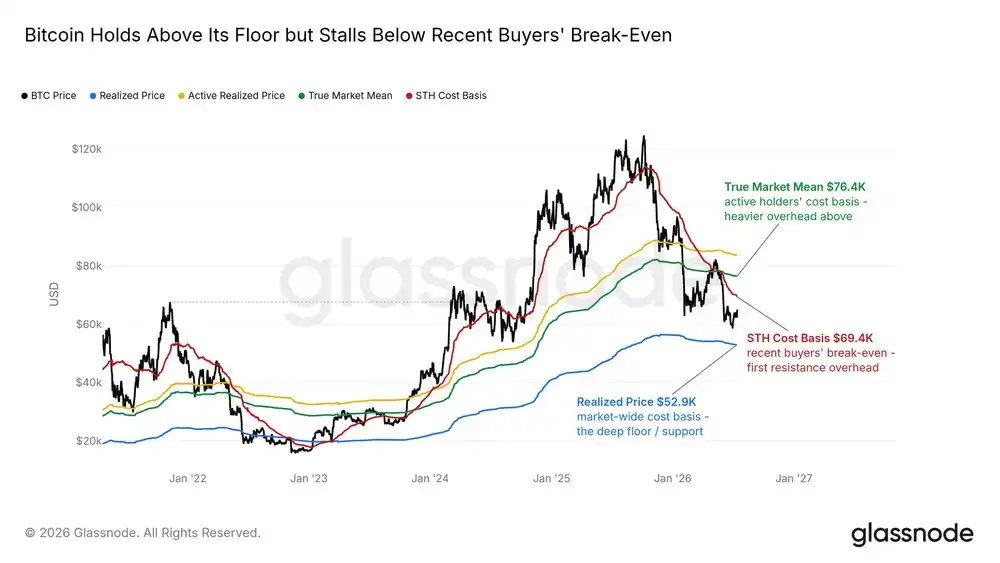
Glassnode said the pressure on Bitcoin this quarter has been, at its core, a real-rates story rather than a broad risk-off move. The 10-year real yield has climbed to around 2.4%, close to its 2026 highs, while the dollar has held above its 200-day moving average since May.
At the same time, the broader risk complex has not shown the same strain. Equities remain near their highs, credit spreads are low, and volatility is still subdued. In Glassnode’s view, that gap matters because it suggests Bitcoin’s weakness has not simply mirrored a broad retreat across risk assets.
Bitcoin led the rebound after softer inflation data
Following Tuesday’s softer inflation print, Bitcoin outperformed other major assets. Glassnode said BTC jumped quickly after the data release and went on to beat both US and European equities over the week. After spending about a month moving sideways near the lows, the market has started responding to favorable news again.
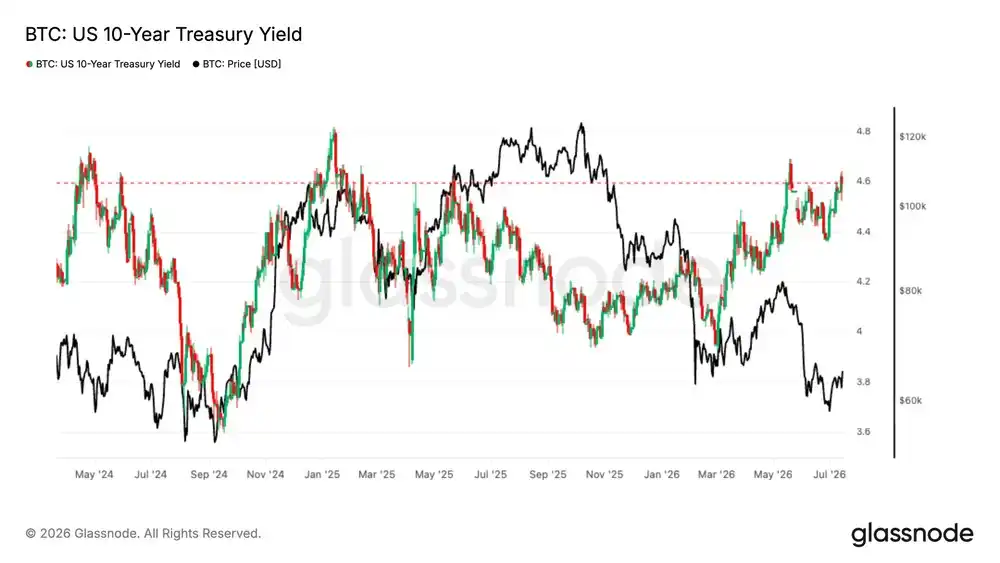
That kind of sensitivity is itself meaningful, the report said. A market that rushes higher on a single inflation release often points to exhausted sellers, with buyers waiting for a reason to step in.
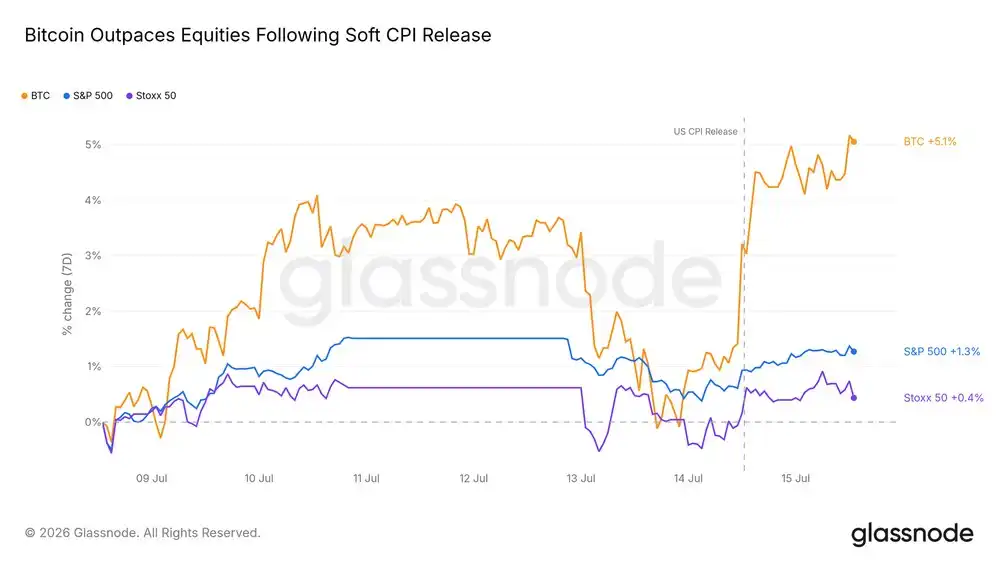
Glassnode also said the macro driver behind Bitcoin’s moves has been shifting. Since winter, its correlation with US equities has kept fading, while its inverse relationship with the dollar has deepened. Bitcoin has not stopped behaving like a risk asset, but the dollar and liquidity channel now appear to matter more than equity sentiment. If macro conditions begin to ease, Glassnode said that channel is the one most likely to transmit first.
Price is trapped between realized price and the short-term holder cost basis
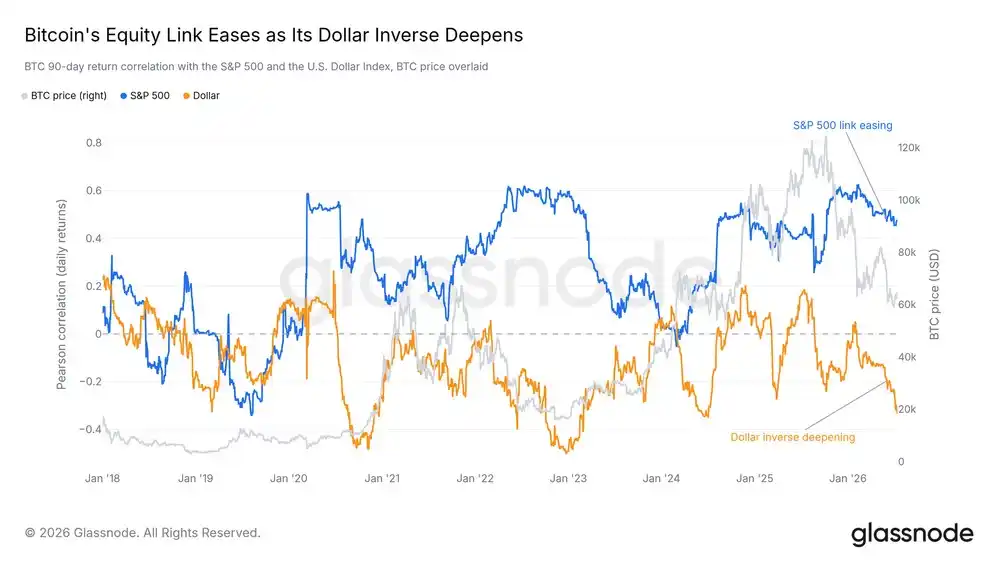
On-chain cost basis data gives a precise map of where Bitcoin sits, according to the report. Price is above the network’s realized price, which Glassnode described as natural support in a bear market, but still below the short-term holder cost basis near $69,000, the average entry price for buyers from the past five months.
That leaves the current recovery pushing into a clear break-even resistance zone. Glassnode said many underwater buyers are still sitting above the market, waiting for a chance to exit. The first test of that level could trigger a strong reaction, because traders who are closest to getting back to even are often among the most likely to sell. A clean reclaim would open more room for the recovery. Rejection would leave the market stuck in its range.
Profit-taking by long-term holders has largely dried up
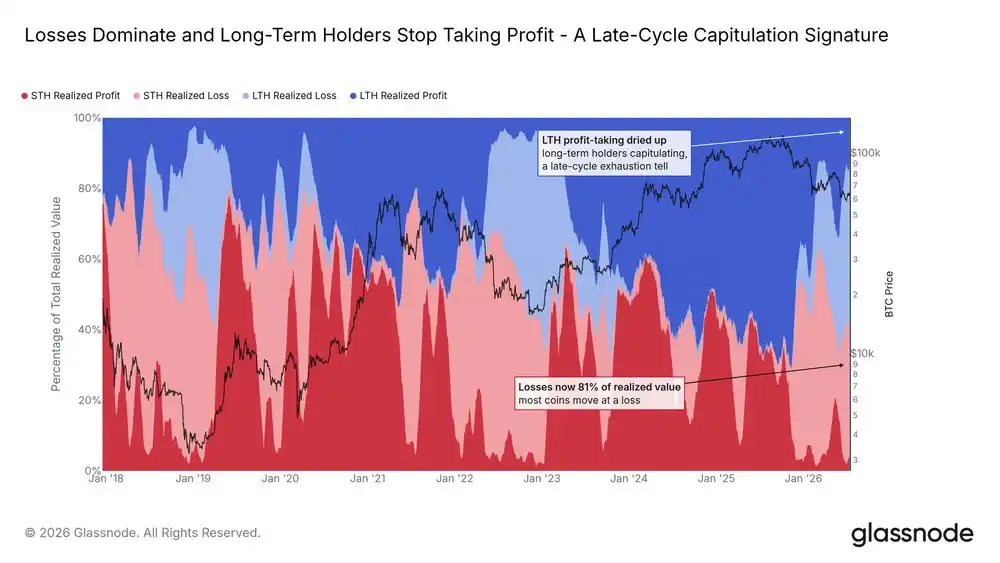
Glassnode said its relative realized profit and loss framework for long-term and short-term holders splits on-chain selling into four groups: experienced holders and newer holders, each selling either in profit or at a loss. For most of this cycle, profit-taking by long-term holders dominated sell-side flow.
That flow has now nearly disappeared. The report said veteran holders who are still selling are mostly exiting losing positions. At the same time, loss-taking from both long-term and short-term cohorts now accounts for much of the on-chain activity, a pattern Glassnode described as typical of the later stages of a bear market.
The more important change is that the share of selling coming from long-term holders has stopped growing. The waves of supply that met each rally this year are no longer expanding.
Capitulation has started to cool
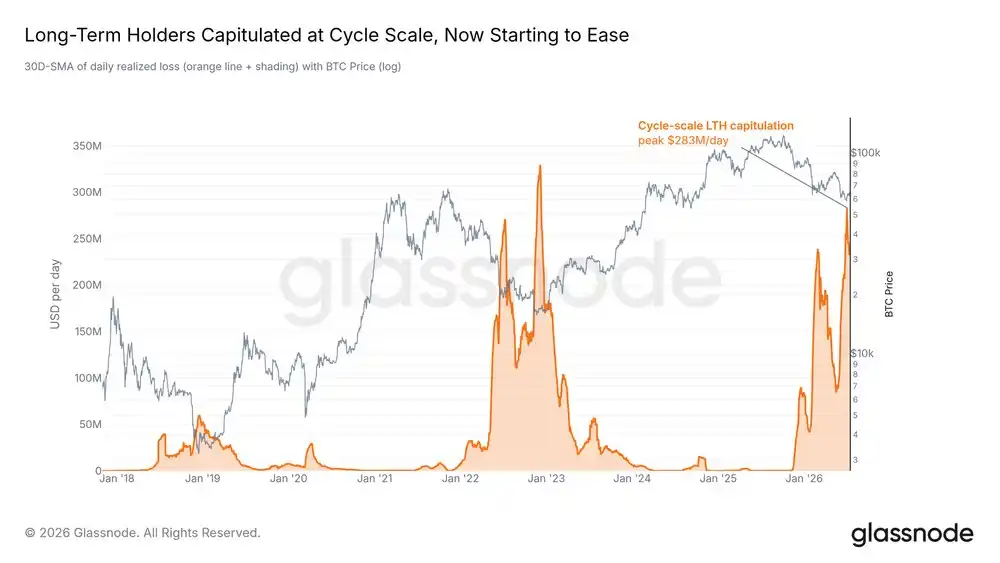
Glassnode called the pace of capitulation the market’s most important current indicator. Its entity-adjusted realized loss metric for long-term holders removes internal transfers and is meant to show how much older capital is truly giving up each day. That measure hit a cycle peak two weeks ago, and in last week’s report, Glassnode said cooling in that indicator was a precondition for any durable recovery.
It has now started to roll over. The firm said one decline is not enough to prove exhaustion, and a fresh shock could still restart the selling. Even so, this is the first time in the current cycle that a core bottoming indicator has shifted from rising to falling. The sellers that drove this bear phase are starting to run out at the margin.
Buyers absorbed the coins sold into the June lows
As older holders capitulated, buyers stepped in. Glassnode said accumulation trend scores broken down by wallet size showed a broad and strong wave of buying around the June lows, spanning small holders through large wallets.
Once price stabilized, that intensity faded and the market moved into a wait-and-see phase. The coins sold at the lows found buyers. Whether those buyers come back with the same strength on the next move will help decide whether this bottom can hold.
ETF outflows have slowed, but inflows have not returned
US spot Bitcoin ETFs are telling a similar story of pressure that has eased without fully disappearing, Glassnode said. Redemption pressure has fallen sharply from the extreme levels seen in June, pointing toward stabilization.
But the channel is not fully repaired. One day this week still recorded the largest single-day outflow in several weeks, followed by only a partial rebound the next day. Until steady inflows return, Glassnode said this remains a market where institutions have stopped fleeing but have not started buying again.
Derivatives traders are backing away from bearish positioning
Derivatives markets have moved in the opposite direction over recent weeks. Glassnode said the options put/call ratio has dropped to its lowest level of the year, showing traders are allowing bearish protection to expire. Perpetual futures funding rates are only slightly above neutral and remain far from crowded long conditions. In other words, bearish bets are being unwound steadily.
Still, the report stressed that position-closing is not the same as fresh buying in spot markets. Repositioning in futures and options does not amount to direct capital entering BTC on the spot side, and Glassnode called that one of the clearest warnings inside the current rebound.
Crash protection premiums are easing and max pain is back in view
The premium paid for downside protection in options, measured through 25-delta skew, surged during the June sell-off and has been falling since then. It now sits well below the extreme reached in February. Hedging each pullback has become noticeably cheaper than it was a month ago.
Demand for protection is still there, Glassnode said, which is reasonable given that the lows have not been confirmed. But the broader direction is normalization. At the same time, spot Bitcoin is trading just below max pain, the price at which the largest share of open options would expire worthless, and is challenging that level for the first time in weeks.
Historically, Glassnode said, reclaiming max pain has often lined up with a shift toward a friendlier market backdrop, though that change can take time. A clean move above it would mark the first structural signal of an upside break from the range. Failure there would reinforce the caution still embedded in options pricing.
Volatility has compressed toward one-year lows
Absolute crash protection costs tell the same story. One-month downside hedges have steadily become cheaper during the recovery, showing that demand for protection has weakened. The market is still paying a premium for downside exposure, but far less than it did at the lows.
On a longer view, Glassnode said Bitcoin’s DVOL volatility index is near a one-year low. The deep bearish pressure that appeared in February and June has faded from the volatility surface. That kind of compression rarely lasts for long and often forms the backdrop for the next decisive move.
What Glassnode says to watch next
Glassnode said the bottom is still under construction, but this week brought an early response. Long-term holder capitulation has backed off from its peak, profit-taking has dried up, and broad buying absorbed the selling seen at the June lows. Bitcoin has reacted more strongly than other assets to favorable macro data, is pressing up from below max pain, and is approaching the short-term holder cost basis overhead. That area is likely to be the first real test of the recovery.
Confirmation, however, has not arrived yet. ETF outflows have slowed but not reversed into stable inflows. Derivatives short-covering has not been matched by spot demand. Volatility compression is still waiting for a catalyst.
The report pointed to three signals that could shift the outlook: spot-led buying that pushes Bitcoin cleanly above and holds it over the short-term holder cost basis; a renewed acceleration in realized losses among long-term holders; or a rejection that sends price back toward realized price and leaves the market trapped in its range again.
The foundation is there, Glassnode said, but follow-through has yet to appear.