


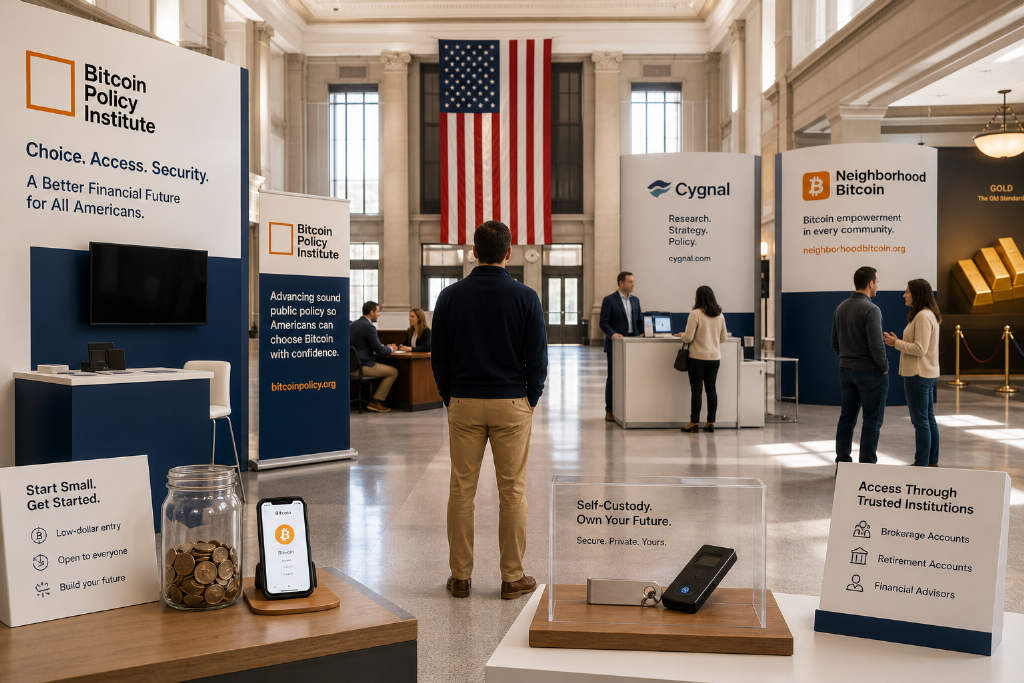
A new survey from the Bitcoin Policy Institute, produced with polling firm Cygnal and education group Neighborhood Bitcoin, found that the "digital gold" framing that has defined Bitcoin messaging for more than a decade is losing force with many Americans. Respondents were more receptive to messages about having control over their own assets, being able to start with a small amount, and accessing Bitcoin through familiar financial institutions.
The study covered 1,516 U.S. respondents. It included eight in-person focus groups held in Ohio and Tennessee, along with a 1,000-person message validation test. Researchers tested 19 different Bitcoin narratives and found that the "digital gold" pitch created confusion in focus groups and ranked near the bottom in the national testing.
Three themes stood out in the testing
Among the 19 messages, the strongest responses clustered around three themes.
- Control: Messages stressing that people can decide how much to invest and do not need to go all-in drew positive reactions. Respondents also reacted well to the idea that someone could start with as little as $10.
- Proven performance: References to Bitcoin’s historical returns across past four-year cycles resonated more strongly.
- Security and ease of use: Messages saying people could gain exposure through established financial firms such as Fidelity and Charles Schwab reduced concerns that Bitcoin is too complicated or unsafe.
52% were classified as a persuadable middle
The survey grouped respondents into three segments. The "persuadable middle" accounted for 52% of the total and included:
- 32% who were curious but still watching
- 20% who were under financial pressure and had no current crypto exposure
For this group, broad claims such as Bitcoin overturning the financial system landed less effectively than a more concrete message: you can start now, through an interface you already know, with a small amount of money.
Before and after exposure to the 19 messages, the share of respondents saying they were "not interested at all" fell from 39% to 32%. The share saying they were "very" or "extremely" interested rose from 19% to 24%. Overall net interest shifted by about 12 percentage points.
Who carries the most weight
The study also tested which kinds of messengers were most effective in recommending Bitcoin. The results ran against common crypto social media assumptions.
- Personal financial advisors: 33%
- Retirement planning experts: 25%
- Friends or relatives who already own Bitcoin: 23%
Celebrities and influencers ranked near the bottom. In the report’s framing, the next wave of Bitcoin adoption may come more from advisor offices and retirement account conversations than from calls on X.
What the findings suggest for exchanges, ETFs and policy advocates
The report pointed to several practical use cases.
- Exchanges and ETF providers: Emphasize familiar interfaces, small allocations and recurring purchases instead of asking users to first buy into a full monetary philosophy.
- Financial advisors: Position Bitcoin as one portfolio decision rather than an all-in or all-out bet.
- Policy advocates: Arguments centered on consumer choice and personal control may be accepted more easily by mainstream audiences than rhetoric about replacing the current financial system.
A shift in how Bitcoin is presented
The findings point to a structural change in the U.S. market: Bitcoin’s adoption bottleneck may be moving from awareness to presentation. The report says that, after the launch of Bitcoin ETFs in 2024, traditional financial institutions such as Bank of America and Charles Schwab have been able to legally offer Bitcoin exposure, lowering the barrier for retail access to crypto. Even so, the study argues that if marketing still leans on abstract themes such as inflation hedging, digital gold, or financial disruption, the 52% persuadable segment may remain out of reach.
The research also notes that raising interest does not automatically translate into actual purchases. With Bitcoin trading around $78,000, the question of how to get more people to start may matter more than repeating what Bitcoin is.