

Bitcoin fell to its lowest level of September on Tuesday as traders watched a US Senate procedural vote on the CLARITY Act and dealt with a broad jump in global bond yields. BTC dropped to $75,560 at the Wall Street open, with risk assets under pressure across markets.
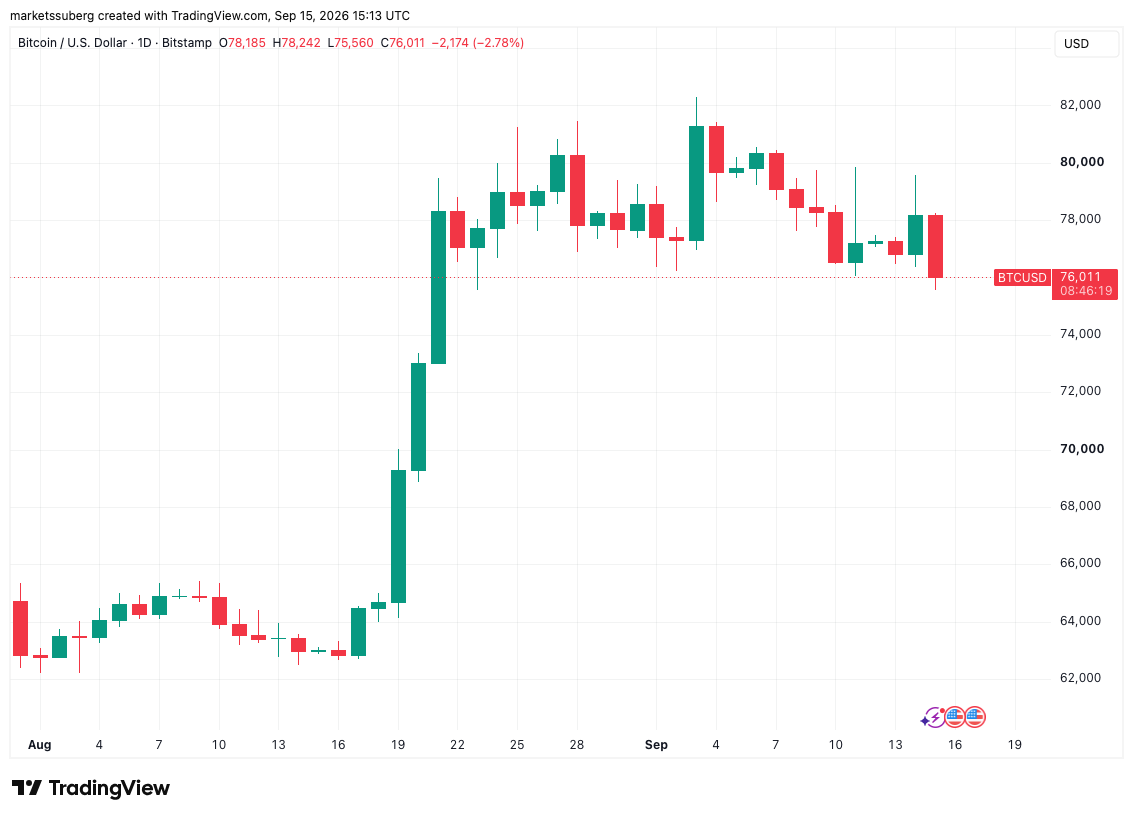
TradingView data showed BTC/USD slipping below $76,000 after rising to $79,600 the day before.
CLARITY Act vote leaves crypto traders cautious
Crypto markets stayed tense ahead of the Senate’s procedural vote on the CLARITY Act, scheduled for 2:15 p.m. Eastern. If the bill receives the required 60 votes, it will move to debate on the Senate floor.
Cointelegraph had reported earlier that consensus pointed to very limited odds of success, even though some sources were optimistic. As of Tuesday, Polymarket users were assigning the CLARITY Act just a 14% chance of becoming law in 2026.
Trading firm QCP Capital said in an analysis published Monday that even if the bill cleared Tuesday’s procedural vote, the immediate market effect would likely be limited because several legislative hurdles would still remain.
QCP wrote: 「The bill’s passage would clarify the respective regulatory roles of the SEC and CFTC, potentially strengthening the medium-term case for institutional adoption by reducing regulatory uncertainty.」
It added: 「However, procedural progress does not guarantee final passage, and the timing of remaining legislative steps will determine the immediate market impact of any vote this week.」
Bond yields climb around the world
US stocks turned negative on the day while bond yields in major economies climbed back to levels not seen in decades. The US 10-year Treasury yield moved above 5% for the first time since November 2023 and later reached 5.041%, its highest level since June 2007.
Reuters reported that the average 10-year yield across the world’s seven largest economies had risen to 4.285%, the highest reading since mid-2008, around the peak of the Global Financial Crisis.
Bond moves in the UK and Japan also drew attention. The UK 30-year yield climbed to 5.95%, the first time it had reached that level since March 1998, while Japan’s 10-year yield touched 3.04%, a 30-year high.
Oil-driven inflation worries add to market stress
Part of the move in yields was tied to concern over a fresh wave of global inflation linked to high oil prices. As conflict in the Middle East widened, several key transit routes faced risk. WTI crude approached $105 per barrel on Tuesday and was heading toward its highest level since early May.
Research outlet The Kobeissi Letter said central banks were likely to tighten policy in response and raise rates. It said the US Federal Reserve was widely expected to increase its benchmark rate by 0.25% on Wednesday, while the Bank of Japan was also expected to raise by 0.25% at its Friday meeting.
In a post on X, The Kobeissi Letter wrote: 「It’s clear what’s coming next. Monetary policy is shifting, rate hikes are returning, and the next battle against inflation has started. Just as we saw Treasury intervention in the US, the UK will likely soon intervene. Yields are simply unsustainable at current levels.」
Against that backdrop, Bitcoin and other risk assets remained under pressure as bond yields set fresh macro highs and oil above $100 a barrel stayed at the center of market concern.