

Bitcoin was trading near $64,000 at the time of writing, leaving it down almost 50% from its cycle high. Even so, the drawdown remains shallower than in many prior cycles. The 2025 rally was powered by ETF inflows, post-halving momentum and renewed institutional demand, sending Bitcoin to an all-time high of more than $126,000 in October 2025. Since then, the trend has turned decisively lower, but analysts still disagree over what the decline actually represents.
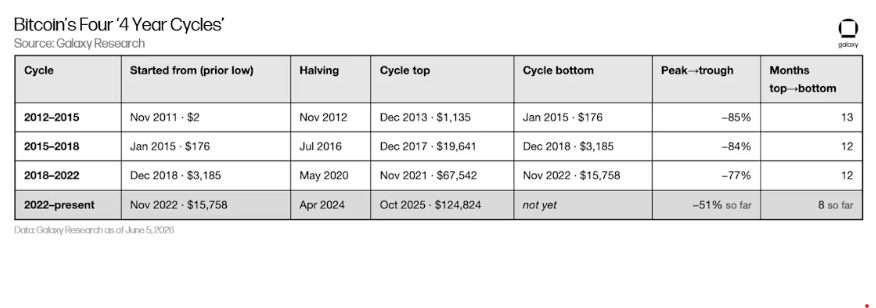
On one side are bullish institutional desks that argue Bitcoin may already have set its cycle low last month. Their case rests on structural demand from spot ETFs, treasury companies and improving long-duration capital flows, all of which they believe reduce the odds of a much deeper washout. On the other side are analysts who see conditions consistent with a late-stage bear market, but not yet a confirmed bottom. The split is no longer only about price targets. It is increasingly about how a “cycle bottom” should be defined in a market reshaped by ETFs, macro liquidity and cross-asset capital rotation.
Bearish camp warns macro and liquidity risks are still in control
Among the more cautious voices is Russell Thomson, chief investment officer at Hilbert Capital. He told Cointelegraph that Bitcoin remains in a downcycle and is likely to break below recent lows before establishing a durable base. In his view, the market structure is still being driven primarily by global macro conditions and liquidity rather than by crypto-native signals.
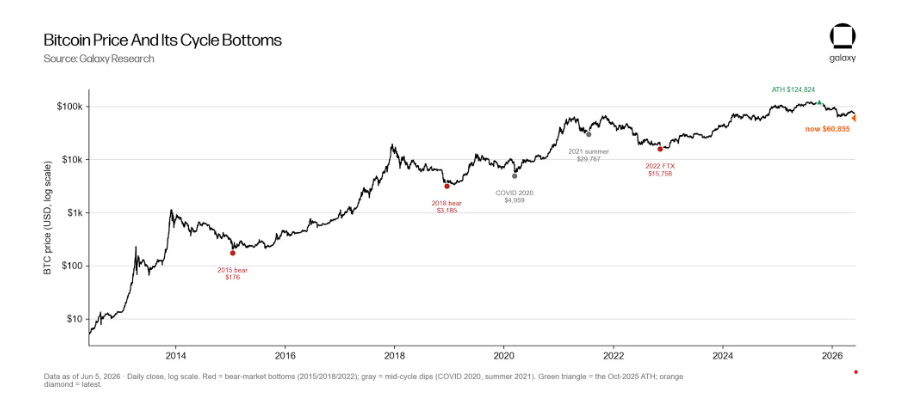
Thomson expects Bitcoin to revisit the $56,000-$52,000 range first, which corresponds to the lows seen in the summer of 2024. If weakness extends, he believes the market could slide further toward $40,000-$45,000, an area tied to earlier consolidation in the 2024 structure. In timing terms, he said Bitcoin’s broader four-year rhythm still appears broadly intact, with a potential low around October 2026, although he added that policy changes could bring that forward.
He specifically pointed to potential Fed rate cuts or passage of the US CLARITY Act as developments that could accelerate a bottoming process. But his larger point is that institutional participation has not insulated Bitcoin from macro cycles. Instead, he argues, it has made the asset more sensitive to global liquidity conditions, leaving it to trade more like a high-beta macro instrument than a detached crypto-native asset.

That interpretation is broadly echoed by Citibank analysts. On July 1, they cut their 12-month Bitcoin target to $82,000 from $112,000, arguing that deeper integration with traditional financial markets has increased Bitcoin’s correlation with risk assets and macro liquidity rather than reducing volatility. From this perspective, ETF adoption changes the investor base, but it does not eliminate downside risk when broader market conditions deteriorate.
Late-stage bear market thesis: exhaustion signals are emerging
A more constructive, though still cautious, view comes from André Dragosch, head of research for Europe at Bitwise. Dragosch told Cointelegraph that the current backdrop looks like a late-stage bear market, with several indicators suggesting downside exhaustion is already taking shape.
He noted that sentiment has deteriorated to levels last seen after the collapse of FTX in 2022, a period commonly associated with seller fatigue. In other words, the market may be approaching a point where much of the forced or emotional selling has already taken place. Even so, Dragosch does not believe the cycle low has been formally confirmed. His position is that the final bottom may be very close, but it has not yet been definitively established because no single indicator can reliably identify a cycle trough.

Dragosch also emphasized that market structure has changed meaningfully. The rise of ETFs and institutional participation has increased off-chain trading and weakened the reliability of some historical cycle indicators. Signals that may have worked better in previous Bitcoin eras now have to be interpreted with more caution. Still, he argued that downside risks appear increasingly limited at current levels.
If macro conditions stabilize, Dragosch said Bitcoin could even begin outperforming artificial intelligence equities in the coming months. That is a notable point because it frames Bitcoin not just as a crypto asset, but as part of a wider contest for global risk capital.

Galaxy Research made a similar observation in June, saying traditional cycle signals had not fully reset and that more downside could not be ruled out. In Galaxy’s base case, Bitcoin could fall to $40,000-$46,000, depending on how liquidity and macro conditions evolve from here.
A structural view: the wrong question may be “when will Bitcoin bottom?”
Dean Chen, an analyst at Bitunix Exchange, offered a more structural reading of the market. He said Bitcoin is still in decline, but that decline is now increasingly defined by competition for global liquidity rather than by internal crypto market structure alone. Following the approval of US spot Bitcoin ETFs in 2024, Bitcoin gained a more persistent institutional bid and a more durable capital base. Yet that same development also embedded it more directly into the broader global allocation cycle.
Chen argues that Bitcoin is now competing head-on with some of the largest capital narratives in world markets, especially artificial intelligence and equities. In his words, the larger challenge is not Bitcoin itself, but the fact that capital continues to flow toward AI infrastructure, stocks and other high-growth opportunities. That framing changes how cycle analysis should be understood.

In Chen’s view, asking when Bitcoin will bottom may no longer be the most useful framework. The more relevant question is when crypto will again become the most attractive destination for global risk capital. That is a subtle but important shift. It suggests Bitcoin’s price floor may depend less on internal capitulation dynamics than on when investors decide to rotate back toward crypto relative to other macro themes.
He also highlighted the rising role of derivatives in price discovery. Funding rates and open interest now exert much more influence over short-term moves than they did in prior cycles. As a result, Bitcoin may not print a clean V-shaped bottom at all. Instead, it could spend an extended period building a structural base while capital, positioning and macro conditions gradually reset.
The debate is now about the meaning of a bottom itself
What emerges from these competing views is a deeper disagreement over how Bitcoin’s cycle structure should be defined. Thomson sees a macro-driven downcycle that has not yet fully run its course. Dragosch sees a late-stage bear market where exhaustion signals are visible, even if final confirmation is still missing. Chen argues that Bitcoin is now embedded in a larger contest for global capital, making traditional bottom-calling models increasingly incomplete.
That leaves the market in an unusual position. The question is no longer just where Bitcoin might bottom, but whether a bottom is still a single event at all in a market shaped by ETFs, institutional balance sheets, derivatives and cross-asset liquidity flows. For traders and allocators alike, the next phase may depend as much on monetary policy, legislation and global capital rotation as on Bitcoin’s own historical cycle patterns.