
Bitcoin Magazine has published an excerpt from Leon Wankum’s Digital Real Estate, arguing that Bitcoin can be understood through a real-estate analogy.
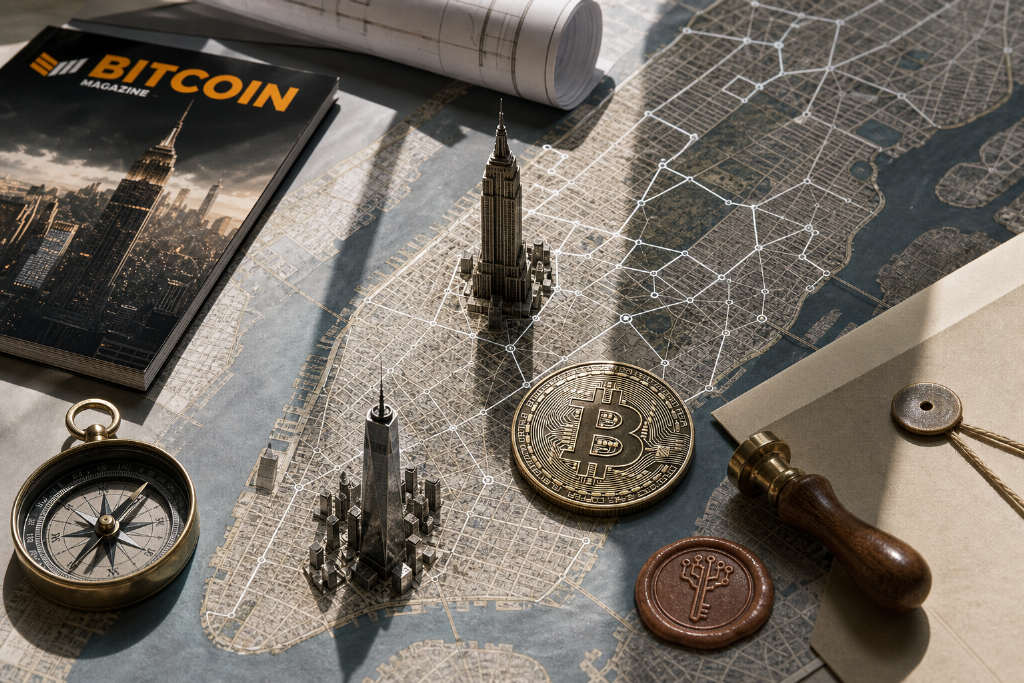
In the piece, Wankum points to comments from Michael Saylor, executive chairman and co-founder of Strategy, formerly MicroStrategy, who has compared investing in bitcoin to buying real estate in downtown Manhattan during the city’s early development. As population, commerce, and cultural activity concentrated there, demand for limited land rose sharply and property values followed. Wankum writes that many of the world’s wealthiest families built fortunes by owning scarce real estate.
His argument starts with scarcity. Real estate in dense urban centers tends to command higher prices than property in less populated areas because prime land is limited. While real estate has utility value for living and production, Wankum says prices are driven in large part by constrained supply in sought-after locations. He names Manhattan, London, Shanghai, Mumbai, Paris, Beijing, Tokyo, and Venice as examples where the number of buildable properties is inherently limited. What gives those places their value, he writes, is the concentration of people, capital, creativity, and energy on top of them.
The excerpt says land values do not rise in isolation. They rise because they capture expanding economic activity that is difficult to replicate or move elsewhere. Wankum also argues that fiat monetary expansion channels additional liquidity into real estate, pushing nominal prices beyond levels justified by utility and income generation alone. Speculation and widespread expectations of future price increases can deepen the perception of scarcity.
He applies the same logic to Bitcoin. Like prime real estate, Bitcoin gains value as more people, capital, economic activity, and trust accumulate around it. At the same time, the economic network built on top of Bitcoin — financial infrastructure, global adoption, liquidity, and digital connectivity — can continue to expand across digital networks without a matching expansion in the monetary base beneath it.
Wankum says internet-based adoption unfolds globally and continuously, at a much faster pace than physical-world economic expansion, which remains constrained by geography.

Still, he marks a sharp distinction between the two assets. Real-estate prices are influenced by development potential, location-specific utility, and relative scarcity, and that scarcity is often intensified by regulation and public policy. Tax incentives for investors, zoning laws, and restricted building permits can artificially reduce supply and push prices higher. Speculative behavior and expectations of continued gains can amplify that effect, making scarcity look more absolute than it really is.
Bitcoin, by contrast, has what Wankum describes as absolute scarcity. Its supply is fixed at 21 million, beyond policy decisions or political interference. That difference, he argues, matters when evaluating assets, because it separates naturally fixed scarcity from scarcity shaped by outside controls.
Under that framework, owning bitcoin resembles owning a plot in a growing, borderless economy that is not tied to any government or geography. As more people and businesses adopt Bitcoin, the value of that digital plot rises. The major difference is mobility. A digital plot is not anchored to a physical place and can be transferred globally within minutes. Unlike land, Bitcoin allows value to move quickly and with relatively low friction across borders, limited mainly by network conditions and liquidity.
The article also says Bitcoin operates on a global network while producing local effects. By allowing individuals to hold and transfer value without centralized permission, it gives them a way to participate in economic systems that depend less on institutions that can restrict access, exclude participants, or change rules unilaterally.
Wankum extends the analogy through Bitcoin’s accounting model. In a traditional bank account, value is recorded as a balance held by an institution. On Bitcoin, ownership is defined through direct control of individually defined units known as unspent transaction outputs, or UTXOs, which are recorded on the network.
He asks readers to think of each bitcoin as a square of land under a holder’s control until it is spent. Once spent, that square disappears and new squares are created for the recipient. Each UTXO can be transferred on its own or combined with others in later transactions. The result, he writes, is a constantly changing map of property claims secured by cryptography rather than institutional authority.
Wankum also states that the analogy has limits. Bitcoin is not the same as income-producing real estate because it generates no operating cash flow. In his view, it is better understood as a scarce digital asset whose value rests on absolute scarcity and optionality rather than income.
Even so, he writes that Bitcoin shares one important trait with real estate: it can serve as a long-term savings vehicle. He adds that it is also being used increasingly as collateral, supporting credit formation and broader economic activity while absorbing monetary demand. For that reason, Wankum presents real estate as a useful framework for understanding Bitcoin’s changing role in capital markets and monetary systems.
The post first appeared in Bitcoin Magazine and is credited to Leon Wankum.