

Bitcoin has remained stuck in a narrow range even as spot Bitcoin ETF inflows continue, with selling from miners and large corporate holders offsetting a meaningful share of that demand. The market has now spent roughly five straight weeks moving sideways, still waiting for a catalyst strong enough to force a break.
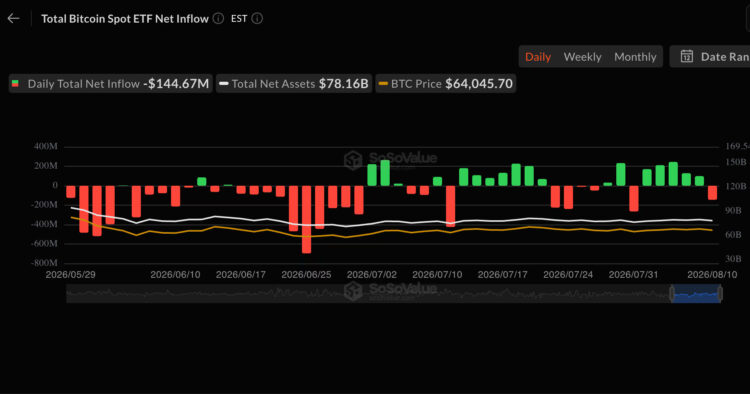
Over the past 24 hours, bitcoin slipped 0.6% to around $63,500. Through most of the summer, the largest cryptocurrency by market value has been pinned between $62,000 and $66,000, with little follow-through in either direction.
ETF demand meets OTC selling
Paul Howard, a senior executive at Wincent, said bitcoin’s recent price action has largely been the result of two forces canceling each other out: steady buying from ETFs and over-the-counter selling pressure from miners and Strategy.
Howard said overall cryptocurrency trading volumes have shrunk to roughly three-year lows, leaving the market without enough capital momentum to drive a decisive breakout higher or lower.
Bitfinex analysts described a similar flow picture. Their team said spot ETFs and companies focused on investing in bitcoin remain the market’s two major price-insensitive sources of demand, meaning they keep buying regardless of short-term moves. But recent selling from mining companies and corporate bitcoin holders has offset part of the ETF bid.
That helps explain why bitcoin managed only about a 2% gain last week even as ETFs continued to draw strong inflows and global risk assets broadly rebounded.
CPI seen as the next test for the range
The next focal point for traders is U.S. inflation data. The latest Consumer Price Index is due on Wednesday, and it may become the key event that breaks bitcoin out of its consolidation pattern.
Jeff Anderson, managing partner at STS Digital, said conviction is weak on both sides of the market, while slow summer liquidity has amplified the wait-and-see mood. As traders look for direction from monetary policy and for progress on the U.S. Digital Asset Market Clarity Act, or the CLARITY Act, implied volatility in the options market has fallen sharply to low levels.
In his view, a move outside the current range, whether upward or downward, could trigger a sharp one-way market.
Anderson also said Wednesday’s CPI report will be the market’s next serious test. He said it is the first major inflation print since Federal Reserve Chair Kevin Warsh spoke about inflation following the Fed’s July meeting.
Range may hold into mid-September
Looking ahead, Howard said the current consolidation could last until mid-September unless a major fundamental bullish catalyst emerges. Progress on the CLARITY Act, he said, could become the next major factor capable of pushing the market out of its current band.
Positioning in derivatives markets also points to caution. Investors are still keeping relatively full hedges in place, suggesting traders are not making aggressive bets on an imminent breakout and are instead waiting for clearer confirmation.
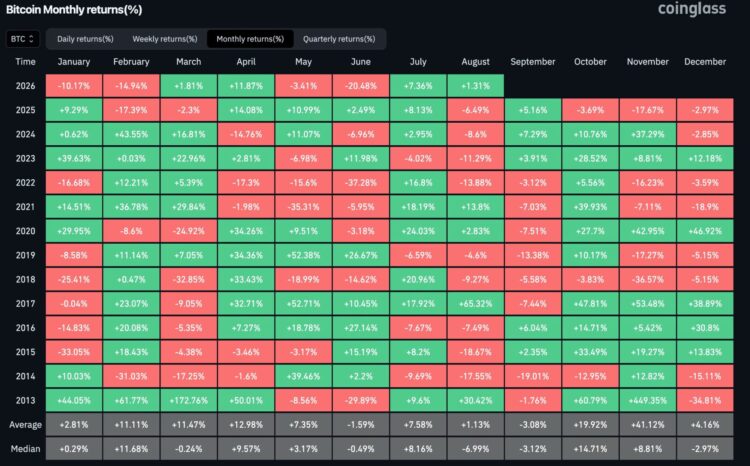
If bitcoin fails to leave the current range soon, seasonal factors may turn less favorable. Anderson said September has historically been bitcoin’s weakest month. According to CoinGlass data, bitcoin has posted an average decline of 4% in September since 2013.