

Bitcoin climbed toward $77,000 over three days and moved back above EMA200 and other bull-market indicators, while Ether rose 20% in a single day and approached $2,400. With BTC stabilizing and ETH starting to catch up, expectations have picked up again for capital to rotate from major tokens into higher-beta altcoins.
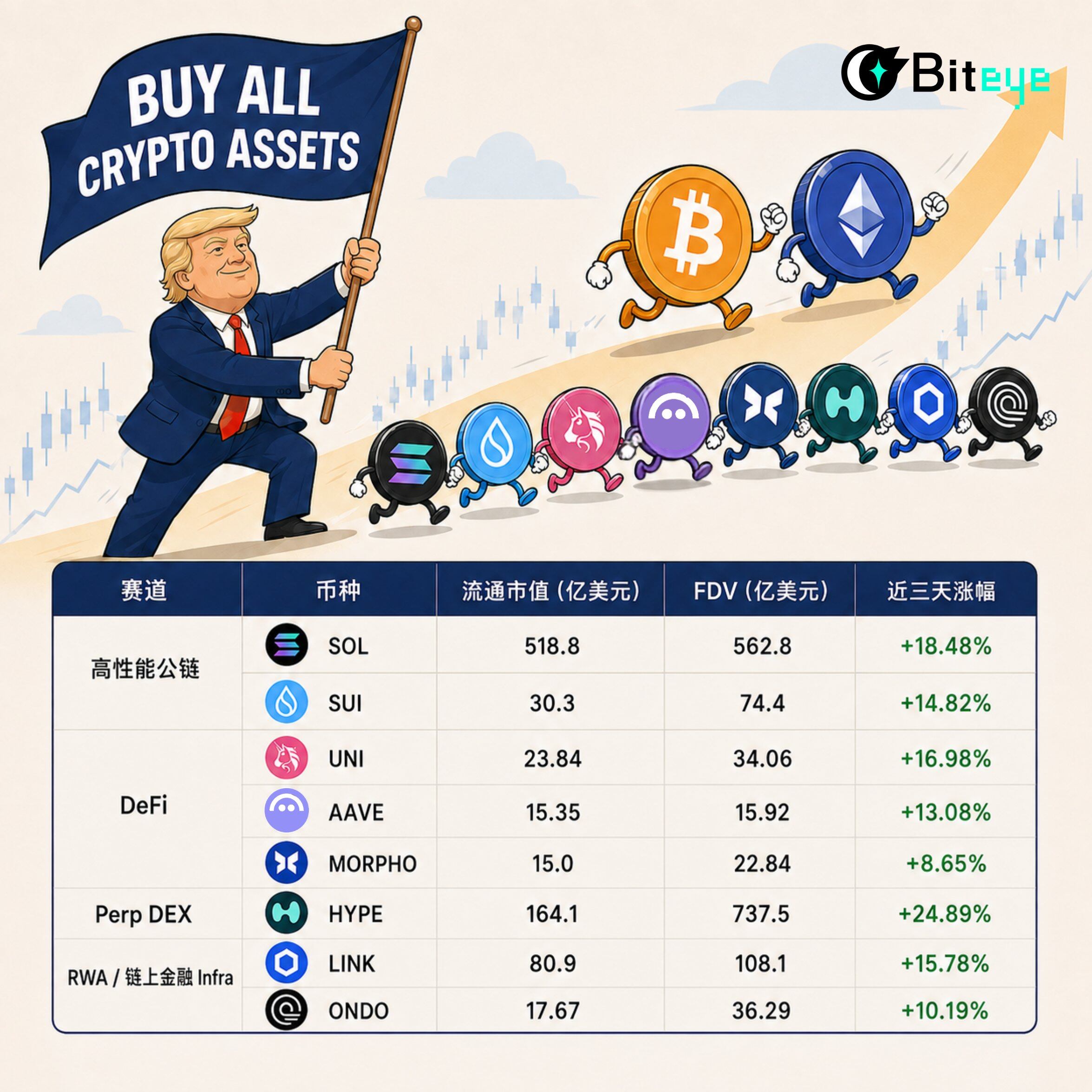
The article’s main point is that this cycle is unlikely to deliver a market where every altcoin rises together. After a period marked by Bitcoin leading on the way up and broad clearing during the bear market, the tokens most likely to benefit from spillover flows are described as those with real users, steady protocol revenue, clear token value capture and relatively healthy token distribution.
High-performance blockchains: SOL for strength, SUI for beta
In the high-performance Layer 1 segment, SOL is presented as the leader. Its circulating market capitalization is about $51.88 billion, with an FDV of roughly $56.28 billion. It gained 18.48% over the past three days. On-chain metrics cited in the article include about $5.31 billion in TVL, roughly $15.86 billion in stablecoins and around $2.8 billion in 24-hour DEX volume.
On supply, about 583 million SOL is circulating, equal to around 92.2% of the current total. The article says there is no obvious large cliff unlock ahead, with the main risk coming from long-term PoS inflation. The top 10 addresses hold just 6.58%. Its view is that SOL is already a mainstream asset in its own right and offers the highest degree of certainty in the public-chain segment, though price swings remain large and performance versus BTC and ETH has been weaker for now, leaving room for a catch-up move.
SUI is listed as the higher-potential name in the same segment. It has a circulating market cap of about $3.03 billion and an FDV of around $7.44 billion, after rising 14.82% over three days. The article cites roughly $427 million in TVL, around $466 million in stablecoins and about $39 million in 24-hour DEX volume.
Only 40.75% of SUI has been released so far, according to the article. It says about 13.5 million tokens worth roughly $9.93 million are expected to unlock on Sept. 1, 2026, with future releases extending beyond 2030. The top 10 addresses hold about 13.55%, which it describes as a moderate concentration level. Its conclusion is that SUI showed strong performance in the previous bull run and carries higher volatility, but its lower float remains a risk and upcoming unlock points need close attention.
The article’s takeaway for this segment is that SOL is the steadier pick and still benefits from a strong ecosystem, while SUI is the higher-beta choice. Because ETH already absorbs a large share of exposure in this area, it suggests a medium-sized position in SOL and a smaller one in SUI.
DeFi lending: focus on protocols with real revenue
For DeFi lending, the article points to UNI, AAVE and MORPHO.
UNI has a circulating market cap of about $2.384 billion and an FDV of about $3.406 billion. It rose 16.98% over the last three days. Uniswap V2, V3 and V4 together hold around $3.1 billion in TVL. The article lists 30-day fees of roughly $79.2 million and protocol revenue of about $6.12 million.
Its original vesting schedule has been completed in full, with no clearly identified large unlock ahead. About 62.4% of supply is in circulation, while the rest mainly sits in the community treasury, burn addresses and protocol contracts. The top 10 addresses hold about 52.03%, including 26.72% in the governance Timelock contract, 10.91% at burn addresses, about 6.69% across major exchange addresses and 1.25% in the Token Distributor. The article says UNI is one of the tokens called out by Standard Chartered. With the fee switch and buyback-and-burn mechanism moving into place, it argues UNI is shifting from a pure governance token toward an asset with protocol value capture, and notes that its 30-day fee base is materially larger than AAVE’s.
AAVE’s circulating market cap is about $1.535 billion, with FDV at roughly $1.592 billion. It gained 13.08% over three days. Aave V3 TVL is listed at about $16.47 billion, with around $30.01 million in 30-day fees and about $4.08 million in protocol revenue. Roughly 97% of supply has already been released.
The top 10 addresses hold about 43.07%, though that includes 15.32% in the staking pool, 5.24% in V3 contracts and 3.61% in ecosystem reserves. The article also identifies AAVE as one of the tokens highlighted by Standard Chartered and says it offers the most balanced mix of token circulation structure and revenue generation, while noting that it has already logged a sizable rebound from the bottom.
MORPHO is presented as the higher-potential name in the DeFi group. It has a circulating market cap of about $1.50 billion and an FDV of around $2.284 billion, after rising 8.65% over three days. Morpho Blue TVL stands at about $8.93 billion, with roughly $16.34 million in 30-day fees, but protocol-layer revenue is described as close to zero at present.
The article says there is a noticeable discrepancy in supply data. CoinGecko shows around 65.7% in circulation, while Tokenomist puts its tradable or released figure at about 34%. No clear next cliff unlock is identified. The top 10 addresses hold about 64.4%, including 39.13% in a wrapper contract and 9.01% at seed-round addresses. Its assessment is that protocol growth has been fast, but token value capture is weaker than AAVE’s and supply reporting lacks transparency.
The broad conclusion for DeFi is that it remains one of the few sectors in crypto with real revenue and a track record through multiple market cycles, which is why the article argues some allocation to DeFi assets still makes sense.
Perpetual DEXs: HYPE leads, but chasing is risky
In perpetual DEXs, the article centers on HYPE. Its circulating market cap is about $16.41 billion and its FDV is roughly $73.75 billion. It climbed 24.89% over the past three days. On-chain data cited include around $1.45 billion in TVL on Hyperliquid L1, roughly $6.57 billion in stablecoins and about $6.27 billion in Bridge TVL. Over 30 days, fees are listed at around $48.39 million and revenue at roughly $34.52 million.
The reported circulating supply is about 222 million tokens, or only around 23% of the total. Based on the white paper model, about 9.92 million tokens are expected to be released on Sept. 5-6, though the article says the team’s actual historical claims have usually been below the modeled amount. In the ownership breakdown, future incentives account for 26.3%, core contributors for 25.4% and the foundation for 6.4%, for a combined 58.1%.
The article describes HYPE as the clear leader among perpetual DEX tokens. At the same time, it says the post-Trump endorsement move, together with the current price advance and unlock structure, does not support blindly chasing the rally. Its sector view is that Perp DEXs are among the hottest trades of this cycle, but with HYPE already well ahead on revenue and buybacks, its market cap and token price are no longer low, which calls for a cautious allocation.
RWA and on-chain financial infrastructure: LINK as core, ONDO as a smaller trade
In RWA and on-chain financial infrastructure, the article favors LINK. Its circulating market cap is about $8.09 billion and FDV is around $10.81 billion. It advanced 15.78% over three days. The article notes about 40.88 million LINK in the community staking pool, and says Ondo’s tokenized stocks and ETF products already use Chainlink data feeds.
On supply, CoinGecko puts LINK’s circulating ratio at about 74.8%, while Tokenomist places tradable float near 58.8%. No fixed large unlock date is listed. The top 10 addresses hold around 30.5%, including about 20.2% in non-circulating official wallets and 4.09% in the community staking pool. Its judgment is that LINK can benefit at the same time from RWA, stablecoins, cross-chain activity and the migration of institutional finance on-chain, giving it more certainty than a single-theme RWA token.
ONDO is named as the higher-potential token in the segment. Its circulating market cap is about $1.767 billion and FDV is around $3.629 billion, after a three-day gain of 10.19%. Ondo Yield Assets TVL is about $2.51 billion, while Global Markets stands at roughly $971 million.
The article says about 49% to 53% of ONDO has been released so far, but 1.94 billion tokens are expected to unlock on Jan. 18, 2027. The top 10 addresses hold about 70.41%, and a single official multisig address accounts for 54.79%. Its view is that ONDO’s business growth is strong, but token value capture, concentration and the large 2027 unlock all stand out as risks.
For this segment, the article’s recommendation is to treat LINK as a core RWA allocation, while ONDO is framed as better suited to a smaller, event-driven position, ideally after the 2027 unlock risk is more fully priced in.
Main conclusion: selectivity over a broad altcoin bet
The article is not simply ranking recent gainers. Its central argument is that, after strength in BTC and ETH, altcoins may attract fresh attention, but the move is unlikely to spread evenly across the market. The names worth tracking, in its view, are concentrated in projects with several identifiable traits:
- real users and on-chain activity,
- stable fees or protocol revenue,
- clearer token value capture,
- and healthier circulation, unlock and ownership structures.
Using that framework, it singles out SOL and SUI in public chains, UNI, AAVE and MORPHO in DeFi lending, HYPE in Perp DEXs, and LINK and ONDO in RWA and financial infrastructure.