
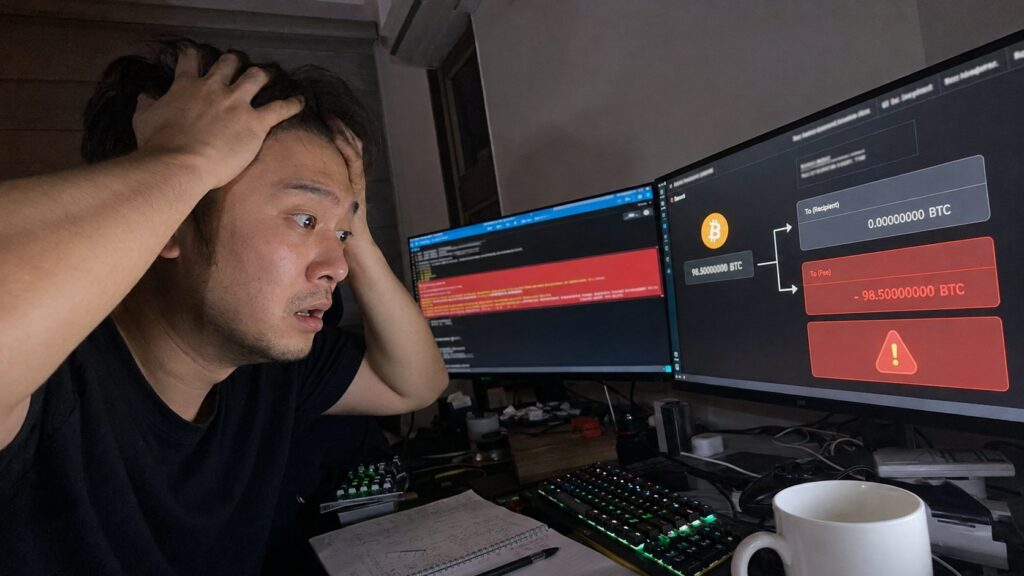
Bitcoin block 962,142 was confirmed on the evening of Aug. 12 and included 4,700 transactions. Four of them, all from the same address, turned their full input values into miner fees, for a combined 177,153,578 satoshis, or 1.7715 BTC. Using the BTC price cited in the source, about $64,180 at the time of confirmation, the loss came to roughly $113,700.
Those four transactions dominated the block’s fee income. Block 962,142 collected 1.8189 BTC in total fees, and the four mistaken transfers contributed 1.7715 BTC, or 97.4% of that amount. The other 4,695 regular transactions accounted for only 2.6%. The block was mined by SpiderPool, and the funds were left with no remaining satoshi and no receiving party.
All four transactions used the same one-input, zero-output-value pattern
The source said block 962,142 was confirmed at 8:16 p.m. Taiwan time on Aug. 12. Of the 1.8189 BTC in fees collected in the block, 1.7715 BTC came from four transactions sent by the same address.
Each transaction had the same structure: one input and one output, with the output set to a zero-value OP_RETURN. That meant there was no recipient and no change output. Whatever amount went into the transaction was fully counted as miner fees. In total, the four transactions burned 177,153,578 satoshis, equal to about $113,700 based on the BTC price cited in the report.
The error kept firing inside the same block, and the amounts escalated
Ordered by UTXO dependency, the amounts lost in the four transactions increased step by step:
- 174,592 satoshis, about $112
- 1,799,921 satoshis, about $1,155
- 14,835,180 satoshis, about $9,520
- 160,343,885 satoshis, about $102,900
Before those four transfers, another transaction had consolidated scattered UTXOs from 12 addresses into a neat 1.6034 BTC amount. That consolidation paid a normal fee of just 858 satoshis, or about $0.55. The source described that transaction as normal, with the problem appearing in the next step.
In other words, the wallet first gathered the funds correctly in the same block, then sent the balance as fees to the miner.
SpiderPool captured nearly all fee revenue in the block
SpiderPool mined block 962,142. The block’s total reward was 4.9439 BTC. After subtracting the 3.125 BTC block subsidy, fee income came to 1.8189 BTC.
Of that, the four mistaken transactions made up 1.7715 BTC, or 97.4% of all fee revenue in the block. The remaining 4,695 normal transactions produced only 4,739,144 satoshis in fees combined, about $3,042.
Based on the calculation in the source, SpiderPool’s total income from the block was about $317,000, with more than one-third coming from what the trader mistakenly handed over.
One fee rate hit 1,724,128 sat/vB
The report said the largest single fee rate reached 1,724,128 sat/vB. The median fee rate in the block was 3 sat/vB, putting the highest one at 570,000 times the median.
RBF was enabled on-chain, but the structure was the actual problem
On what caused the script failure, the source said market chatter linked the incident to an automated script misusing RBF, short for Replace-By-Fee. What can be confirmed on-chain is that the four transactions all used a sequence value of 0xfffffffd, which indicates RBF was enabled.
That setting, by itself, was not unusual. The same sequence value is the default in Bitcoin Core wallets, and the earlier consolidation transaction’s 12 inputs used the same value as well.
The fee was the input-output difference
The source pointed to the output structure as the real issue. In Bitcoin, the fee is not entered in a separate field. It is the difference between the total input value and the total output value. If a transaction’s only output is a zero-value OP_RETURN, the difference becomes the entire principal.
Under that structure, the wallet had no reason to produce a warning, and the money was sent out as fees.
The article also referenced a 0.75 BTC incident in April 2025. In that case, the user added a large UTXO during a second RBF attempt but failed to return the change to their own address.
Similar fee mistakes have happened before
The source noted that a larger case occurred in June 2024, when an OKX consolidation program error burned 254.28 BTC, worth about $17.6 million at the time.
There is no on-chain way to force a refund
In its FAQ section, the source said there is no on-chain mechanism to recover an accidentally overpaid Bitcoin transaction fee. Any refund depends entirely on whether the mining pool that found the block is willing to return the funds.
It cited a 2023 example in which a mining pool publicly asked the sender of an accidental 20 BTC fee to come forward within three days. Even so, any reimbursement was voluntary, and the source said most cases end without the funds being recovered.