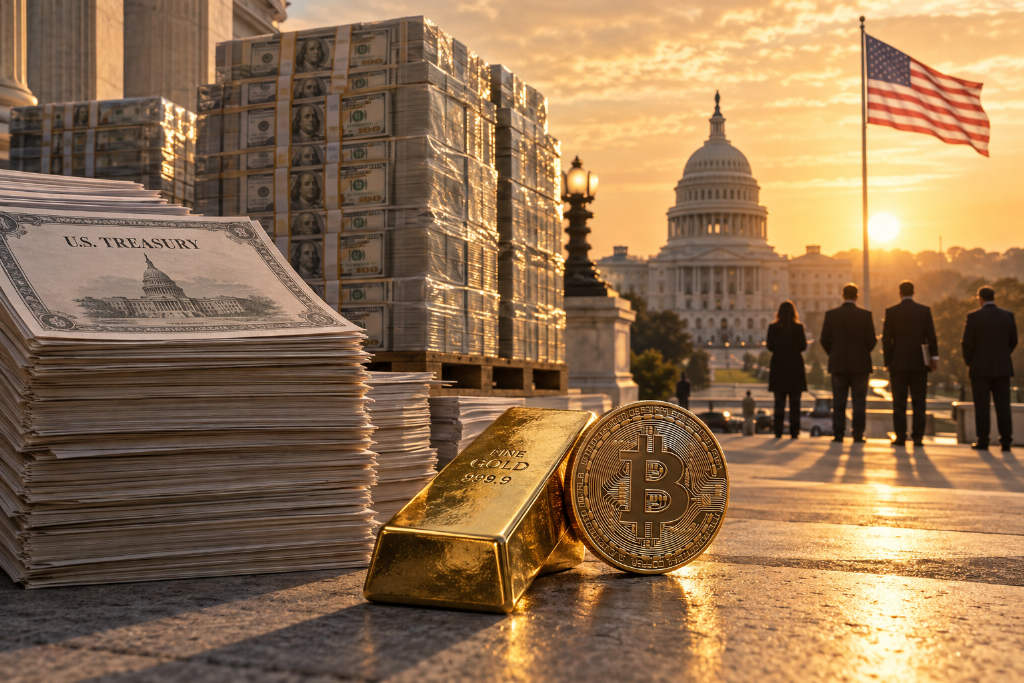
Bitcoin briefly approached $90,000 earlier this month, according to Forbes, while mounting global debt and weaker fiat purchasing power have helped strengthen the so-called debasement trade in assets such as Bitcoin and gold. Data from the Institute of International Finance showed global debt rose by $10 trillion in the first half of this year, pushing the total above $365 trillion. In the United States, total debt has surpassed $40 trillion, and annual interest costs have climbed to $1.27 trillion, exceeding defense and Medicaid spending and trailing only Social Security.
The Institute of International Finance warned that interest expenses are likely to rise further as benchmark rates move higher. Coin Bureau founder and cross-asset analyst Nic Puckrin said the current backdrop favors Bitcoin and gold as debasement assets, adding that it helps explain part of Bitcoin’s recent rise. Separately, analysts at The Kobeissi Letter said the U.S. dollar’s purchasing power has fallen 23% since 2020, and that even a 30% asset gain over the same period would amount to little more than breaking even in real terms. They also noted U.S. inflation has stayed above the Federal Reserve’s 2% target for 60 straight months.
Bitcoin briefly approached $90,000 earlier this month, according to Forbes. At the same time, global debt has kept rising, and the so-called debasement trade tied to falling fiat purchasing power has become one factor supporting gains in assets such as Bitcoin and gold.
Global debt tops $365 trillion
Data from the Institute of International Finance showed that global debt increased by $10 trillion in the first half of this year, bringing the total above $365 trillion. U.S. debt has exceeded $40 trillion, while annual interest payments have risen to $1.27 trillion, higher than spending on defense and Medicaid and second only to Social Security.
The group warned that interest costs will keep climbing as benchmark rates rise.
Analysts say the backdrop favors Bitcoin and gold
Nic Puckrin, founder of Coin Bureau and a cross-asset analyst, said the current environment is supportive for Bitcoin and gold as debasement assets, and that this is part of the reason behind Bitcoin’s recent move higher. As debt loads grow across major economies, real borrowing costs are more likely to be pushed lower, while inflation is allowed to reduce the real value of debt, making that trade more attractive.
Dollar purchasing power down 23% since 2020
Analysts at The Kobeissi Letter said the U.S. dollar’s purchasing power has fallen 23% since 2020. If an asset rose only 30% over the same period, an investor would have little more than broken even after adjusting for purchasing power. U.S. inflation has also remained above the Federal Reserve’s 2% target for 60 consecutive months.
This article was originally published by Bit.Fan. For more cryptocurrency news and market insights, visit www.bit.fan. Disclaimer:
The market information, project data, and third-party content displayed on this platform are for industry information sharing only and do not constitute any form of investment advice or return commitment.
Cryptocurrency trading carries high risks. Users should fully assess their risk tolerance and make independent decisions. All profits, losses, and legal responsibilities are borne by the users themselves.