
Bitcoin miners moving into AI is no longer a fresh story. As more companies crowd into the trade, Wall Street is assigning less premium to the narrative. Blocksbridge Consulting recently said market reactions to miner investments in AI/HPC infrastructure have cooled sharply, and even large AI hosting contracts are no longer producing the kind of stock response seen earlier in the cycle.

According to the data cited, early AI business announcements once drove an average absolute stock move of 24.1%. More recent deals have produced an average absolute move of about 10.2%. The economics of AI/HPC hosting, though, have improved: annualized revenue per megawatt has risen from roughly $1.67 million in earlier leases to about $1.9 million.
The shift suggests investors are no longer paying up for AI slogans alone. The market is paying closer attention to tenant quality, project delivery, capital intensity and whether future cash flow actually materializes. For bitcoin miners, the AI pivot has moved out of the story-selling phase and into a phase of proving the business model.
With second-quarter earnings coming in, that test is becoming more concrete. A PANews review of five leading miners shows a split field. Some are still building and have no meaningful AI revenue yet. Others are already generating new sales from AI/HPC hosting and are starting to reshape their revenue mix. Even so, lower revenue, larger losses and heavy capital spending are still common across the sector, and many of the promised cash flows remain some distance away.
Share prices reflect that more selective view. Most major bitcoin miners have pulled back over the past month, though broader weakness in AI stocks has also played a part. Even when companies announced large AI/HPC leases or reported business progress, the market reaction was often muted.
MARA: losses widen and AI revenue is still close to zero
MARA shares fell about 11.6% over the past month and dropped about 5.25% on the day its second-quarter earnings were released.
The latest results show a mining business still pressured by the cycle and an AI/HPC buildout that remains largely pre-commercial. In the second quarter, MARA posted revenue of about $175 million, down 27% from $238.5 million a year earlier. Net loss widened to more than $610 million, compared with profit of about $810 million in the same period last year. Adjusted EBITDA was a loss of $361 million, down sharply from adjusted EBITDA of $1.245 billion a year ago, mainly because of roughly $343 million in digital asset impairment tied to the decline in bitcoin prices.
MARA said its strategy now rests on three infrastructure pillars: bitcoin mining, power resources and AI compute infrastructure.
On the mining side, MARA held 35,577 BTC at the end of the quarter, down 29% from 49,951 BTC a year earlier. It mined 2,422 BTC during the quarter and sold 2,213 BTC at an average price of about $73,000. Combined cash and BTC holdings stood at about $2.5 billion.
On the AI/HPC side, MARA said it had 1.4 GW of operating capacity as of the end of June 2026, with total capacity at 1.9 GW and potential energy capacity at about 4.8 GW. A project in Matagorda County, Texas, is a central piece of the plan. The site is designed for as much as 2 GW of power capacity and is intended to become an AI/HPC computing campus, with construction expected to start in 2027. MARA is also partnering with Starwood to build a data center and has acquired Long Ridge energy assets and French HPC operator Exaion, which it said is expected to generate less than eight figures in annual revenue, or millions of dollars for the full year.
To support expansion of its energy infrastructure, MARA added a $100 million credit facility and pledged 18,750 BTC as the initial collateral. The move increases liquidity and capital efficiency around its bitcoin holdings to help fund more infrastructure spending.
For now, AI/HPC contributes almost nothing to MARA’s revenue. On the earnings call, management said the first half of the year was focused on scaling and platform transition, while the second half will be about execution: signing customer agreements, bringing new assets into operation and testing the platform’s earning power.
Core Scientific: hosting now drives the business, and BTC accumulation has resumed
Core Scientific shares slipped about 3.04% over the past month and were up about 0.05% on the day of its earnings release.
The company’s latest quarter shows a much smaller dependence on mining revenue and a business now led by AI/HPC infrastructure income. In the second quarter, Core Scientific reported revenue of about $164.2 million, up about 109% year over year. It still posted a net loss of about $1.155 billion, but adjusted EBITDA reached about $41.1 million. Gross profit was about $70 million, with a gross margin of about 43%.
The revenue mix has changed fast. Mining revenue fell to about $21.5 million in the quarter, equal to roughly 17% of total revenue. At the same time, the company’s bitcoin holdings rose from 547 BTC at the end of the first quarter to 848 BTC, an increase of 301 BTC during the period. Core Scientific had previously sold large amounts of BTC to support its transition into AI and high-performance computing, but it began adding again in the second quarter.
The real growth engine was AI/HPC hosting. Hosting revenue reached about $136.7 million in the quarter, far above the $10.6 million recorded a year earlier, and represented about 83% of total revenue. The company had deployed about 395 megawatts of billed capacity, rising to 437 megawatts by mid-July, which corresponds to annualized hosting revenue of about $635 million.
Core Scientific also announced a 15-year infrastructure agreement with Advanced Micro Devices, or AMD, covering 530 MW across five data center campuses, with potential base contract revenue of more than $14 billion. The company said its total leasable customer power capacity stands at about 1.1 GW, with potential contract revenue above $24 billion.
The transition is expensive. Second-quarter capital expenditures were $797.5 million for data center construction and land acquisition, while net cash used in investing activities exceeded $1.18 billion in the first half. Core Scientific also raised funds through instruments including $3.3 billion of senior secured notes. That added interest expense and pushed leverage higher. Shareholders’ equity remains negative, and management still faces swings on the balance sheet. Hosting revenue is also concentrated among a small number of customers, while construction schedules, power availability and supply-chain stability will directly affect delivery and revenue realization.
On the earnings call, management said the inflection point in the transition had already passed and that the company is now positioned to keep creating value for customers and shareholders. The next task, it said, is to deliver compute capacity efficiently, maintain strict project control and allocate capital responsibly.
TeraWulf: HPC leasing has become the main revenue source
TeraWulf shares fell about 12.97% over the past month and dropped about 4.29% on the day of its second-quarter earnings release.
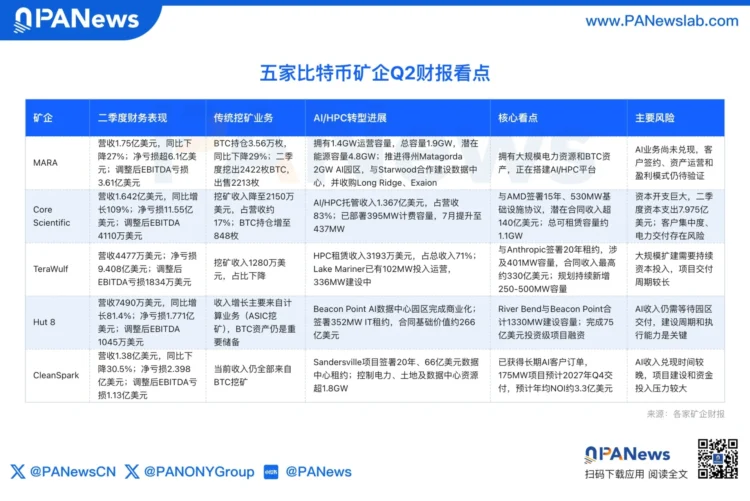
Its traditional mining business also weakened under the cycle, but the AI/HPC pivot has started to show up in revenue. TeraWulf reported quarterly revenue of about $44.77 million. Bitcoin mining accounted for about $12.8 million, while HPC leasing produced about $31.93 million, or around 71% of total revenue. Net loss widened to about $940.8 million, mainly because of a $755.7 million loss tied to changes in the fair value of warrants. Adjusted EBITDA was a loss of $18.34 million. As of June 30, cash and restricted cash totaled about $3 billion.
Execution at the Lake Mariner data center campus remains on track. By early July, 102 MW of critical IT capacity was in operation and another 336 MW was under construction. Build cost per megawatt of critical IT remains within the company’s guidance range of $8 million to $10 million. After delivery of CB-3, the $600 million credit support provided by Google for Fluidstack’s lease obligations became effective. TeraWulf is also pursuing another 250 MW of power capacity. At Lake Hawkeye, the site spans about 183 acres with potential for about 320 MW of critical IT load, though operations are not expected to begin before 2029.
After the quarter, TeraWulf signed a 20-year data center lease with Anthropic covering about 401 MW of critical IT capacity at its Justified campus in Kentucky. Revenue over the contract term is about $19 billion and could reach about $33 billion if Anthropic exercises two five-year renewal options. Initial delivery is expected to begin in the second half of 2027.
TeraWulf also sold its 50.1% stake in the Abernathy joint venture for about $530 million and acquired the Muskie Data Campus in Kentucky, securing a power service agreement for as much as 1 GW. The Federal Energy Regulatory Commission, or FERC, approved the acquisition of the Morgantown generating station in Maryland, removing a major regulatory obstacle for its Chesapeake Data Campus subsidiary. That campus can scale to as much as 1 GW, with data center operations expected to begin around 2030.
TeraWulf reiterated a target of signing 250 MW to 500 MW of additional critical IT capacity each year. Chief executive Paul Prager said the company is moving from platform buildout to scaled execution and that the model is repeatable, centered on controlling power-advantaged infrastructure, locking in long-term customers backed by credit support and delivering capacity in phases.
Hut 8: revenue jumps, losses remain, and the first AI campus is commercialized
Hut 8 shares declined about 6.3% over the past month and fell about 9.74% on the day of its second-quarter earnings release.
In the quarter, Hut 8 generated about $74.9 million in revenue, up 81.4% year over year. The increase was driven mainly by its compute business, especially ASIC mining, which contributed about $72.5 million. Digital infrastructure revenue was $1.3 million and power revenue was $1.2 million. Even with strong top-line growth, the company posted a net loss of about $177.1 million, largely because of $138.6 million in unrealized losses on digital assets. Adjusted EBITDA rose 149% year over year to $10.45 million.
Commercially, Hut 8 said it had completed the commercialization of Beacon Point, its first gigawatt-scale AI data center campus. After the quarter ended, it signed a second 352 MW IT lease. The base term of that contract is worth about $26.6 billion and is expected to generate more than $1.75 billion in average annual net operating income. The company said the deal covers 949 MW of contracted IT capacity, with all contracted counterparties carrying investment-grade credit. River Bend and Beacon Point together have 1,330 MW of power capacity under construction, with first data hall deliveries targeted for the second and third quarters of 2027, respectively. At the end of the second quarter, Hut 8’s total development pipeline stood at about 8,660 MW.
On financing, Hut 8 completed $7.5 billion of investment-grade project financing during the quarter: $3.3 billion for River Bend and $4.25 billion for phase one of Beacon Point. Both were structured as non-recourse and non-dilutive arrangements. The company described them as a first for investment-grade construction financing of a single-sponsor data center project and said the capital supports large-scale buildout.
Chief executive Asher Genoot said the company’s main job has now shifted from winning orders to delivering projects and converting contracted capacity into operating assets and steady cash flow.
CleanSpark: all current revenue still comes from mining, but a $6.6 billion lease stands out
CleanSpark shares rose about 2.16% over the past month but fell about 5.56% on the day its second-quarter results were released.
For the third quarter of fiscal 2026, CleanSpark reported revenue of $138 million, down 30.5% year over year. Net loss reached $239.8 million, versus net income of $257.4 million in the same period last year. Adjusted EBITDA also swung sharply, moving from $377.7 million a year earlier to a loss of $113 million.
As of June 30, the company held $202.6 million in cash, bitcoin assets worth about $814.9 million, net long-term debt of $1.78 billion and working capital of $761 million. The balance sheet still shows substantial asset reserves and financing capacity, but expansion in data centers and compute infrastructure will require heavy spending.
For now, all of CleanSpark’s revenue still comes from bitcoin mining. AI/HPC-related operations have not contributed meaningful revenue yet.
The quarter’s biggest development was at the Sandersville project, where CleanSpark signed a 20-year data center lease worth $6.6 billion with an unnamed global technology company. According to the company, the project uses a high-specification data center design with construction costs of about $10 million to $12 million per megawatt. For 175 MW of capacity, that implies total investment of about $1.75 billion to $2.1 billion. Average annual net operating income is expected to be about $330 million.
That revenue will not arrive until construction is completed, with first delivery expected as early as the fourth quarter of 2027. CleanSpark said the required equity funding has already been secured and that key long-lead equipment has been purchased and prepaid, supporting the planned launch timeline.
Compared with miners still centered on AI narratives, CleanSpark’s advantage is its accumulated base of power resources, land and data center operating experience. The company said it controls more than 1.8 GW of power, land and data center resources in the United States.
The dividing line is no longer the story, but delivery
Across these five miners, the AI pivot is entering a more decisive phase. Investors are no longer focused mainly on which company has the biggest AI narrative. The market is looking at operating metrics instead. For bitcoin miners, power, land and compute infrastructure may secure entry into the race, but valuation re-rating will depend on execution, customer quality and whether future cash flow arrives on schedule.