
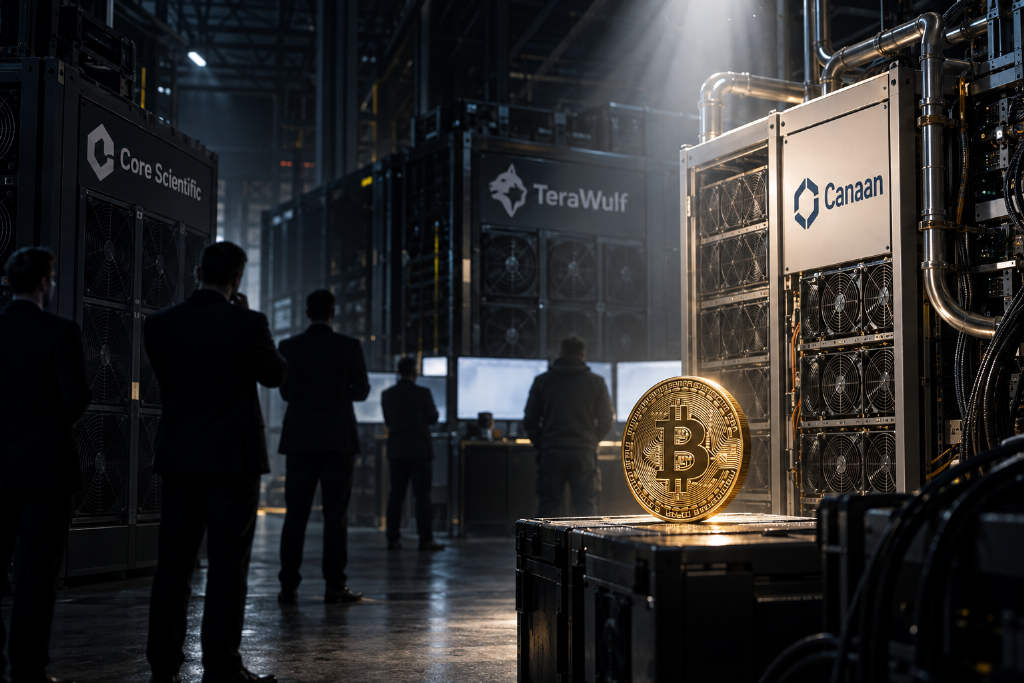
Bitcoin has turned higher again, but mining stocks, which have often moved with even greater volatility, have fallen behind this time.
According to The Block, bitcoin has gained about 22% since Aug. 17. Exchange and stablecoin-related stocks broadly kept pace with the move. Among 11 bitcoin miners and related companies tracked in the data, only Canaan outperformed BTC. The median return for the rest was about 1.8%. Core Scientific and TeraWulf lagged bitcoin by roughly 27 percentage points and 24 percentage points, respectively.
The divergence stands out because many miners have spent the past year pitching AI data centers as a second growth path, with some of them actively scaling back mining operations.
AI revenue is already showing up at TeraWulf and Core Scientific
TeraWulf offers one of the clearest examples. The company posted $44.8 million in second-quarter revenue, with $31.9 million from HPC data center leasing, more than 70% of total revenue. At the time of its earnings release, 102MW of critical IT load was already in operation and another 336MW was under construction. At that point, TeraWulf could no longer be viewed simply as a bitcoin miner.
The shift came with a visible trade-off. Second-quarter digital asset revenue dropped to $12.8 million from $47.6 million a year earlier, a decline of more than 70%. Bitcoin production in the same period fell from 485 BTC to 179 BTC. Even with that transition under way, the stock still failed to keep up with bitcoin in the latest rally.
Core Scientific’s change has been even more pronounced. Its second-quarter data center hosting revenue reached $136.7 million, up more than 12-fold from $10.6 million a year earlier, and accounted for more than 80% of the company’s $164.2 million in total revenue. By mid-July, 437MW had begun billing, equivalent to about $635 million in annualized hosting revenue.
Still, even with AI-related revenue already booked, both Core Scientific and TeraWulf underperformed during the latest BTC rebound.
Mining equities are no longer just leveraged bitcoin proxies
One reason is that the market’s valuation framework for mining companies has changed.
The traditional bitcoin mining model was relatively straightforward. When BTC rose and costs such as electricity and equipment stayed comparatively stable in the short term, profit growth could outpace the move in bitcoin itself. That is why mining stocks were often treated as high-beta bitcoin vehicles.
Once a company moves into AI data centers, a different set of variables enters the valuation picture: construction costs, financing rates, customer credit, GPU and networking equipment supply, grid interconnection, and whether projects can be delivered on schedule.
Core Scientific reported $797.5 million in capital expenditures in the second quarter, more than double its $389.2 million in the first quarter. The company has signed about 1.1GW of customer power capacity with potential contract revenue above $24 billion, but large contract value is not the same as free cash flow today.
TeraWulf, as of the end of the second quarter, held about $5.7 billion in debt and $3 billion in cash and restricted cash, leaving net debt of about $2.7 billion. AI operations may offer longer-duration and more predictable revenue, but the market is also counting the heavy capital required to build them.
MARA faces a different issue: the AI narrative is not yet a major revenue source
For MARA, which remains centered on mining, the problem looks different.
MARA reported $174.9 million in second-quarter revenue, down 27% year over year. Of that amount, $170.1 million came from bitcoin mining revenue, showing that most of its business still comes from BTC. The company said it controls about 1.9GW of energy assets and has identified AI, critical IT load, and digital infrastructure as the next phase of strategy, but AI has not yet become a primary source of revenue in the way it has at Core Scientific or TeraWulf.
As a result, the market is re-sorting miners into separate groups. Some are still being treated as bitcoin mining companies. Others are moving closer to data center REITs or digital infrastructure businesses. Many remain somewhere in between.
The AI pivot is not a failure, but the valuation premium is fading
That does not mean the move into AI has failed.
In May, miners including Cipher and Hut 8 surged on large AI data center deals, and some companies briefly reached record highs. In August, Riot announced a 20-year data center agreement valued at about $9.1 billion, and its shares jumped more than 25% in after-hours trading.
What has changed is the market’s threshold. When the AI data center story was new, having land and power was enough to drive a re-rating. Now investors want more concrete proof: live megawatts, real AI revenue, and how much cash flow remains after substantial capital spending.
The recent split, with bitcoin up 22% and the median miner return at just 1.8%, may not show that the market is rejecting the AI transition. It may show instead that mining stocks are losing the old valuation model in which they simply tracked BTC.
As miners move from producing bitcoin to building data centers, they gain a new growth story tied to AI. They also take on the stricter valuation standards applied to the data center business. The next question for the market is no longer who controls the most power, but who can turn each megawatt into durable free cash flow the fastest.