
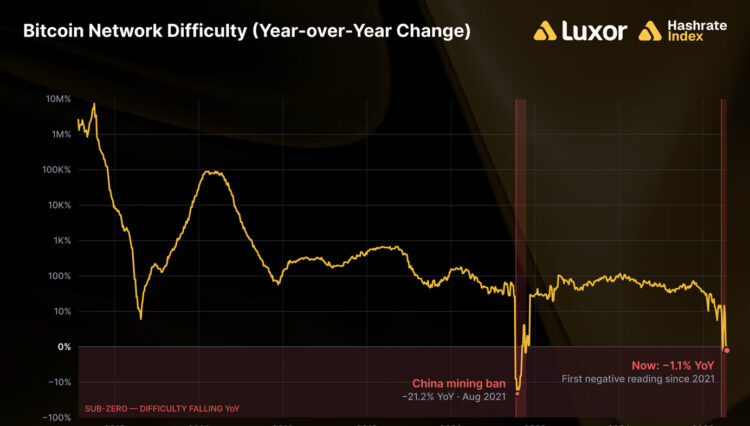
Bitcoin’s network is seeing a rare retreat in mining power. Weaker prices, shrinking mining revenue, and a shift of capital and electricity toward artificial intelligence computing have pushed Bitcoin mining difficulty about 14% below this year’s high, according to Blockcast. The move marks only the second time in Bitcoin’s history that mining difficulty has dropped below the level recorded in the same period a year earlier, pointing to a clear decline in global mining hashrate.
Difficulty slips to 126.23 T after a modest adjustment
On-chain data shows Bitcoin mining difficulty now stands at 126.23 T after a 0.74% downward adjustment. That is 1.1% lower than the 127.62 T recorded a year ago. Compared with the all-time high of 155.97 T reached in November 2025, the decline is 19.1%.
Bitcoin adjusts mining difficulty every 2,016 blocks, or roughly every two weeks, based on changes in hashrate. The mechanism is designed to keep block production near one block every 10 minutes regardless of how many miners are active on the network.
Mining difficulty is generally treated as a reflection of competition among miners. Higher difficulty means tighter competition. If hashrate rises over a two-week period, difficulty typically moves higher as well, making Bitcoin mining harder. If hashrate falls, difficulty is adjusted lower, making blocks easier to solve.
Back-to-back cuts in June and early July
Data cited in the report shows that after downward revisions of 10% in June and 5% in early July, Bitcoin mining difficulty had fallen about 14% from its high in January this year.
This is the second time Bitcoin mining difficulty has dropped below the level seen a year earlier. The first came after China imposed a nationwide ban on Bitcoin mining in 2021, when about half of the world’s hashrate went offline almost at once and difficulty dropped sharply. As miners relocated to the United States, Kazakhstan, and other regions, network hashrate recovered quickly.
Luxor ties the decline to weaker mining economics
This time, the report says, the drop is not the result of regulatory action. It is tied instead to worsening mining economics across the sector.
Analysis from Hashrate Index, part of mining data platform Luxor, said soft Bitcoin prices and heavily compressed mining returns have forced mining companies to redirect capital, power resources, and operational focus toward AI and high-performance computing, or HPC, infrastructure.
It also said summer power curtailment in Texas, along with electricity outages in other major mining regions, has further weakened overall hashrate.
Hashprice touched $27.66 in late June
The lower difficulty has not given miners much relief. Hashprice, the metric used to measure expected daily revenue per unit of hashrate, fell to $27.66 per PH/s per day in late June, just $0.01 above the record low reached in February this year.
Although it has recently recovered to about $31.7 per PH/s per day, that level remains well below past bull-market conditions, leaving miners under heavy operating pressure.
Based on pricing data from Luxor’s forward market, average hashprice is projected to come in at around $31.85 per PH/s per day by the end of December, only slightly above current levels.
That pricing suggests the market does not expect a meaningful improvement in Bitcoin miner profitability over the rest of 2026. With mining revenue still under pressure and AI infrastructure expanding quickly, the global Bitcoin mining industry continues to face another round of transition and reshuffling.