Bitcoin that has sat untouched for a decade or longer is starting to move in 2026 at a rate that stands out against most recent years, according to new data from Galaxy Research.
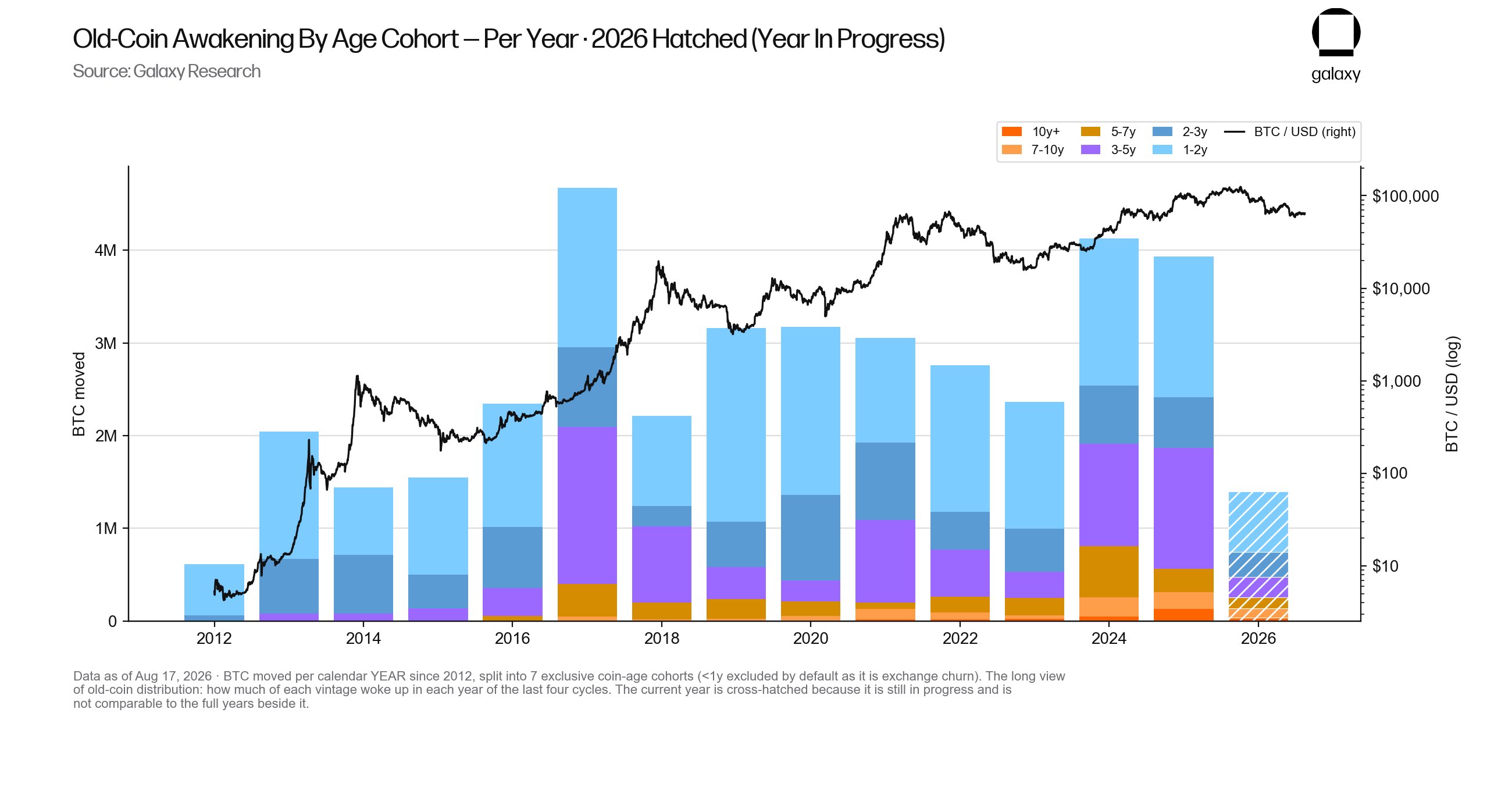
A chart published by the firm last week tracks how much Bitcoin from each vintage woke up in each calendar year since 2012, broken down by age cohort. The most striking detail appears at the base of the 2026 column, where the red band representing coins that are at least 10 years old is clearly visible.
Galaxy marked the 2026 bar with cross-hatching because the year is still in progress and cannot be compared directly with the full-year bars beside it. Even so, the oldest cohort already shows up more clearly than it did in most prior years, when movement from decade-old coins was barely noticeable.
Six long-dormant wallets moved 553.59 BTC in late August
The pace has picked up in recent weeks. Galaxy said six wallets dormant since 2011, 2012, and 2014 moved a combined 553.59 BTC between Aug. 16 and Aug. 26, worth roughly $40.15 million.
One address moved 212 BTC, valued at about $13.66 million, after sitting untouched since August 2012. That 14-year stretch translated into a gain of roughly 557,640% based on a cost basis near $12.
Another address shifted 10.74 BTC, worth around $692,000, after remaining dormant since June 2011.
The most profitable transfer in the group involved 40 BTC last held in May 2012. Those funds were sent to German custody bank Boerse Stuttgart Digital, with the move representing a 1,535,911% gain.
Old coin transfers draw attention, but the chain does not reveal intent
Transfers involving Bitcoin this old tend to attract scrutiny because so few holders from the network’s earliest years still control their keys. Each wallet that wakes up can be read as a sign that long-dormant supply is re-entering circulation.
What the chain does not show clearly is intent. It is usually difficult to tell whether the coins are being sold, moved into a new custody arrangement, or consolidated across wallets. In most recent cases, the funds have moved toward professional infrastructure rather than directly onto the open market.
Noah Doe case and Coldcard exploit may help explain the burst of activity
Galaxy pointed to two possible drivers behind the recent flurry.
Some of the reawakened wallets carry a “Salomon Client Dusted” tag tied to the Noah Doe case, a lawsuit in New York that seeks to have about 39,069 dormant addresses declared abandoned property. Wallets named in the case have been moving regularly since a judge paused the matter in June.
Separately, about 233,000 BTC left long-term wallets during the Coldcard hardware-wallet exploit, as unsettled holders rushed to move funds into safer setups.
Moves come as Bitcoin trades through a choppy market stretch
The transfers are landing during a volatile period for Bitcoin. The asset fell as low as $76,877 on Friday, giving back much of an earlier double-digit weekly gain after Federal Reserve Chair Kevin Warsh, in his first Jackson Hole keynote, warned that inflation was not cooling quickly enough and that the central bank still had “work to do.”
Traders took the remarks as hawkish. According to CME’s FedWatch tool, the probability of a September rate hike rose to about 56% from 35% a day earlier.
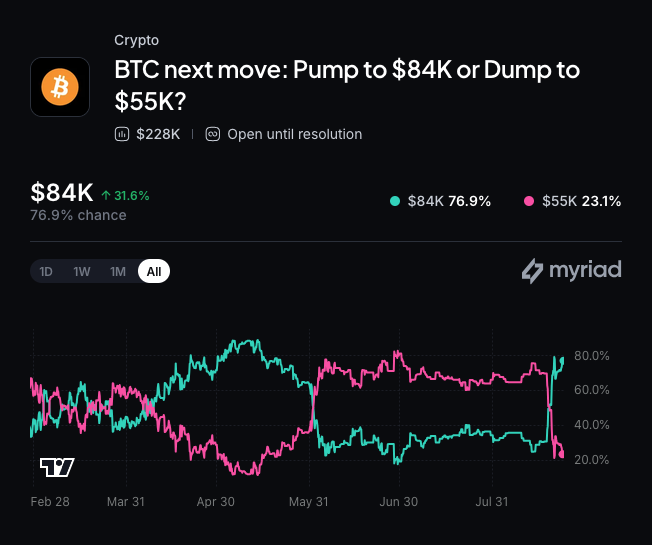
Even so, the broader backdrop remains supportive. U.S. spot Bitcoin ETFs brought in $2.8 billion over eight straight days through Wednesday, the longest inflow streak since April. On Myriad’s prediction market, traders still favored a move toward $84,000 over a decline to $55,000.