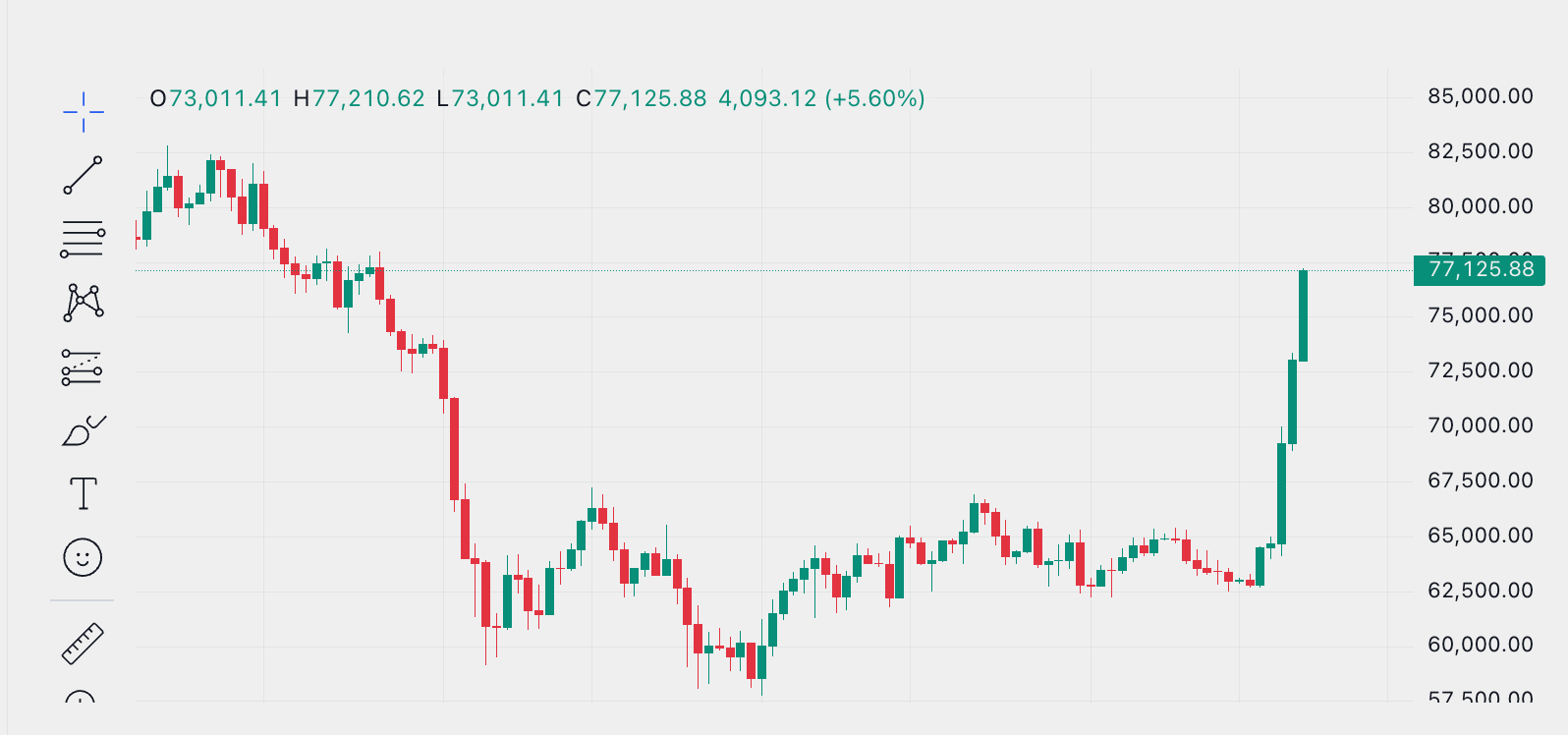
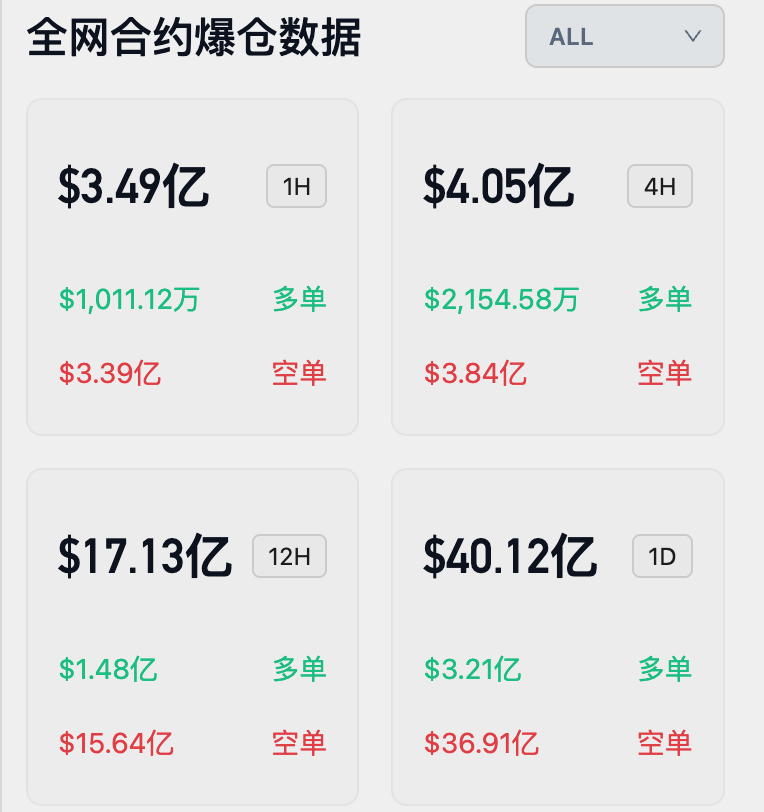
Bitcoin jumped from a $64,100 low on Aug. 19 to as high as $79,500 on Aug. 21, a gain of more than 20% in three days. CoinAnk data showed more than $4 billion in liquidations across crypto markets, with short positions accounting for $3.7 billion. The move came alongside $606 million of net inflows into spot Bitcoin ETFs, a rebound in altcoin market capitalization above $1 trillion, and fresh policy signals from the U.S. Treasury, the White House and the CFTC. Analysts remain split on whether the move marks a lasting turn or an overheated squeeze, with some pointing to an RSI reading of 92.6 and resistance around $78,000-$80,000. Key dates now include Sept. 15, when the U.S. Senate is due to vote on the CLARITY Act.
Bitcoin surged from a $64,100 low on Aug. 19 to as high as $79,500 on Aug. 21, a move of more than 20% in three days. At the time this article was published, BTC's high was $75,720, with the data updated. The market's tone shifted from cautious to short-term bullish, though several analysts warned that the rally has pushed prices into overbought territory.
The squeeze was brutal. CoinAnk data showed more than $4 billion in liquidations across crypto assets, including $3.7 billion in shorts, marking the most severe short squeeze since 2021. Bitcoin had spent weeks trading in a narrow range between $62,000 and $66,900 starting July 8, and the latest move wiped out a large buildup of bearish positioning.
Bitcoin's market cap now stands at about $1.5 trillion, above Meta's $1.39 trillion valuation and up to 13th place among global assets. Spot Bitcoin ETFs recorded $606 million in net inflows on the day, extending their streak to four consecutive days of positive flows.
Altcoins also joined the move. The total altcoin market cap climbed back above $1 trillion for the first time in nearly a month. ETH rose as much as 18% in a single day and 25% on the week to $2,361, its highest level in more than two months. XRP gained 20% over 24 hours and 31% over the week, reaching $1.30 and adding about $10 billion in market value in one day. HYPE rose 15% on the week to a high of $75, close to its all-time high of $76.85. SOL briefly topped $90 and was up nearly 15% on the week.
For digital asset treasury companies, the rally also changed balance sheets in a direct way. As of Aug. 16, Strategy held 840,447 BTC at an average cost of $75,385. With BTC rising, the world's largest listed Bitcoin holder has effectively returned to break-even.
The rally was not driven by crypto alone. On Aug. 19, the U.S. Treasury said it would at least double its long-dated Treasury buyback program, raising each operation from $2 billion to $4 billion. The 30-year Treasury yield fell from 5.337% to 5.187%, and the dollar index slipped below 99.
That same day, Donald Trump hosted a group of crypto executives at the White House, including Coinbase CEO Brian Armstrong and Ripple CEO Brad Garlinghouse. He urged the Senate to advance the CLARITY Act and said the U.S. was considering buying a "substantial amount" of Bitcoin as a reserve asset.
A day earlier, on Aug. 18, the SEC had already floated a new regulatory framework proposal. On Aug. 21, the policy push continued. CFTC Chair Michael Selig said at the agency's first Innovation Advisory Committee meeting that if the CLARITY Act remained stalled because of Democratic opposition, the CFTC would use its existing authority to build a framework for crypto markets. He said staff had been told to study rules covering crypto exchanges, leveraged and margin trading, and compliance paths for developers of on-chain financial protocols.
The move also came with a wave of forced liquidations. Lookonchain data showed that three of the biggest losing liquidation addresses were measured in the hundreds of millions of dollars: an address starting with 0x8c96 was liquidated for 1,829 BTC, worth about $120 million; pension-usdt.eth lost 49,808 ETH, worth about $111 million; and an address starting with 0x8eff was liquidated for 1,343 BTC, worth about $92.56 million.
One of the best-known examples in the Chinese crypto community was the whale nicknamed "先定10个大目标." On Aug. 19, he reportedly made $20 million from a long position, then flipped short at higher levels and opened a combined $222 million in BTC and ETH shorts. After the market pushed higher, he was forced out on Aug. 20 and gave back $6.28 million. He did not stop there. On Aug. 21, he shorted again, opening about $17.9 million in BTC and ETH shorts, with BTC entered at an average price of $74,506.57 and ETH at $2,346.83.
At the same time, other whales took the opposite side. Two whale addresses sold 5,250 ETH and 550 BTC for a $6.26 million profit, while another address that had previously accumulated 120,000 ETH added again and now holds a combined $182 million in long positions across two wallets, with an average entry price of about $2,265.
Analysts are still split on what the rally means. Bitwise research analyst Ishmael Asad called it the strongest confirmation so far that a bottom is in, saying institutional allocation is still in its early stages and that room remains for long-term inflows. Coinbase CEO Brian Armstrong said the market may be "on the cusp of the next crypto spot trading bull market."
Trader mignolet said he had not been bullish since August 2025, but now admits that view was wrong. He said the rebound may last longer than expected, that he no longer expects a quick breakdown, and that he is now bullish on Bitcoin and no longer short. CryptoQuant founder Ki Young Ju also said spot and perpetual futures demand have both turned positive for the first time since the 2025 October all-time high, adding that the bear market is over and a new bull cycle has begun.
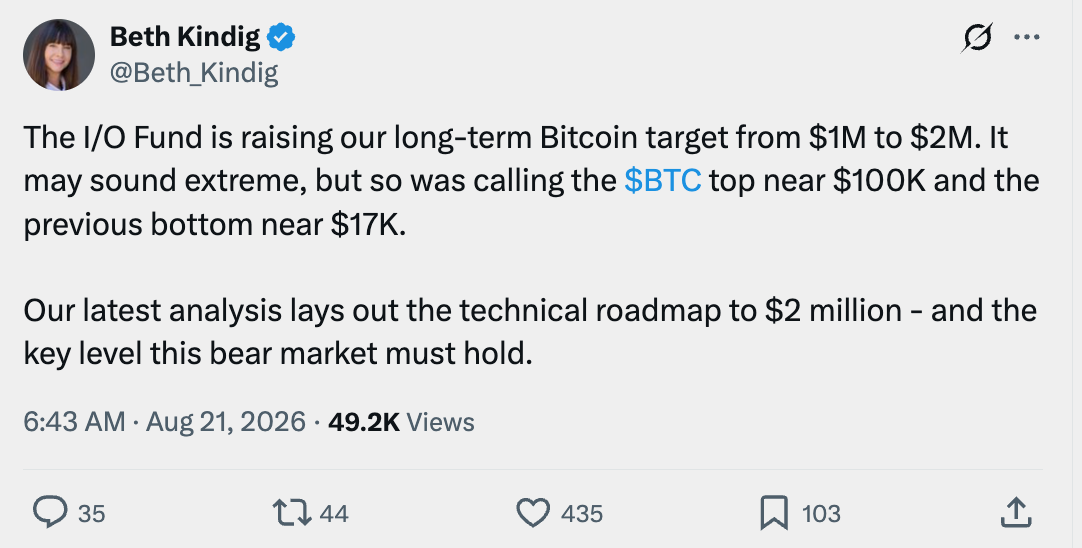
Institutional calls remain aggressive. Standard Chartered digital asset research head Geoff Kendrick set a year-end target of $100,000. Risk Dimensions CIO Mark Connors went further, saying BTC could reach $180,000 to $360,000 by 2030. Beth Kindig, known as the "Nvidia Queen," said I/O Fund raised its long-term Bitcoin target from $1 million to $2 million.
Not everyone is chasing the move. Smart Money said the rally is not a bottoming move but a "trap" built around the September CLARITY Act vote, with prices rebounding off support, luring in shorts and wiping leveraged accounts. Its 4-hour RSI reading was 92.6, up from 82.8 the previous morning, and it advised against chasing price higher while watching whether $73,244 holds.
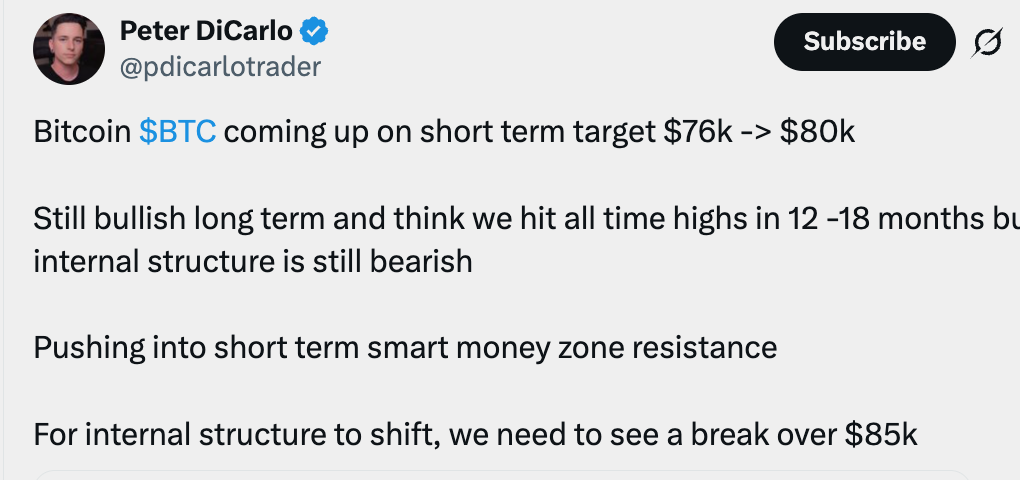
Trader Peter DiCarlo said he still sees Bitcoin moving toward $80,000 in the near term and remains bullish over the long run, expecting a new all-time high within 12 to 18 months, but said the internal structure is still bearish for now. For that to change, he said, Bitcoin would need a decisive break above $85,000.
Bitcoin has nearly erased two months of losses in just three days. After shorts were heavily flushed out, the next test is whether real spot demand can keep stepping in.
Markets will now focus on four things: whether spot Bitcoin ETF inflows can stay positive, whether price can break and hold above the $78,000-$80,000 resistance band, whether BTC can move above the average cost basis of active investors at about $75,800, and the outcome of the U.S. Senate vote on the CLARITY Act on Sept. 15.
Risk is always present in markets, and investors should be cautious. This article does not constitute investment advice. Readers should consider whether any opinions, views or conclusions here fit their own situation before making decisions.


This article was originally published by Bit.Fan. For more cryptocurrency news and market insights, visit www.bit.fan. Disclaimer:
The market information, project data, and third-party content displayed on this platform are for industry information sharing only and do not constitute any form of investment advice or return commitment.
Cryptocurrency trading carries high risks. Users should fully assess their risk tolerance and make independent decisions. All profits, losses, and legal responsibilities are borne by the users themselves.