
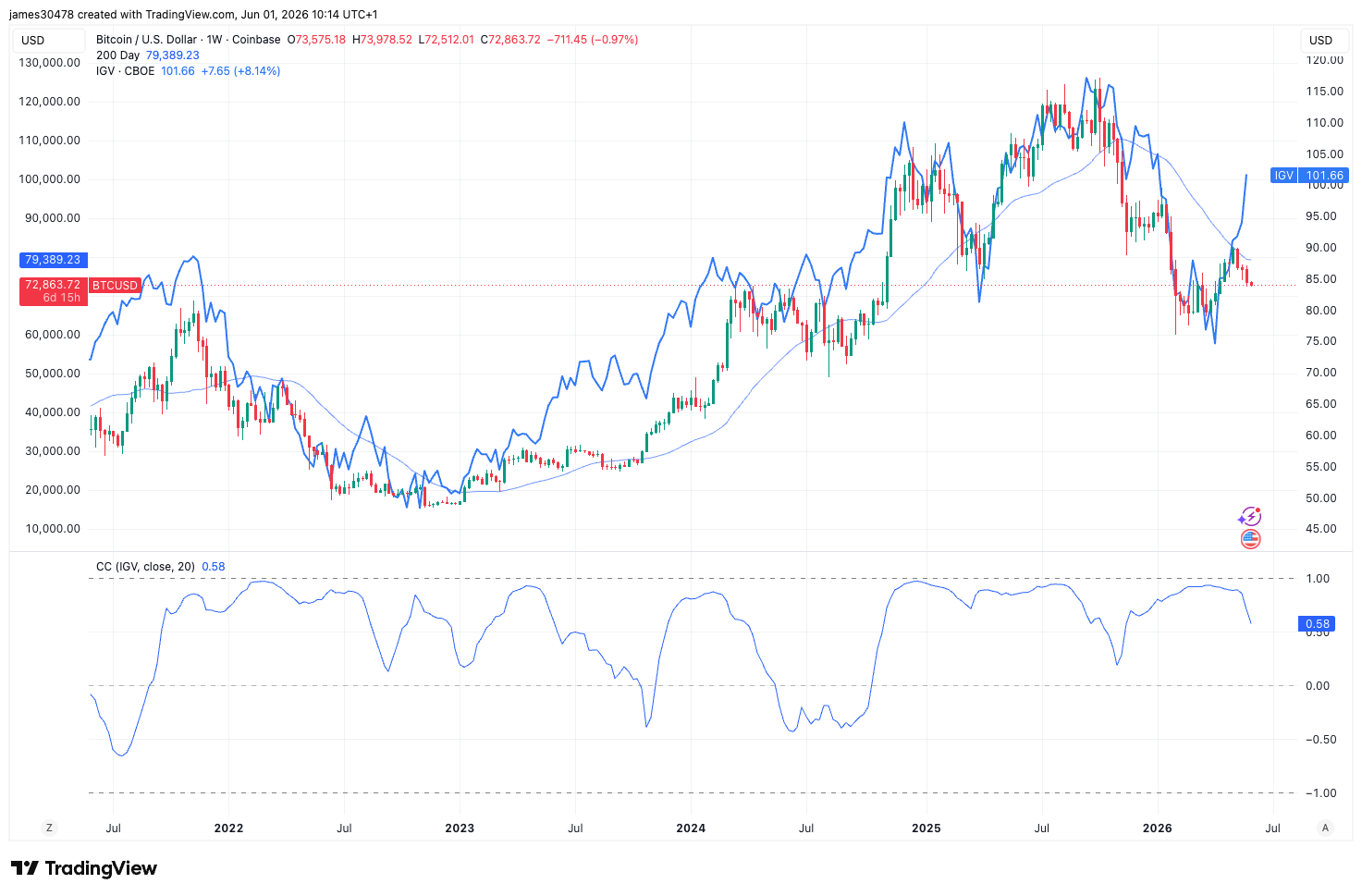
Bitcoin and software stocks, once tightly correlated for the past five years, have sharply diverged. Since May 14, the iShares Expanded Tech-Software Sector ETF (IGV) has gained roughly 12%, while Bitcoin has fallen about 10%, marking one of the largest disconnects between the two assets in recent years.
The 20-day rolling correlation coefficient has dropped to 0.58. The last time it reached such low levels was in October 2023, when Bitcoin traded near $25,000 before rallying to $70,000 over the following six months. A second instance occurred in the summer of 2024, just before President Trump's election victory propelled Bitcoin toward $100,000.
IGV Stages Strong Comeback Above 200-Day MA, Bitcoin Lags
IGV has rallied 36% from its early-April low, closing near 98 on Friday and trading around 104 in pre-market action Monday. The ETF has reclaimed its 200-day moving average, a key technical indicator. Bitcoin, by contrast, is hovering around $73,000, roughly 10% below its 200-day moving average of $79,388.
Both assets hit all-time highs in October 2025 before experiencing significant drawdowns — Bitcoin declined roughly 50%, IGV about 37%. The software sector's weakness was largely driven by AI disruption fears and the so-called 'SaaS apocalypse' narrative, which weighed on names like Oracle (ORCL), Microsoft (MSFT), and Palantir (PLTR).
Historical Low-Correlation Periods Foreshadowed Big Bitcoin Moves
Historically, periods of such weak correlation have not lasted long. Either Bitcoin eventually catches up to software stocks, or IGV's recovery proves a fakeout. With IGV showing strong momentum and sitting above its 200-day moving average, the latter scenario appears less likely. If the pattern from 2023 and 2024 repeats, Bitcoin could be setting up for a significant rally.