
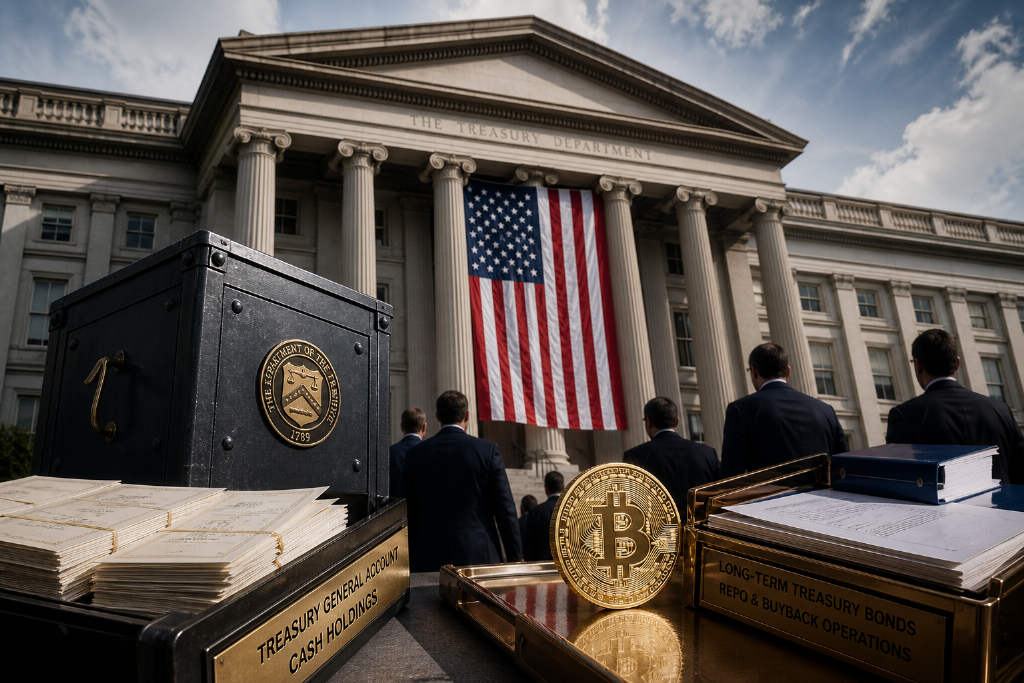
Bitcoin is up about 22% over the past seven days and was trading near $80,000 after touching the low $80,000s intraday. A widely repeated explanation for the move is a supposed $1 trillion Treasury liquidity injection, but Unchained said that framing goes well beyond what the U.S. Treasury has actually committed to so far.

What the Treasury has committed to
The report says CNBC described a scenario in which Treasury Secretary Scott Bessent could tap the government’s roughly $1 trillion cash account to support an expanded bond-buyback program. What has actually been announced, however, is a smaller and more specific step: the Treasury will raise long-end buybacks to at least $4 billion per operation.
That change does not begin immediately. On Aug. 19, the Treasury said it would increase the maximum size of its long-end buybacks from $2 billion per operation to at least $4 billion, effective from Sept. 9 through Nov. 4. No operation has yet been carried out at the new size.
In the most recent operation, dealers offered nearly $20 billion of bonds for sale and the Treasury purchased its full $2 billion limit. Raising the cap means the Treasury will be able to buy more against that supply, but the larger operations do not start until September. Bitcoin’s rally arrived before any dollar had been spent under the expanded size.
The $1 trillion figure is optional firepower, not deployed cash
Unchained separates the buyback announcement from the much larger number that captured traders’ attention. The roughly $1 trillion refers to the Treasury General Account, the government’s cash balance at the Federal Reserve. As of Aug. 19, that account held about $936 billion.
That balance is money Bessent could choose to use. It is not money the Treasury has already released into the market. The article sums up the distinction plainly: the Treasury’s cash balance is firepower available to Bessent, while the concrete commitment so far is to raise operations to at least $4 billion, and the latest operation still bought only $2 billion.
The report cites the U.S. Treasury, FRED and FXStreet for those figures.
Why traders moved before the money did
According to Unchained, the market did not need the full trillion-dollar story to infer that something larger might be coming. The morning after the Treasury’s announcement, Bessent appeared on CNBC and said the operations could exceed $4 billion per issue and that the Treasury had a large toolkit. He also said, 「I have asymmetric information. What do I know that the market doesn’t know?」
Traders did not wait for a fuller explanation of what that toolkit might include. The roughly $1 trillion sitting in the Treasury’s account quickly became the most obvious candidate. CNBC then reported on Aug. 24 that officials were weighing that exact option.
The rally came first
That sequence is central to the report’s argument. The more important questions, it says, are whether those funds are ever spent, how quickly they might be deployed, and whether the rally has already front-run a wave of liquidity that may turn out to be much smaller in practice.
Based on the facts cited in the piece, Bitcoin’s 22% seven-day jump happened before the larger buybacks began and before any portion of the Treasury’s roughly $936 billion cash balance was shown to have entered markets through the expanded program.
