
Federal Reserve officials and international policymakers delivered a concentrated set of warnings ahead of Jackson Hole, with inflation, rates and fiscal risk all in focus.
On Tuesday evening, Boston Fed President Susan Collins published an article on the Boston Fed website saying that if evidence of sustained disinflation does not appear, "I believe it would be appropriate to tighten policy soon." The same day, Richmond Fed President Tom Barkin said at an event in Charlotte, North Carolina, that the United States’ public debt, now above $40 trillion, would at some point face "a reckoning." International Monetary Fund Managing Director Kristalina Georgieva told reporters in Washington that every country needs to deal with its own fiscal problems and that central banks must stay laser-focused on price stability.
Earlier that morning, at 10 a.m., the Conference Board reported an August consumer confidence reading of 89.4, the lowest in seven months.
Collins says a hold depends on more proof of cooling inflation
Collins backed leaving rates unchanged for now, but only under a clear condition. "Maintaining the current target range for the federal funds rate will require continued evidence that inflation is indeed declining," she said. If that evidence does not materialize, "I believe it would be appropriate to tighten policy soon to ensure that we achieve price stability within a reasonable time frame."
She described recent inflation readings as "somewhat encouraging," while adding that monthly figures can be volatile and that it remains to be seen whether the recent improvement will last.
One of her sharper lines was that inflation has run above target for more than five years and the Fed cannot wait forever. Her concern is that a prolonged miss could alter consumer expectations, which would make the target itself harder to reach.
Collins is not a voting member this year. Still, the position does not stand alone. At the July meeting, the Fed held rates steady for a fifth straight time, but three officials dissented in favor of a 25 basis-point increase, and two nonvoting officials also supported a hike. The policy rate remains in a 3.5% to 3.75% range, where it has been since last December.
Barkin warns of a debt "reckoning"
Asked about U.S. public debt crossing $40 trillion, Barkin answered in more direct terms: "As things move forward, there will be a reckoning here. No one can tell you when. We are the global currency, we have the rule of law — all these are reasons people continue to buy our debt. But, you know, at some point, people stop buying your debt, and that’s the risk out there."
After the event, he told reporters that the July rate decision had been a "tough call." The case for waiting, in his view, was practical: by the next meeting on Sept. 15-16, policymakers will have two more months of data. "So far we’ve gotten one full set of data, and we’re going to get another full set and see what we can learn."
PCE remains above target as officials point to three inflation drivers
The key policy question is what is pushing inflation higher and whether rate hikes can do much about it.
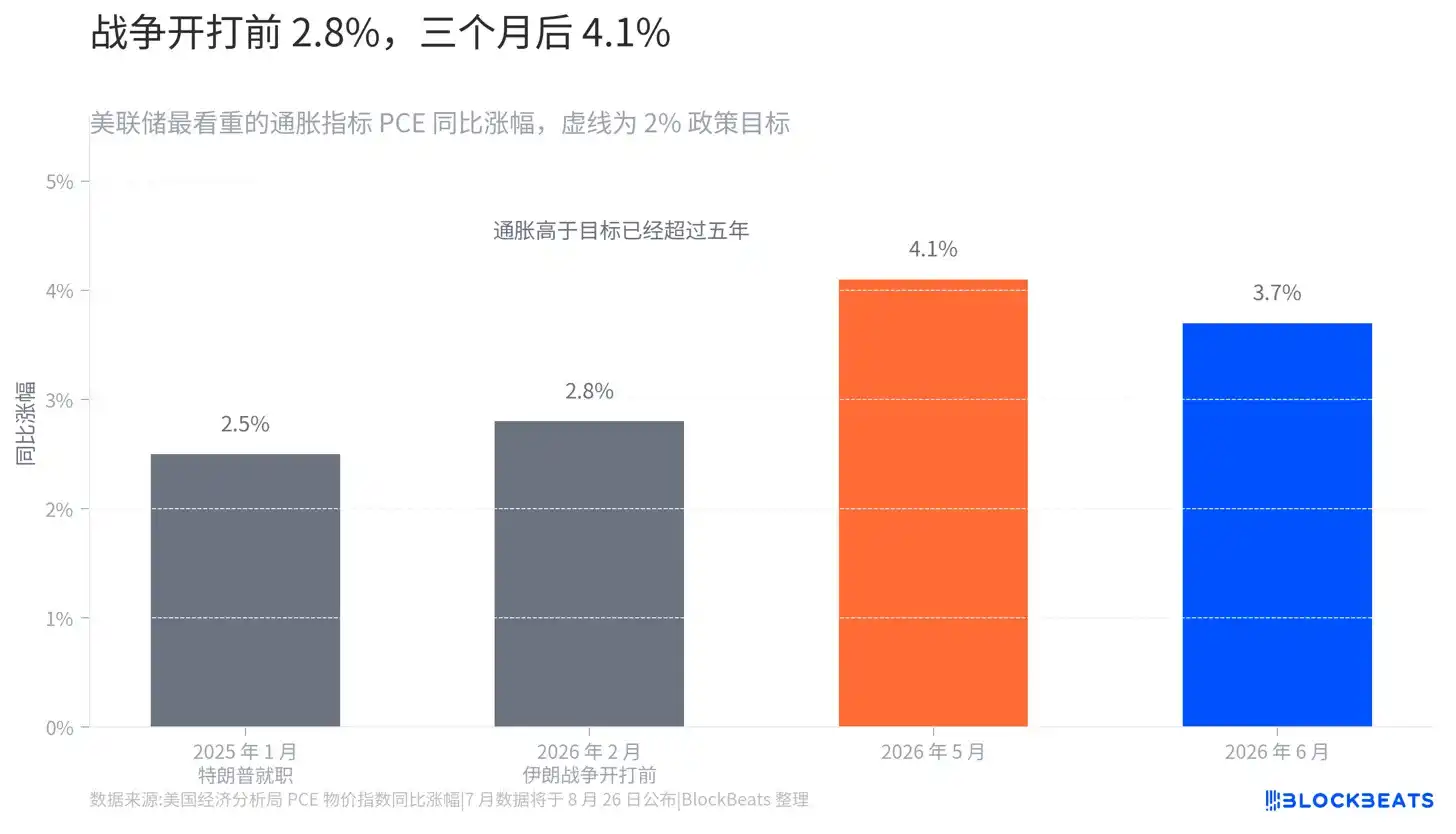
The Fed’s preferred inflation gauge is the personal consumption expenditures price index. It stood at 2.5% when Donald Trump took office in January 2025, was at 2.8% before the Iran war began on Feb. 28 this year, climbed to 4.1% in May and then eased to 3.7% in June. The policy target is 2%.
Fed officials have listed three major factors behind the move: import tariffs imposed by the Trump administration, higher oil prices tied to the Iran war, and large-scale AI investment.
Collins said the first two appear to be fading. In her view, the earlier tariff pass-through has largely run its course, and the inflation effect from rising oil prices should also start to ease.
She flagged the third factor directly in her article: "On stronger-than-expected economic activity, I would note that AI buildout appears to be putting upward pressure on core goods inflation."
That leaves rate policy in an awkward position. Higher rates work through a familiar channel: borrowing costs rise, demand weakens, and prices follow. But tariffs are set by policy, not credit costs. Shipping conditions through the Strait of Hormuz depend on events in the Middle East, not the federal funds rate. And the $730 billion in data-center spending tied to AI buildout, along with orders competing for power, transformers and memory, is taking place in an environment where rates are already not low. Those investments are less sensitive to financing costs than ordinary corporate spending.
IMF frames the issue as a tug-of-war
Georgieva offered a broader framework. She said the global economy has held up so far largely because of a surge in AI investment. She also said the energy shock from the closure of the Strait of Hormuz turned out better than earlier fears, helped by the use of oil and gas reserves, increased non-Gulf energy supply, lower energy demand, more renewable output and a return to coal in some regions.
Even so, she said uncertainty remains high, with evidence visible in rising bond yields and stalled progress on inflation. In a recent interview, she put it this way: "We are really in a tug of war. A negative supply shock from the Middle East, a positive demand shock from AI."
Her risk list also included shrinking oil and gas reserves as the Northern Hemisphere moves toward winter, a strong El Niño that could worsen food insecurity, and AI-related financial stability risks. She left little room for complacency: "None of this calls for complacency — that is my key message. We are not doing badly, but that should not be a reason to say, ‘Well, everything is going fine, it’s easy.’"
In July, the IMF broadly left its 2026 global growth forecast at 3%, while raising its projection for global consumer prices, mainly because of energy and food.
Put simply, rate policy cannot easily reach those supply-side pressures. What it can hit directly is demand.
Consumers are weakening first
That pressure is already showing up more clearly in the U.S. consumer.
The Conference Board’s consumer confidence index fell to 89.4 in August, down 0.8 points from July’s revised 90.2 and below economists’ expectation of 90.2.
The details were split. Views on present conditions improved: the present situation index rose 6.8 points to 121.2, its first gain in four months. Labor-market perceptions improved as well. The share saying jobs were "plentiful" rose from 24.4% to 27%, and the gap between those saying jobs were plentiful and those saying jobs were hard to get increased to 7.5%, the first rise in three months. July’s reading had been the lowest in more than five years.
The expectations side deteriorated. The expectations index dropped 5.8 points to 68.2, the lowest since January, a 7.8% decline. Only 14.6% of respondents said they expected more jobs over the next six months, down from 16.4% a month earlier.
Conference Board chief economist Dana Peterson summed it up this way: "Consumers were more pessimistic about business conditions and the labor market over the next six months."
The survey was collected from Aug. 3 to Aug. 16. During that stretch, the U.S. average gasoline price stayed above $4 a gallon as renewed U.S.-Iran conflict pushed oil prices higher. Consumers’ 12-month inflation expectations also rose, to 5.8% from 5.6% in July.
Other indicators point in the same direction. U.S. retail sales posted their biggest drop in more than a year in July. The labor market unexpectedly stalled that month, with employers cutting a net 23,000 jobs. The Labor Department also revised down payrolls for May and June by a combined 103,000. The unemployment rate fell to 4.1%, but because several thousand people left the labor force rather than because hiring improved. The University of Michigan’s consumer sentiment index also fell in August for the first time in three months.
After five years of elevated inflation, patience among U.S. households is wearing thin. The midterm elections are now less than 70 days away.
What markets are watching before Friday
Two items stand out next: July PCE data and Friday’s Jackson Hole gathering.
In a Reuters survey, economists expected core PCE to rise 3.3% year over year in July, unchanged from the previous month. A Wall Street Journal survey put headline PCE at 3.6%. Either way, inflation would remain well above the Fed’s 2% target.
On Friday, Kevin Warsh is set to deliver his first major speech since becoming Fed chair. The criticism around him is that he has not been candid about how he sees the economy. Georgieva is also due to attend Jackson Hole for the first time this week.
Market pricing remains divided. Futures imply about a 75% chance of a December rate hike. Chris Beauchamp of IG said the probability of no move in September was "firmly around 60%," and argued that Warsh’s speech was unlikely to shift much because he prefers to keep his views close.
One market signal has already moved. Gold was trading near $4,660, close to a three-month high, and up more than 7% over the past week.