

Bitcoin has opened October on the back foot, cutting against the market's usual "Uptober" narrative. Analysts interviewed by Decrypt said the month should not be treated as a reliable signal that Bitcoin has found a bottom, and warned that more downside remains possible.
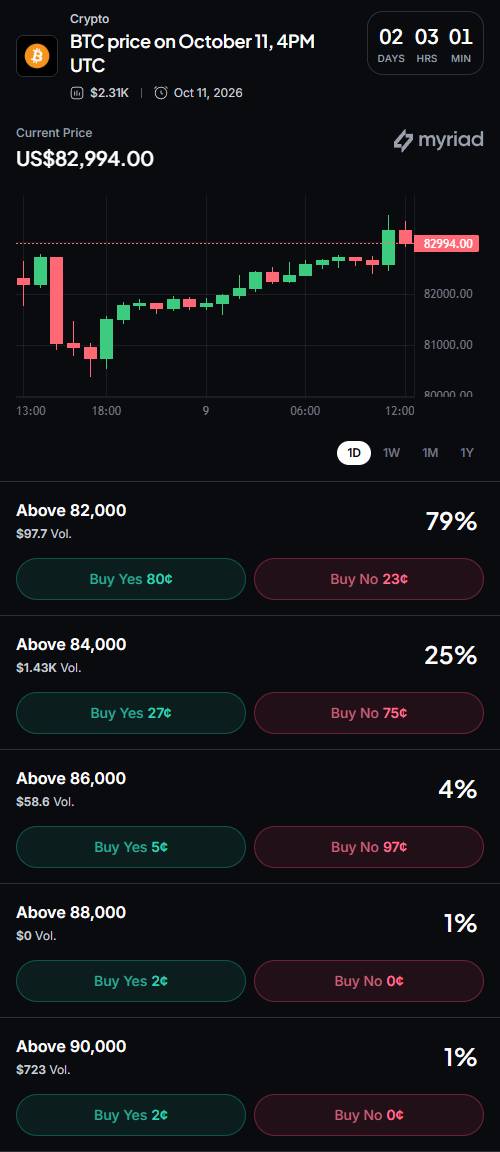
According to CoinGecko data, Bitcoin fell as low as $80,427 over the past week and was recently trading just under $83,000, down 4.1% over seven days. On Myriad, the prediction market owned by Decrypt parent company Dastan, users put the odds of Bitcoin ending the week above $82,000 at 79%, while the chance of a move above $84,000 stood at 28%.
$83,000 is the first level analysts are watching
Luke Deans, senior research associate at Bitwise Europe, told Decrypt that the $83,000 area remains important from a market-structure standpoint. He said the zone combines the average ETF cost basis, the prior technical higher-high threshold, and a price area that has been tested several times in recent weeks.
Bitcoin slipped below $83,000 early Thursday and then tried to recover. Deans said the market's response to that break would be "informative." If Bitcoin struggles to reclaim the level, he said, traders should start looking at lower structural support targets.
On-chain and technical measures point to deeper support below
Ananda Banerjee, founder and principal quantitative researcher at Charlie Quant Lab, told Decrypt that he sees the strongest support at $77,000. He tied that view to on-chain metrics showing a notable cluster of Bitcoin supply acquired around that level.
Deans agreed that $77,000 matters. He said the True Market Mean, or the average acquisition price of active investors, is also near that level.
He also identified lower support near $74,000 through the Short-Term Holder Cost Basis, which tracks the average acquisition price of newer market participants. The 200-day moving average sits at $72,000, he said, giving traders an independent technical reference alongside the on-chain measures.
"Through this lens, Bitcoin could fall materially from current levels and still remain within what we would consider a constructive risk-on structure," Deans told Decrypt. "A move into the $72,000 to $77,000 region would represent a strong retest of the broader transition zone."
If that zone holds, he said, a range that previously acted as resistance for Bitcoin could turn into support, which would be a positive signal. If the area fails, it could "impair current market structure."
Spot demand stays weak as ETF flows deteriorate
Bitcoin did try to break above $87,000 at the start of the week, but the move did not stick. Bitfinex analysts told Decrypt that the failed push was driven "mainly by futures positioning rather than spot demand." In their view, "spot demand remains the missing piece."
They pointed to U.S. spot Bitcoin ETF inflows of $241.1 million in the week of September 28 to October 2, down sharply from $2.39 billion the week before. "The average ETF investor is back at breakeven for the first time since January, a level at which inflows have historically been slow," the analysts said.
Can-Luca Köymen, investment strategist at Sygnum Bank, also told Decrypt that low spot volume is holding back Bitcoin's price action.
Bitfinex analysts said Bitcoin's consolidation range now sits between $84,000 and its yearly open of $87,722. They added that the September CPI release on October 14, together with any pickup in ETF flows, could break that range.
Bitcoin ETFs post their worst one-day outflow since June 25
According to Decrypt's ETF tracker, Bitcoin ETFs saw $484.9 million in net outflows on Wednesday, the largest single-day loss since June 25. BlackRock's IBIT led the decline with $207.7 million in outflows, followed by Fidelity's FBTC at $105.1 million.
Analysts said those flows would need to reverse for "Uptober" to regain traction. Instead, the funds shed another $244 million on Thursday, leaving the direction of travel pointed lower.
Is "Uptober" over?
Most of the experts Decrypt spoke with were reluctant to say the October trade is finished after only one negative week. Even so, they warned against building investment decisions around a heavily promoted calendar effect instead of market fundamentals.
Jake Kennis, senior research analyst at Nansen, told Decrypt that historical data does support stronger October performance. "Bitcoin has posted a median October return of roughly 14% since 2013, with 10 of the past 13 Octobers finishing positive," he said.
He added that the bigger drivers are not the month itself. "But ultimately liquidity, positioning, macro conditions, and underlying demand are more important drivers than any specific date," Kennis said.